The Shelter Told Me This Dog Was “Too Broken” to Adopt — Then He Saw My Veteran Hat and Wouldn’t Let Go
I didn’t go to the shelter looking for a miracle. I went because my daughter Emily said the house had gotten too quiet since her mother passed, and she was right. Two years since Linda died, and the silence had started to feel like a person living there.
I’m Frank Delaney, sixty-seven, U.S. Army retired. From 2010 to 2014 I was a K-9 handler with the 10th Mountain Division, and through most of my Afghanistan deployment my partner was a German Shepherd named Rex.
When my tour ended, Rex stayed — the dogs belong to the program, not the handler. I was told he served until 2020, retired sound, and was adopted by a family outside San Antonio. I got one photo: Rex on a porch, muzzle going gray. Then nothing.
On a gray Tuesday in October I drove to the Montgomery County shelter in Dayton with no plan except to look. It smelled of disinfectant and wet concrete. A staffer named Carla Mendez walked me down the rows of barking, tail-wagging dogs.
At the end of the corridor, in kennel twelve, a German Shepherd lay facing the wall. Gaunt, coat dull, a thick scar running from his left eye to his jaw. “Don’t put your fingers near that one,” Carla said quietly. “He failed his behavioral eval twice.”
“Honestly, Mr. Delaney? He’s scheduled for review on Friday. We don’t think he’s adoptable.” Review. I knew what that word meant — I’d heard softer words for harder things my whole adult life. The dog hadn’t moved once.
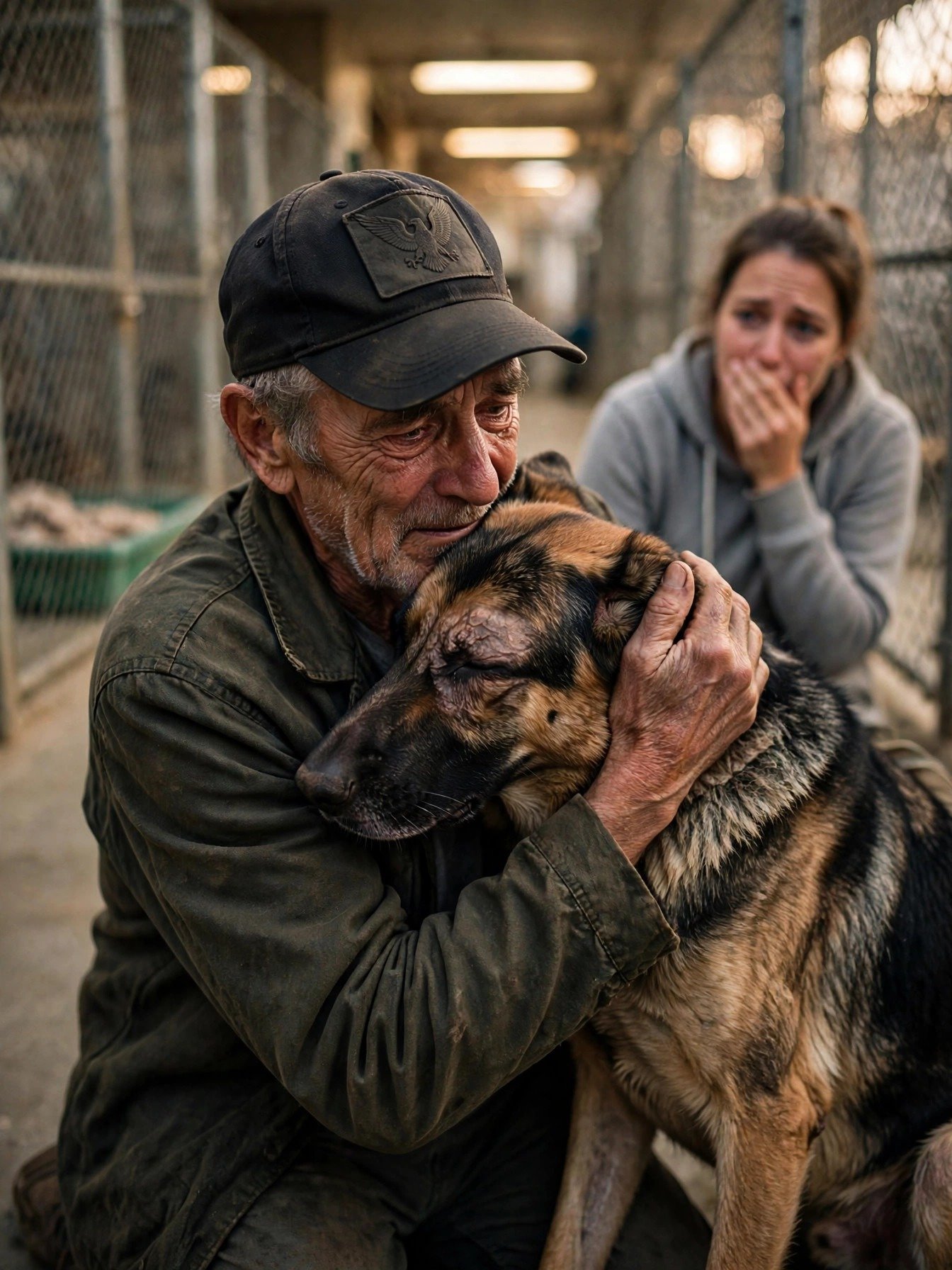
I crouched to his level the way you do with nervous dogs, and my old embroidered cap — 10th Mountain Division, the one I wear everywhere — tilted forward. His ear twitched. His head came up slowly, like it cost him something. He stared at the cap.
Then the dog that hadn’t moved in three weeks stood, crossed the kennel in three strides, and pressed his whole body against the chain link in front of me, whining deep in his chest. “He hasn’t come near the fence since intake day,” Carla breathed.
I put my hand flat to the wire and he pushed his muzzle into my palm, his scarred body trembling. When I stepped back, he followed along the fence, step for step, and made a sound I can only call panic. Carla called for the vet tech.
The tech, Megan, opened the kennel, and the dog walked past both women, sat square on my boots, and leaned his full weight against my legs. When Megan tried to lead him back, he planted all four feet. Not aggressive — immovable. Decided.
Then I saw it. He turned his head, and inside his left ear, faded but there, was a tattoo. My hands shook before my brain caught up — military working dogs are tattooed in the left ear, and I knew because I held Rex’s ear for the vet the day they inked his.
“Megan,” I said, my voice strange to me, “can you read that tattoo?” She crouched with a penlight. “A-5-3-4. That’s a Department of Defense format.” She went to the office computer. Five minutes later she came back, and her face had gone white.
“This tattoo belongs to a retired military working dog named Rex,” she said slowly. “German Shepherd. Served 2012 to 2020.” Carla frowned — “That can’t be right” — and I said, very quietly, “I was his handler. Paktika Province, Afghanistan. 2012 to 2013.”
Megan sank onto a bench. “Record says he was adopted in Texas in 2020. His adopter died two years ago. The dog went to a nephew, the nephew moved, and somehow he ended up loose in Kentucky. His microchip migrated down his shoulder — nobody ever found it.”
I sat on the kennel floor, and Rex — my Rex — laid his great scarred head in my lap like fourteen years had been fourteen minutes. I knew that scar. A blast outside a compound in Paktika threw gravel everywhere, and I carried him two hundred yards to the medevac, sure I was losing him.
“He’s fourteen,” Megan said softly. “The eval failures — he wasn’t aggressive, Frank. He was grieving. He lost his person, then another person, and he was waiting for someone who smelled right.” She glanced at my cap. “He was waiting for you.”
Carla tore the Friday review paperwork in half in front of me. “He’s not broken. He was just lost.” The shelter had a program — veterans adopt free. I signed with a pen that kept skipping, and Rex sat on my foot the whole time, like he’d learned what paperwork meant and wasn’t taking chances.
He rode home in the passenger seat, head out the window, ears back, the way he rode in the Humvee when we were young and immortal. I talked the whole way. I told him about Linda. I told him the house was too quiet. He thumped his tail like he understood the assignment.
That night he walked every room, sniffed Linda’s reading chair, then climbed — joints complaining — onto the rug at the foot of my bed and sighed the deepest sigh I’ve ever heard from any living thing. Emily called, and when I told her, she cried. I pretended I wasn’t crying too.
They told me he was too broken to adopt. They were wrong about him, and for two years I’d been wrong about me. Some things you lose in a war; some just take fourteen years to find their way home. That night the house wasn’t quiet — it held the sound of an old dog dreaming, paws twitching, chasing something good.