He Sat Alone in the Nursing Home for 3 Years With No Visitors — Then the Honor Guard Walked In on His 100th Birthday
My name is Karen Doyle, and I’ve been a nurse at Willow Creek Care Center in Mason City, Iowa, for eleven years. In all that time, I never met anyone like Harold Whitaker. He turned one hundred last Tuesday, and almost nobody came — until everybody did.
Harold enlisted in the U.S. Army in 1943, at seventeen, lying about his age by a year. He served with the 29th Infantry Division and landed on Omaha Beach on the morning of June 6, 1944. He was nineteen, carrying a rifle nearly as tall as he was.
He came to Willow Creek three years ago, after a fall in the farmhouse where he’d lived alone since his wife, Ruth, passed in 2011. They never had children. His only relative is a nephew in Oregon who sends a Christmas card each year and has never visited.
Every morning at seven, Harold wheels himself to the big window at the end of Hall C. He watches the birds at the feeder outside, and drinks his coffee black, the way he says the Army taught him. He never complains. He barely talks.
Under his bed he keeps a shoebox. Inside it there’s a faded Bronze Star citation, a black-and-white photo of six young soldiers with their arms around each other, and a letter Ruth wrote him in 1945, read so many times the creases are soft as cloth.
Three weeks before his birthday, I was changing the sheets on his bed while he napped, and I did the math in my head. One hundred years old. Three years in this building. Not a single visitor, not one birthday card on the wall. Something in my chest broke open.
That afternoon I sat beside him and asked if I could share his story — just a short post, I said, so folks in town would know a hero was turning one hundred. He waved a hand like swatting a fly. “Don’t make a fuss, Karen,” he said. “I’m nobody special.”
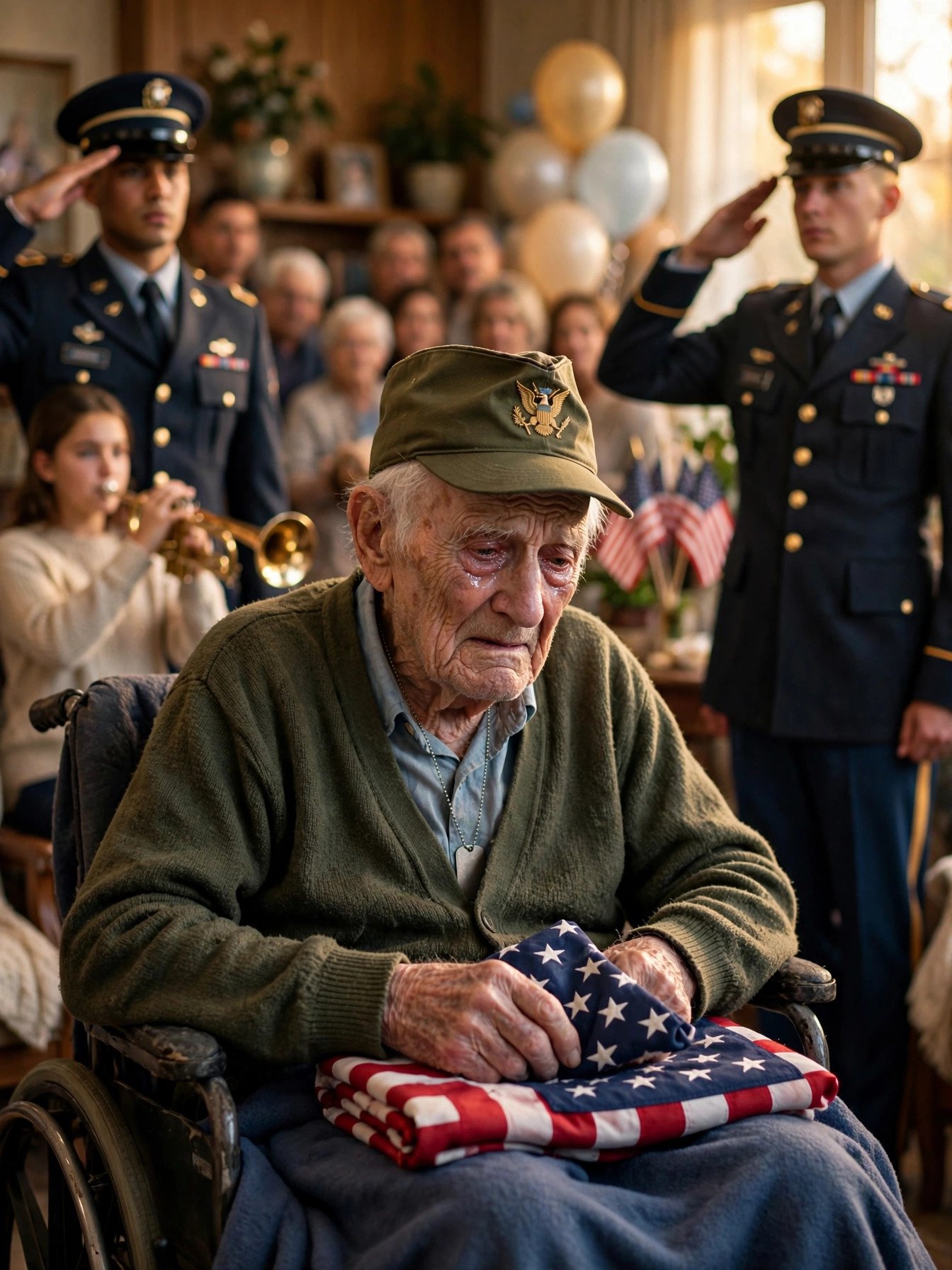
I posted it anyway that evening, with a photo of him in his wheelchair, wearing the old 29th Division cap his nephew mailed years ago. I wrote three sentences: his name, his service, his birthday. Then I put my phone down and went back to my rounds.
By midnight the post had been shared four hundred times. By morning, the local paper had called the front desk. The VFW post in Clear Lake called. The high school band director’s office called. I stood in the hallway staring at my phone, thinking: what have I started?
On the morning of his birthday, Harold woke up expecting nothing. I helped him into his good shirt — the one with the pearl buttons Ruth always liked — and combed his thin white hair. “You look handsome, soldier,” I told him. He snorted. “Flattery won’t get you extra dessert, Karen.”
The first visitors arrived at nine: two little girls from down the street with a handmade card covered in glitter. Then a young couple with a plate of cookies. Then a man in a Vietnam veteran cap who shook Harold’s hand and couldn’t seem to let go.
By ten o’clock the parking lot was full, and cars were lining up on the street. The administrator came running down Hall C, half-laughing, half-panicked: “Karen, three hundred people are in our lobby. The fire marshal will kill me.”
At eleven sharp, it happened. Six members of the Iowa National Guard Honor Guard marched through our front doors in perfect step, rifles at shoulder arms. Behind them came the Mason City High School marching band, squeezing into a hallway built for wheelchairs.
The band played “Happy Birthday” — forty teenagers blasting it with everything they had — and Harold Whitaker covered his face with both hands and wept. Then the band director raised her hand, and the room fell silent.
A single trumpet stepped forward. A girl of seventeen, cheeks already red. She lifted the horn, and the first clear notes of “Taps” floated down Hall C. When the trumpet started, the whole room went silent — three hundred people, and you could hear a pin drop.
“They played it for my buddy Eddie Kowalski,” Harold whispered to me later, his voice shaking. “Normandy, June ’44. He was eighteen. I carried that tune eighty years, never thinking I’d hear it played for me while still breathing.”
When the last note faded, the Honor Guard commander knelt beside Harold’s wheelchair and presented him with a folded American flag and a shadow box holding replacement medals — the Bronze Star and the Purple Heart he’d earned at Saint-Lô and never mentioned. “On behalf of a grateful nation,” the commander said.
Then the cards came by the laundry basket — hundreds of them. I read a few aloud. One was from a woman in Des Moines: “My father served in the 29th. He talked about a kid from Iowa who shared his last cigarette on the beach. I think that was you.” Harold closed his eyes and nodded.
Before the crowd left, Harold asked me to wheel him to the lobby doors. In a thin but steady voice he said: “I thought everybody forgot. Turns out they were just waiting to be asked.” Three hundred strangers applauded until the windows rattled, and the little glitter-card girls cried.
That was two weeks ago. Now every Sunday the lobby fills again — kids doing homework beside him, veterans drinking bad coffee, the trumpet girl practicing in the corner. Yesterday Harold told me, “Karen, I stormed a beach at nineteen. Turns out the bravest thing I ever did was let people in.” He wasn’t nobody special. He was everybody’s.


