My Neighbors Called the Cops on the “Homeless Drunk” Sleeping Behind Our Church — Then the Mayor Showed Up With a Key
Frost was on the grass behind the fellowship hall that late-October morning. I was unlocking the church kitchen for the food pantry when I spotted a man curled on the bench by the dumpster, an army blanket to his chin. I’m Diane Mercer, sixty-eight, a volunteer at Grace Community Church in Millbrook, Ohio.
By noon, half the street had seen him. By two, Mrs. Hensley had called the Millbrook police about a drunk vagrant behind the church; she felt unsafe walking her poodle past the lot. Officer Denny Cole repeated the word “vagrant” later like it embarrassed him.
Denny’s cruiser came around three. He crouched by the bench and talked to the man a long while — no handcuffs, no raised voices. The man’s name was Walter Kowalski: not drunk, bothering no one, breaking no law.
The calls kept coming. Tom Barger, two doors down, called twice in one week. Someone called mid-service one Sunday; we heard the sirens faintly through the sanctuary windows. Each time, an officer checked on Walter and left.
Each morning I left a paper bag by the bench: sandwich, apple, thermos of coffee. On the fourth morning he was awake. “You don’t have to do that, ma’am,” he said, polite in a way that takes effort when you’re cold. His forearm bore a faded tattoo: a cavalry horsehead, “1st Cav” beneath it.
Walter Kowalski was seventy-one. He served 1971–73 as a combat medic with the 1st Cavalry Division in Vietnam, earning a Bronze Star for dragging two wounded men from a rice paddy under fire near An Loc in 1972.
He came home to Cleveland, married a nurse named Carol, and worked thirty-four years as a machinist at the Timken plant. He buried Carol in the spring of 2019. Her final year of medical bills took the house. His pride, he said, took the rest.
He gave me his story over three weeks, hands around a thermos. A daughter in Arizona, six years of silence — not anger, just the drift of a man ashamed of where he’d landed. “Churches are the one place nobody runs you off from,” he said.
The town meeting was Mrs. Hensley’s idea — forty signatures demanding the church “address the vagrant situation.” The room was packed. She cited property values. Barger said his teenage daughter feared the church lot. Someone in back said “those people,” and heads nodded.
Pastor Jim said Walter was a human being, a veteran down on his luck, and the church would not chase him off. Scattered applause, cold silence. My knuckles were white. Then the back door opened, and Mayor Linda Pryce walked in with an envelope and a brass key.
Linda went to the podium. “Before we vote, I’d like to read something into the record.” She drew out a yellowed sheet and read Walter Kowalski’s Bronze Star citation aloud — what a twenty-one-year-old medic did in a rice paddy in 1972 while people shot at him.
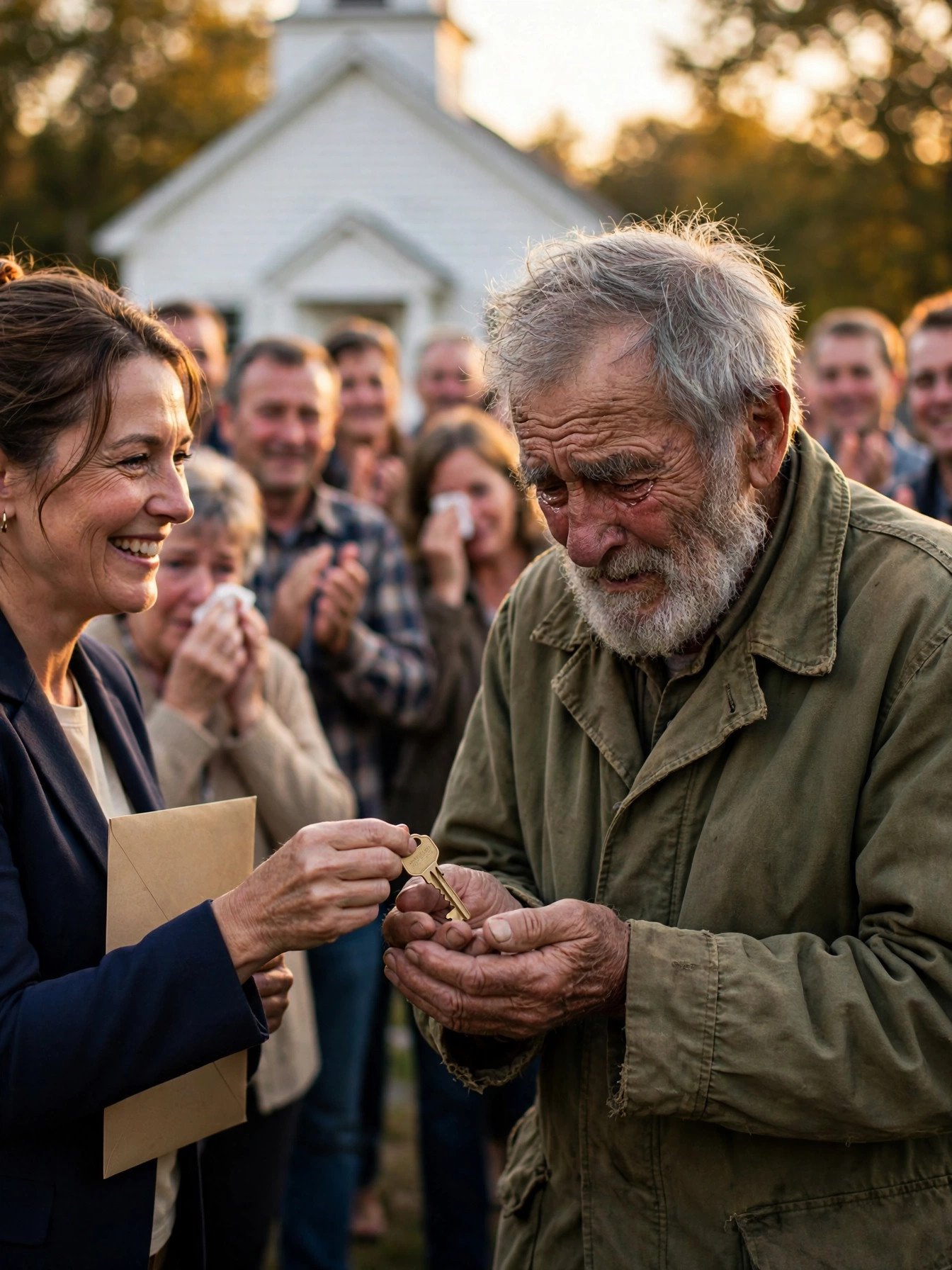
The room went silent. She read the final line — “his conspicuous gallantry reflects great credit upon himself and the United States Army” — and held up the key. Pete Sandoval had donated the furnished one-bedroom above his hardware store. VFW Post 4219 would cover a full year’s rent.
Nobody argued. One by one, people stood — not to leave, but to applaud. Mrs. Hensley sat frozen, face scarlet, then rose and clapped with the rest. I cried, past caring who saw. In the back doorway stood Walter, Denny Cole’s hand on his shoulder.
Linda pressed the key into his palm, closing his fingers over it. He stared at it, then at her. “I don’t know what to say, ma’am.” “Say you’ll let us help.” He nodded, and his shoulders shook — the way a man shakes when he’s held himself together too long.
Casseroles arrived within a week, notes taped to the foil. Mrs. Hensley brought a red-and-blue quilt and apologized before half the choir. Tom Barger spent a Saturday fixing the leaky faucet. The petition signers now competed to be kindest. I’ve stopped sneering at late kindness.
Walter moved in the first Saturday of December. The VFW men carried his whole life upstairs in three garbage bags and one duffel. That night we brought a Christmas tree, and he hung his citation beside it. “First wall I’ve had in a while,” he said.
That winter the church started the Walter Fund — he hates the name and pretends he does. A small account for county veterans needing a deposit, a bus ticket, a car repair. The VFW administers it. It has helped nine men and two women.
Walter connected with the VA clinic in Dayton: a doctor, and a counselor named Priya — “she doesn’t treat me like a folder.” Blood pressure down, fourteen pounds gained. In February he called his daughter in Arizona; they talked two hours. She’s visiting this summer with grandkids he’s never met.
On Christmas Eve, Walter asked to ring the church bell before the candlelight service. He climbed the belfry in his good coat — the choir’s gift — and rang it eleven times, slow and steady. Mrs. Hensley stood on her porch and cried.
This Memorial Day, Walter marched with the VFW down Main Street, Bronze Star pinned where it belongs, the crowd cheering his name. Most mornings he unlocks the kitchen with me and starts the coffee. Last week a young man slept under the overhang; Walter reached him first with a sandwich and a thermos. “Churches are the one place nobody runs you off from,” he told the kid. This is how a town remembers.