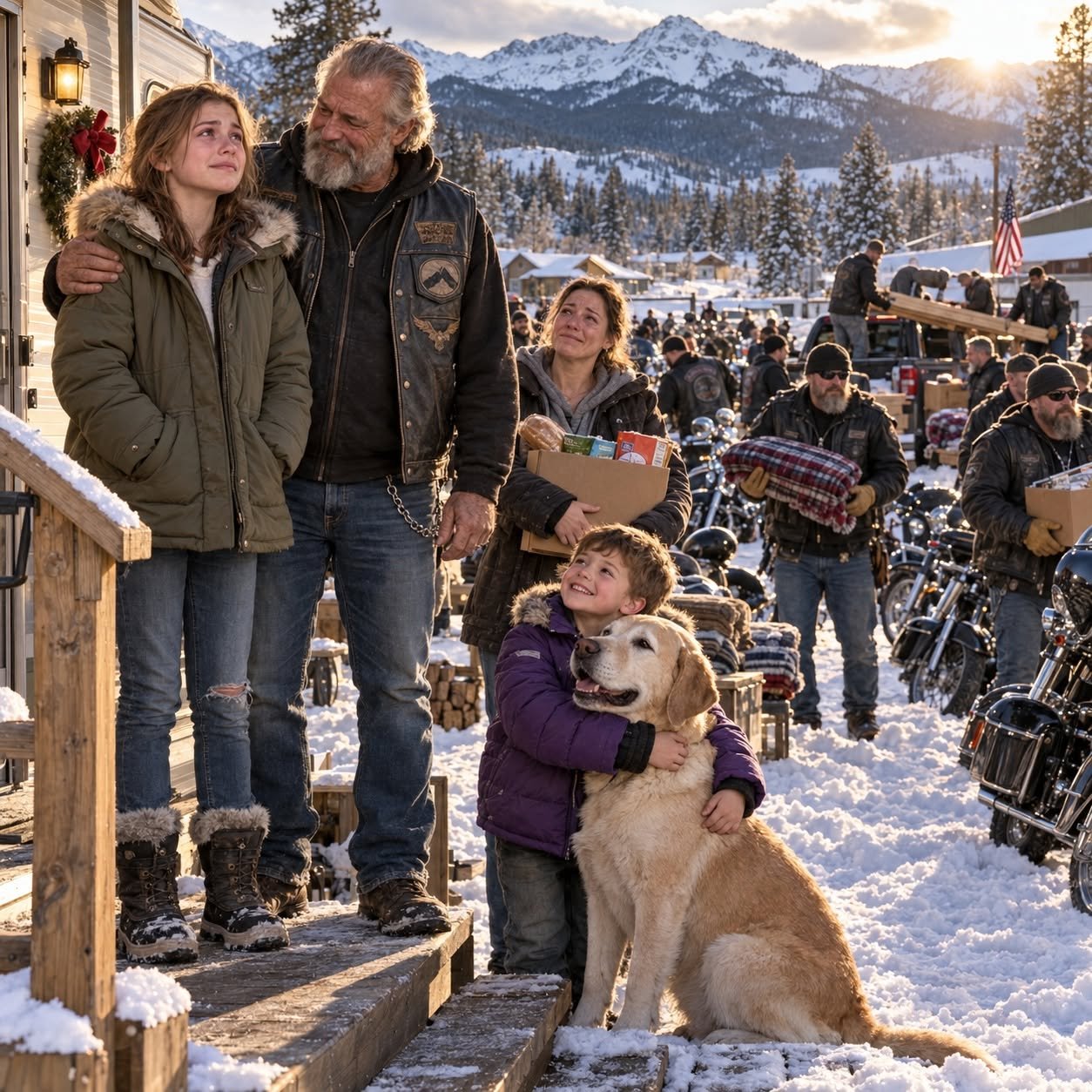
The Homeless Girl Who Carried a Lost Boy Through a Blizzard — and the Bikers Who Carried Her Home
The paramedics wrapped me in three blankets, but I was still shaking so hard I could barely hold the hot cocoa someone pressed into my hands.
All around me, the parking lot of the Timberline Roadhouse glowed with headlights and red emergency lights, snow still falling sideways. Liam was on a stretcher, wrapped like a cocoon, a paramedic kneeling over him. His father, Ryan, held the boy’s small bare hand and wouldn’t let go.
“Grace.”
I looked up. The big man with the shaved head — the one who had shouted at me when I stumbled out of the storm — was kneeling in the snow beside me.
“I’m Tank,” he said. “What’s your last name, Grace?”
And there it was. The question. The one my mother and I had spent two years dodging, the one that could end with a social worker and a file and everything we had built in that tent behind Highway 34 getting taken apart.
“Nolan,” I whispered. “Grace Nolan.”
Because lying to the man who was about to save a little boy’s life felt like the one thing I couldn’t do.
“Where do you live, Grace?”
I stared into my cocoa. The steam rose up and blurred everything. “I can’t tell you that,” I said.
Tank was quiet for a moment. Then he said, “Okay.”
Just that. Okay. He didn’t push. He stood up and walked back toward the roadhouse, and I watched him go, confused, because in my experience adults never just accepted a no.
A gray-bearded man sat down beside me next. Older, calm, with the kind of eyes that had seen a lot of winters.
“I’m Preacher,” he said. “You carried that boy two miles through the worst storm in thirty years. You want to tell me how?”
“My dad taught me,” I said. “He was a wildland firefighter. He taught me about cold. About keeping moving. He died two years ago.”
“I’m sorry, sweetheart.”
“It’s okay,” I said, and then, because I was exhausted and thirteen and everything was coming apart at once, I added, “No, it’s not. Nothing’s been okay for two years.”
Preacher nodded like that was the most reasonable thing he’d ever heard. “Your mom know where you are?”
Tears started, and I couldn’t stop them. “She was at work when the storm hit. She cleans motel rooms. She’ll be so scared. She’ll think — ” I stopped.
“Think what?”
“That someone found us.”
And then it all came out. The tent behind Highway 34. The blue tarp roof. The blankets in garbage bags. The lies we told the school and the motel. Two years of being invisible on purpose, because my mother was terrified that if anyone official found out a thirteen-year-old girl was living in a tent, they would take me away from her.
“She tried so hard,” I said. “You have to understand. She tried harder than anyone.”
“I believe you,” Preacher said.
Then Ryan came over, his coat covered in snow, his eyes red. He knelt in front of me and took my shaking hands in his.
“Grace,” he said, his voice breaking. “My boy wandered away from the sledding hill this afternoon. We’ve had fifty people searching. The sheriff’s department had helicopters grounded by the storm. If you hadn’t — ” He couldn’t finish.
“Diesel found him first,” I said. “His dog. The dog stayed with him.”
“Diesel’s our dog,” Ryan said. “He ran after Liam when he wandered off. We’ve been looking for both of them.”
Diesel, the old yellow Lab, was lying at my feet at that moment, leaning his whole weight against my leg, and I scratched his ears and he thumped his tail in the snow.
“You gave him your coat,” Ryan said. “And your sweater. In a blizzard. You could have died, Grace.”
Ryan looked at me for a long moment. Then he said, “Your father would be so proud of you.”
That broke me completely. I cried into my blankets while snow fell on all of us, and Diesel pressed closer, and Ryan kept one hand on my shoulder like he was afraid I might disappear.
The ambulance took Liam to the hospital in Pine Hollow with Ryan riding along. The doctor at the roadhouse — a retired ER nurse who rode with the club — checked me over and said I had mild frostbite on two fingers and would be fine. Tank drove me back toward town himself, and when I finally told him where to turn off Highway 34, he didn’t say a word the whole way down the dark road. He just followed my directions with his headlights cutting through the falling snow.
My mother was standing outside our tent when we pulled up, wild-eyed, holding our flashlight. She had walked home through the storm when the motel closed early, and she had been searching for me for hours.
“Grace!” She ran to me and held me so tight I couldn’t breathe. “Where were you? I thought — I thought — “
“Mom, this is Tank. He’s — he’s from the Timberline Roadhouse. Something happened tonight.”
I told her everything. About Liam. About the blizzard. About the coat and the sweater and the two miles. My mother listened with her hand over her mouth, and when I finished, she looked at Tank and said the words she had dreaded for two years.
“Are you going to call someone? About … us?”
Tank looked at our tent, at the blue tarp, at the little woodstove with the coffee-can chimney, at the garbage bags of blankets. He looked at my mother’s exhausted face and my frostbitten fingers.
“Ma’am,” he said slowly, “I’m not a social worker. I’m a biker who watched your daughter do the bravest thing I’ve seen in thirty years. But I’m going to be honest with you. I can’t drive away from this and pretend I didn’t see it.”
My mother’s face crumpled.
“So here’s what I’m going to do instead,” Tank said. “I’m going to ask what you need. And then my club is going to help you get it. No files. No caseworkers. Just people who show up. Can you live with that?”
My mother stared at him. “Why would you do that?”
“Because tonight, when my president’s grandson was dying in the snow, your daughter carried him home,” Tank said. “Now it’s our turn to carry somebody.”
It turned out Liam was the grandson of the club’s president, and Ryan was his son. That was why the man at the door had shouted Ryan’s name. But as the story of the night spread through the clubhouse, the bikers started saying something else too. They started saying my name.
The Iron Ridge Riders had been loading those boxes of children’s winter coats for a charity delivery before the storm hit. That delivery never made it out that night. Instead, the next morning, a truck pulled up to our tent with more than coats.
They brought a used camper — clean, insulated, with a working heater and a real bed — and parked it on a rented lot at the edge of town where Mom could stay legally. They brought groceries. They brought firewood. And in the back of the truck, in a box with my name on it, was a brand-new winter coat in my size, with a note tucked in the pocket.
The note said: For the girl who gave hers away. — Liam
But the part that changed everything came two weeks later. Ryan showed up at the camper with a woman from the Pine Hollow school district — not a caseworker, a counselor — and a job offer. The motel where Mom cleaned rooms needed a daytime supervisor, with a raise and benefits. The school district had a re-enrollment plan for me that didn’t involve a single question I couldn’t answer. And Ryan’s construction company had a small rental house, two bedrooms, heat that worked, sitting empty since fall.
“First month’s rent is paid,” Ryan said. “After that, your mom’s new salary covers it easy. This isn’t charity, Grace. Your mom works. You go to school. That’s the deal.”
My mother cried. I cried. Diesel, who had apparently decided he was my dog now and came with Ryan everywhere, thumped his tail against the camper wall.
Spring came to Pine Hollow. I went back to school — really went back, with my real name and a real address. I made friends. I joined the track team, because it turned out all those years of walking everywhere had made me fast. And every Friday evening, I rode my bike out to the Timberline Roadhouse, where the Iron Ridge Riders had permanently reserved a stool for me at the end of the bar.
Liam and I became something like siblings. He drew me pictures of dinosaurs — always a T-Rex, because anything else, he solemnly informed me, was suspicious. I taught him what my dad taught me: how to read wind, how to find direction, how to keep moving. He taught me how to laugh without feeling guilty about it.
On the first anniversary of the blizzard, the club held a coat drive at the roadhouse. Hundreds of coats, collected from all over the county, stacked in boxes for families who needed them. Tank asked me to hand out the first one.
I gave it to a girl about my age who wouldn’t meet my eyes, standing behind her mother with her shoulders hunched against more than the cold.
“It’s warm,” I told her quietly. “And there’s no shame in it. I know. I’ve been where you’re standing.”
She looked up at me then. And I saw my own face from a year ago looking back.
That night, driving home with Mom — to our house, with heat and light — I thought about what I had believed on the roadhouse porch a year earlier: that saving Liam’s life would destroy my own.
I had it exactly backward.
Saving Liam’s life was the night my own life finally began.