She Hid From Her Abusive Ex for Fourteen Months — Then Six Bikers Stood Between Them, and the Quietest One Revealed His Secret
I knew my ex-husband had found me before I even turned around. It wasn’t his face. It wasn’t his voice. It was the way the bell above the diner door rang when he pushed through it. After eleven years with a man like Derek Hale, your body learns things your mind wishes it could forget.
My name is Rachel Morgan. I was thirty-five when this happened, living with my eight-year-old daughter, Lily, in a rented trailer outside a little Nevada town called Copper Ridge. Fourteen months earlier, I had packed two grocery bags with clothes, carried a sleeping child to my car, and left Reno at two in the morning. I didn’t say goodbye. I didn’t leave a note. I just drove.
For years, I had told myself Derek would change. The apologies sounded convincing. The flowers looked sincere. The promises always came after the worst nights. Eventually, I realized apologies were only the bridge between one frightening moment and the next. So Lily and I disappeared. Or at least I thought we had.
I found work at the Sunrise Diner near Interstate 80. Six-to-two shift. Bad coffee. Good tips. Truckers, ranch hands, railroad workers. And three mornings a week, six members of a motorcycle club called the Desert Ravens. The town didn’t like them. People whispered about their tattoos. Their leather. Their motorcycles. Every unsolved broken window somehow became their fault.
I had been nervous around them at first too. Then years of serving people teaches you things. Bo, the biggest, always left five dollars under his plate even when his breakfast cost eight. Mason fixed the diner’s freezer once and refused payment. Raymond carried groceries to an elderly customer’s car whenever he saw her struggling. And their oldest member, everyone called Doc. Silver beard. Early sixties. Quiet. Always sat facing the door. Black coffee. Exact tip. Never asked personal questions. I liked that about him.
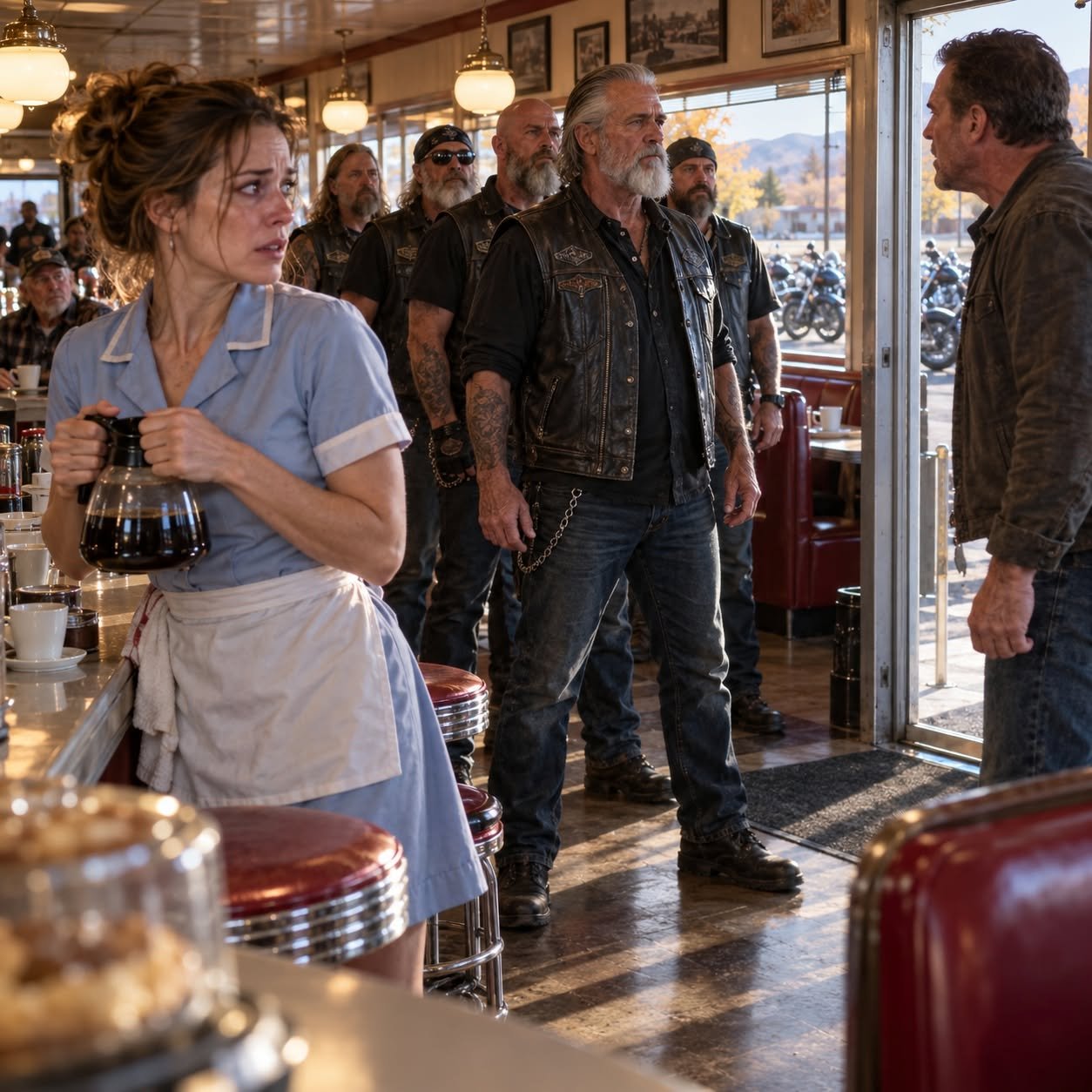
That Tuesday morning, I was pouring coffee when the bell above the door snapped hard. My hand stopped. Then came the voice. “Rachel.” The coffee pot trembled. I turned. Derek stood inside the Sunrise Diner. He had gained weight. His hair had thinned. But the smile was identical. Warm enough to fool a stranger. Cold enough for me to know what came after it. “Been looking everywhere for you.”
I put down the pot. “You need to leave.” “I just want five minutes.” “No.” “Rachel.” He stepped closer. Six chairs scraped across the floor behind me. At exactly the same time. Bo stood first. Then Mason. Then the others. Doc rose last. Slowly. Derek glanced toward them. His smile flickered. “This is family business.” Doc walked forward. “Woman told you to leave.” His voice was almost friendly. “Seems pretty clear.”
Derek looked at six men wearing black leather. For most of his life, size had been enough to make people move. That morning, it wasn’t. He backed toward the door. Then looked directly at me. “This isn’t over.” The bell slammed behind him. I held onto the counter until my fingers stopped shaking. Doc was the only one who approached. “You okay?” It was the first personal question he had asked me in four years. “I’m fine.” The lie came automatically. Doc looked at me for several seconds. Then nodded. “We’ll be back Thursday.” He left.
But Thursday became Friday. Friday became Saturday. Without saying anything, the Desert Ravens started appearing more often. Bo’s motorcycle somehow developed a mysterious mechanical problem that required him to spend several evenings parked near the road leading to my trailer. Mason’s towing route suddenly passed Lily’s elementary school every afternoon. Nobody said they were protecting us. They simply showed up.
Three weeks later, Doc sat across from me after lunch rush. “How long?” I knew exactly what he meant. I could have lied. Instead I whispered: “Eleven years.” His eyes hardened. “Then hear me carefully.” I looked at him. “You’re not alone anymore.” I nearly cried right there in booth number four. Then November arrived. And Derek stopped trying to frighten me directly. He did something much smarter.
A process server left papers on my trailer door. Emergency Petition for Temporary Custody of Lily Morgan. Derek claimed I had become unstable. That I was exposing our daughter to dangerous criminals. His evidence? The Desert Ravens. The men protecting me had become the weapon he planned to use against me. I sat at my kitchen table reading the papers again and again until the words blurred. Maybe Derek had finally found the perfect way to beat me. Not by coming after me. By taking Lily.
Doc arrived that afternoon because I had missed my shift. He read the petition. Then looked at me. “He’s using us.” “Maybe he’s right.” Doc’s expression changed. “About what?” “Maybe letting you help made everything worse.” He sat down across from me. “Twenty-eight years ago, I watched somebody believe the same lie.” “What lie?” “That being isolated makes you safer.” He slid the custody papers back toward me. “It doesn’t.” Then he leaned forward. “But six men standing outside your house won’t win this.” My stomach dropped. “What will?” “Evidence.”
Three days later, I walked into the Desert Ravens’ clubhouse expecting motorcycles and beer. Instead, I found a folding table covered with printed photographs, timelines, school records, phone logs, and dash-camera images. Mason’s tow truck had captured Derek’s pickup outside Lily’s school four different times. The diner had security footage from the morning he confronted me. My landlord documented the days he came asking where I lived. For the first time, the fear in my life had dates. Times. License plates. Proof.
Then Deputy Tyler Grant walked through the clubhouse door. He had dismissed my concerns weeks earlier. He stared at the evidence. Then at the bikers. “This is… organized.” Bo smiled. “We own filing cabinets too.” Even Deputy Grant laughed. But the hearing didn’t end Derek. The judge rejected his emergency custody request. The evidence was too strong. I should have felt safe. Instead, as we left the courthouse, Derek passed close enough to whisper: “This still isn’t over.”
Six nights later, I was closing the diner alone. The back door opened. I looked up. Derek walked into the kitchen. And when I saw the expression on his face, I knew he hadn’t come to talk. My phone lay beside the register. I reached for it. He moved faster. The phone hit the floor. Then Derek stepped between me and the only unlocked door. And somewhere outside, far down the highway, I heard the distant rumble of one motorcycle. For the first time, I didn’t know whether it was coming fast enough.
It was. What I didn’t know was that Doc had been parked two blocks away all evening — he had been taking the closing-shift watch for weeks without telling me, because he knew Derek was escalating. Doc heard the crash of my phone through the back door, and he did two things at once: he called 911, and he came through that door. Derek turned at the sound, and for the last time in my life, I saw the exact moment his confidence broke. Because Doc wasn’t shouting. Doc was just standing there, calm as stone, with a phone recording everything, saying: “Deputies are three minutes out, Derek. You get to choose how this ends.”
Derek chose badly. He lunged. Doc stepped aside — the man had been a medic in the Army before any of us knew him, and he moved like it — and by the time the deputies arrived, Derek was sitting on the kitchen floor with his hands where they could see them, and my statement was already recorded. He was arrested that night for breaking and entering, attempted assault, and violating the protective order the judge had issued after the custody hearing. This time, there was no smile that could fool anybody. The evidence was overwhelming, and the prosecutor had been waiting for exactly this.
Derek went to prison. Not for a month. For years. The custody case was closed permanently in my favor, with supervised-only contact that Derek forfeited by his own actions. Lily and I finally slept without checking the locks three times. And on the night the verdict came down, Doc asked me to sit with him at the diner after closing, and he told me the story nobody in the Desert Ravens had ever heard.
Twenty-eight years earlier, Doc had been a young Army medic married to a woman named Carol, and he had a little sister named June. June married a charming man who hurt her for years while the whole family told themselves it was a private matter. Doc was deployed when June finally tried to leave. By the time he got home, June was gone — killed by the husband she had been afraid to name. “I spent my whole life since then,” Doc told me, his coffee untouched, “making sure the next woman who ran would have somebody standing behind her chair when the door bell rang.”
That was the secret the quietest man in leather had carried for nearly three decades. He never told it for sympathy. He told it so I would understand why he had never asked me a personal question in four years — because he was waiting until I was ready — and why, when I finally was, he never looked away.
Lily is older now. She gets straight A’s and wants to be a veterinarian. She still calls Bo “Uncle Bo” and she still gets birthday cards from six bikers every single year. The Desert Ravens still come to the Sunrise Diner three mornings a week. The town still whispers, but the whispers changed. Now people say: those are the men who stood up for Rachel Morgan. And Doc still sits facing the door, black coffee, exact tip — except now, when I pour his refill, he asks me how my day was. And I tell him the truth. Every time.