The Mountain Man Who Knew Her Rag Doll
October of 1878 had brought an early cold to Bozeman, Montana Territory. A bitter wind swept down from the Gallatin Range and drove dust through Main Street, where the orphan train had just arrived. On a rough wooden platform, Reverend Thaddeus Cornwall displayed the children like goods at a market. And when the last child remained unclaimed, the town decided she was nobody’s problem.
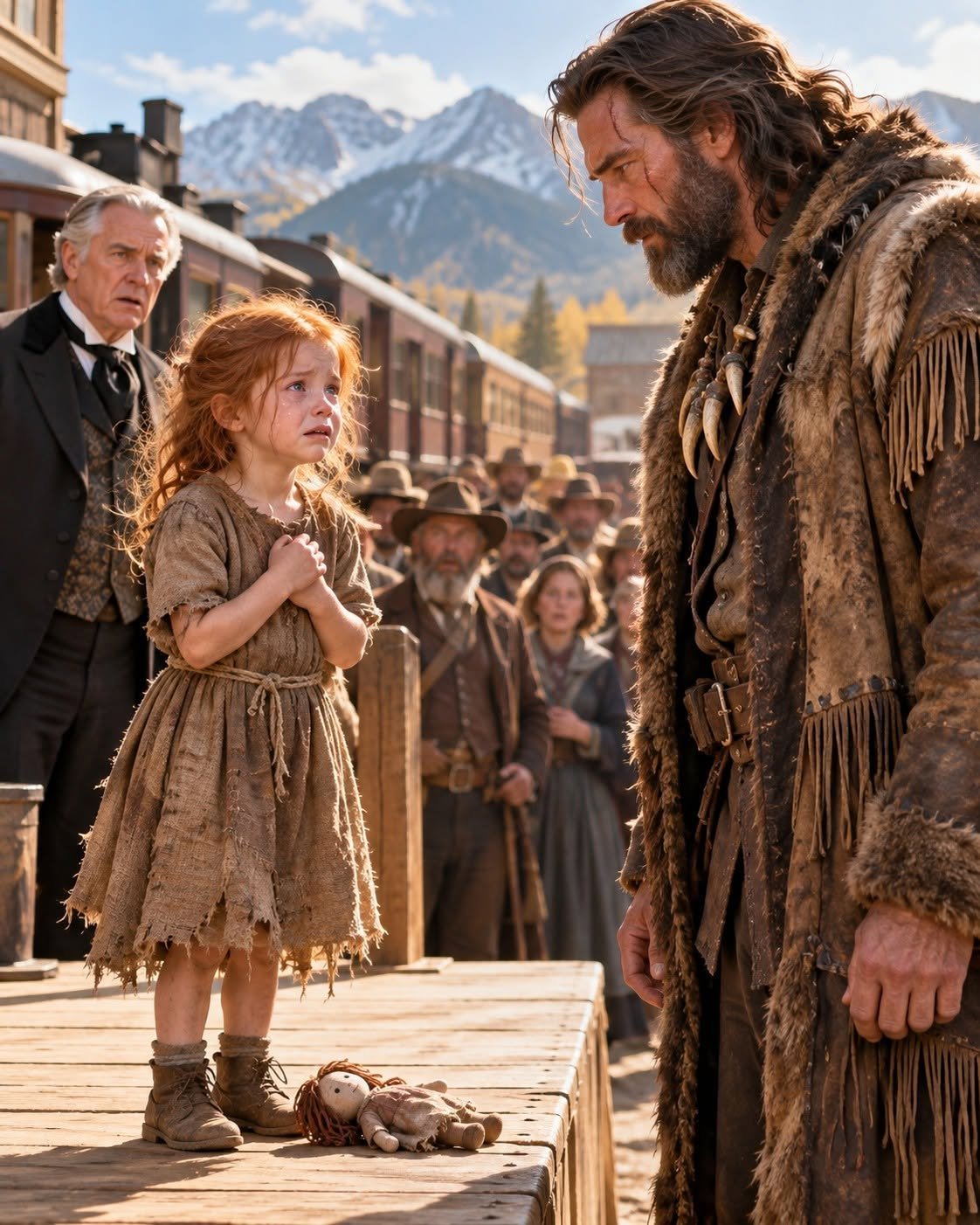
Seven-year-old Abigail stood alone on the platform, painfully thin, dressed in something like a potato sack tied with twine, copper hair tangled, her small chest rattling with a cough she had carried for three days. “Nobody wants me,” she sobbed, covering her dirty face as her faceless rag doll fell at her feet. Jebediah Rust had spat into the dirt and said he wouldn’t pay for a child just to dig her grave come December. The crowd had laughed.
Then a silence fell over the square — the kind of silence that means something large is moving. People stepped aside. Even Rust moved backward. Through the opening walked Jeremiah Boon: six feet four, wrapped in a weathered buffalo-hide coat, a necklace of enormous grizzly claws on his chest, a jagged white scar running from his temple to his jaw. The most feared and least understood man in the territory.
Jeremiah ignored them all. He walked straight to the platform, and his pale blue eyes fell not on the trembling girl, but on the rag doll at her feet. He stopped dead. His great weathered hand trembled as he bent to pick it up. He turned the faceless doll over, and there — stitched into the back of its patched dress with uneven blue thread — was a small, clumsy heart. And inside the heart, two initials: E.B.
Jeremiah Boon’s face went white. “Where did you get this?” His voice came out like gravel breaking. Abigail stared up at him through her tears. “It was with me. In the basket. In Boston. The matron said it came with me when they found me.”
The crowd had gone utterly still. Cornwall cleared his throat. “Mr. Boon, if you’re not here to claim a child—” “I’m claiming her,” Jeremiah said without looking up. He lifted the doll as if it were made of glass. “This was my wife’s. Elizabeth Boon.” A murmur ran through the square like wind through grass.
For the mountain man had a past the town only half knew. Twelve years earlier, Jeremiah had lived in Missouri with his young wife Elizabeth, and they had a baby daughter with copper hair. When sickness swept through the county, Elizabeth died. Jeremiah, broken and drinking, had left the infant with Elizabeth’s sister in Boston while he went west to work the fur trade — intending to send for her once he was sober and settled. He never sent for her. He told himself she was better off. He told himself a lot of things.
“The doll,” Jeremiah said, his voice cracking, “my wife stitched that heart the night before she died. She put our initials in it so the child would always carry us. I thought…” He stopped. He thought a lot of things he could not say in front of a crowd. He thought of the letter from Boston, three years unanswered, that had finally stopped coming. He thought of the sister who had died of the same coughing sickness, and the child who had been put on a train with nothing but a doll.
Abigail was looking at him with wide, frightened gray eyes — his eyes. She had his pale blue eyes, darkened to gray. Jeremiah knelt, and for the first time in a decade, the great mountain man wept. “Little one,” he said. “I’m your father.”
The square erupted. Cornwall sputtered about paperwork. Jebediah Rust found somewhere else to be. Abigail did not move. She stared at the giant kneeling in the dust before her, and then she did the bravest thing a seven-year-old had ever done in Bozeman: she held out her arms.
Jeremiah Boon lifted his daughter as gently as if she were a bird’s egg, tucked the rag doll against her chest, and carried her out of that square without another word to anyone. He took her to the mercantile, bought her a warm wool dress, boots that fit, a heavy coat, and cough syrup. Then he rode with her up into the Gallatin Range to the cabin he had kept empty for years.
That winter nearly killed them both. Abigail’s cough deepened into something that rattled the cabin walls, and Jeremiah sat up for nine straight nights, spooning broth into her, wrapping her in furs, praying to a God he hadn’t spoken to since Missouri. “Don’t you leave me too,” he whispered over her fevered sleep. “I just got you back.”
She lived. In the spring, the color came back to her cheeks, and she followed him everywhere — learning to read sign, to set a snare, to ride. She asked him a thousand questions about her mother, and Jeremiah answered every one, even the ones that hurt. He told her about Elizabeth’s laugh, and her terrible cooking, and the night she stitched a blue heart into a doll so her baby would always carry them.
But Abigail had one question she saved for a summer evening, when they sat on the cabin porch watching the sun sink behind the peaks. “Why did you leave me in Boston?” Jeremiah was quiet for a long time. Then he told her the truth — about the drinking, the shame, the letters he was too cowardly to answer. “I failed you, little one,” he said. “I can’t change that. I can only be here now.”
Abigail took his great scarred hand in her small one. “You came back,” she said simply. “That’s the part that matters.” Jeremiah wept again that night — the second time in a decade, and the last time anyone ever saw.
The following week, Jeremiah rode back down to Bozeman with Abigail wrapped in her new coat, and did something no one expected of the mountain man: he walked into Reverend Cornwall’s office and demanded legal papers. Cornwall, still red-faced from the platform scene, signed the guardianship without argument. “The Lord works in mysterious ways,” the reverend muttered. “Mysterious and about time,” Jeremiah replied.
That first year in the mountains was Abigail’s education. Jeremiah taught her to read tracks in the mud — deer, elk, bear — and to move through the forest without snapping a twig. He taught her which berries would kill her and which would keep her alive. On her eighth birthday, he gave her a small rifle and taught her to shoot straight. She was a natural. “Your mother had that same steady hand,” he told her, and for once the memory didn’t hurt.
Old Hank Dwyer, Jeremiah’s trapping partner, came by that winter and took one look at the little girl in the buffalo coat and burst out laughing. “Boon, you got yourself a daughter?” “Got her back,” Jeremiah corrected, and something in his voice made Hank nod and never ask again. Hank carved Abigail a whistle from an elk antler and taught her to call owls. She practiced until Jeremiah threatened to leave the territory.
The bond between them was tested in February, when Jeremiah was caught in a rockslide above the trap line and came home with his leg gashed to the bone. Abigail, not yet nine, cleaned the wound with snowmelt, packed it with the yarrow poultice he had taught her, and bound it tight — all while keeping him talking so he wouldn’t pass out. “Who taught you that?” he asked weakly. “You did,” she said. “Now be quiet and let it work.” He healed clean, and from that day he introduced her as “my daughter, the doctor.”
Years passed. Abigail grew tall and strong, with her father’s pale blue eyes and her mother’s stubborn chin. She learned to read from a Bible Jeremiah traded three beaver pelts for. She learned to shoot, to track, to survive. And she learned something else: that the man the town feared as a monster was the gentlest soul she had ever known.
When Abigail was sixteen, she rode down to Bozeman and stood on that same wooden platform — now used for town meetings — and told her story to a crowd that listened in tears. Reverend Cornwall, old and gray, asked her forgiveness. Jebediah Rust, also old and also gray, sent a parcel of preserves every Christmas for the rest of his life.
Abigail never left the mountains. She married a young surveyor who loved her copper hair and wasn’t afraid of her father. They built a cabin in the next valley over, and every Sunday, Jeremiah came down the trail with his grizzly-claw necklace and his rifle, and his grandchildren would run to meet him, fighting over who got to sit on his knee first.
The rag doll sat on Abigail’s mantelpiece for the rest of her life — the faceless doll with the blue heart and the initials E.B., Elizabeth Boon. When her own daughter asked about it, Abigail would say, “That doll crossed the whole country to bring me home.” And it had. It had crossed the country in the arms of a little girl nobody wanted — and it had brought her to the one man who had been looking for her all along.


