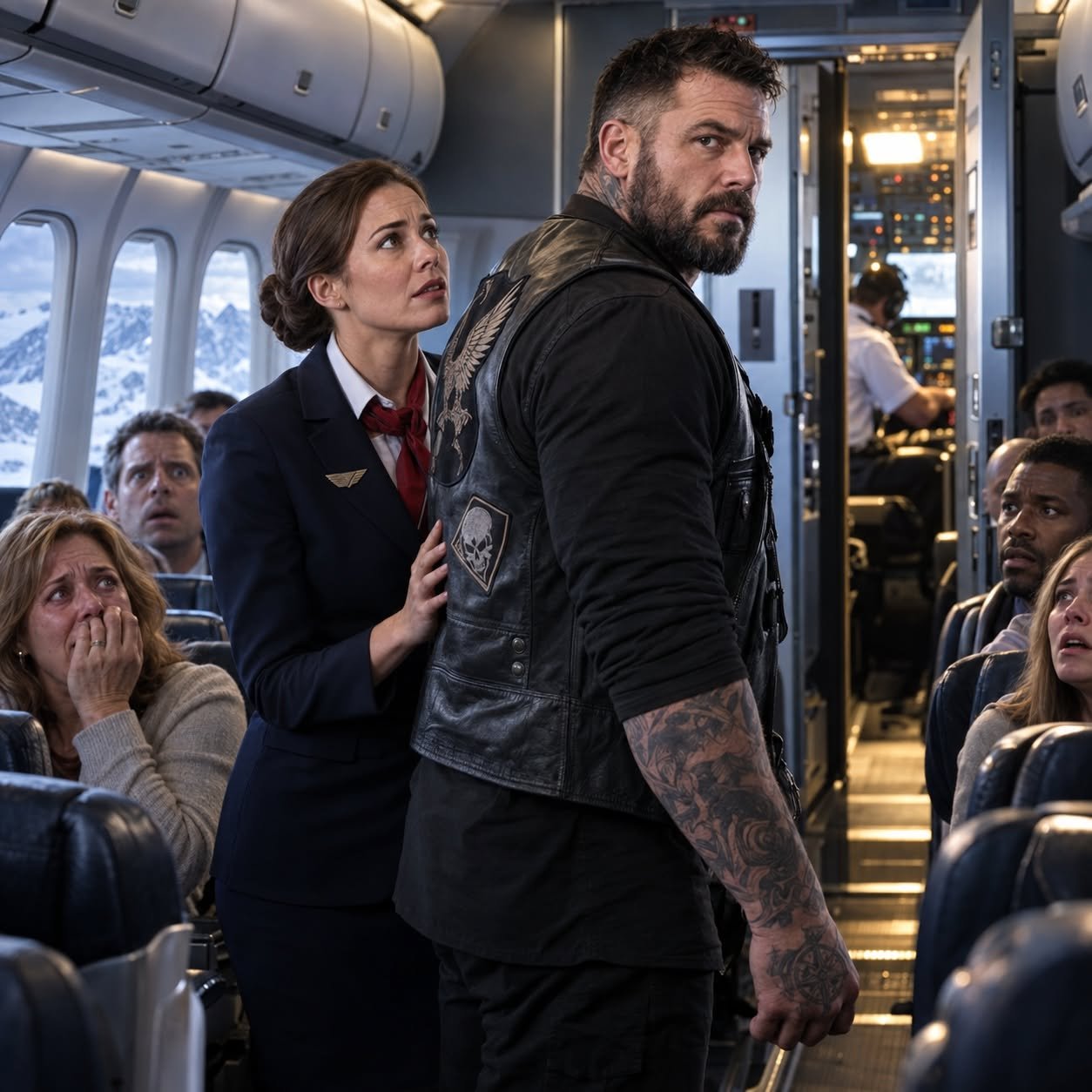
The Biker in Seat 6A Landed a Dying Plane — and the Promise That Brought Him Home
The seat clicked into place beneath me, and for the first time in six years, my hands closed around the yoke of an airplane I knew how to fly.
Eric, the young first officer, was breathing hard beside me. Sweat ran down his face. The right engine was losing oil pressure fast, the captain was unconscious on the floor behind us, and two hundred people were sitting in a cabin above the frozen Alaskan wilderness trusting that someone in this cockpit knew what to do.
“Eric,” I said, steadying my voice. “Run the checklist with me. We do this together, step by step.”
The muscle memory hit me like a wave. Twelve years in the Air Force. Thousands of hours in the C-40, the military cousin of this very Boeing. My body remembered what my heart had tried to forget.
“Oil pressure’s falling through forty,” Eric said. “We’re losing altitude.”
“Then we secure the engine before it tears itself apart,” I said. “Fuel cutoff, bleed air off. Nice and calm.”
His hands were shaking, but he followed my calls. When the right engine died, the airplane yawed hard, and I corrected with the rudder the way I had corrected a thousand times over deserts and oceans half a world away. The shuddering eased. The cabin went quiet in the way cabins do when everyone is holding their breath at once.
Naomi appeared in the doorway, pale but composed. “The doctor has the captain stable,” she said. “How bad is it?”
“Bad enough that we need to land,” I said. “Nearest suitable runway?”
Eric checked the display. “Juneau. About forty minutes out, if the left engine holds.”
Juneau. Mountains, short-ish runway, winter weather coming in. Not the easiest landing of my life, but landable. I looked at the fuel gauges. I did the math the way I used to do it, quick and cold.
“Tell Anchorage what’s happening,” I told Eric. “Mayday call. Declare the emergency. Then tell them we’re coming to Juneau with one engine and a medical priority.”
For the next forty minutes, I flew that airplane the way I had flown everything in my career: one careful decision at a time. Eric and I worked the descent together. The left engine held. The mountains of the Inside Passage rose up white and jagged through breaks in the clouds, beautiful and terrifying, and I kept my eyes on the instruments the way Dad’s old instructor had taught me.
“Trust the gauges,” I told Eric. “Your eyes will lie to you in this terrain. The gauges won’t.”
On final approach, the crosswind pushed us sideways. I felt it in the seat of my pants before the instruments showed it, and I crabbed into the wind, gentle, patient. Below us, the runway lights of Juneau appeared through the snow like a line of held candles.
“One hundred feet,” Eric called out.
“Fifty.”
The left main touched first, then the right, then the nose. I brought the thrust reverser in on the one good engine and felt the airplane slow, and slow, and slow, until it stopped on the centerline with snow falling around us.
For a long moment, neither of us spoke. Then Eric laughed, a short broken sound, and put his face in his hands.
“You okay?” I asked.
“You just saved two hundred people with a leather vest on,” he said. “Are you okay?”
Behind us, the cockpit door opened. Naomi stood there crying openly now, the professional mask finally gone. “Everyone’s alive,” she said. “The captain’s awake. The doctor says he’ll be fine. And out there — ” She gestured toward the cabin. “Out there, people are standing and clapping and they won’t stop.”
I walked back into the cabin and the applause hit me like a physical thing. Two hundred pairs of hands. People on their feet. The businessman who had moved his laptop bag away from me in Portland was crying. The woman from 6B — the one who had hugged her purse like I was a thief — grabbed my arm as I passed and said, “Thank you,” over and over, like she couldn’t find any other words.
And the old pilot from across the aisle stood up, slow with age, and held out his hand.
“I told you,” he said, gripping my hand hard. “I know a pilot when I see one.”
“You helped me stand up,” I said. “Don’t forget that part.”
His name was Walter Graves. Twenty-eight years flying military aircraft. He stood with me on the tarmac in Juneau while the snow came down and the paramedics loaded the captain into an ambulance, and we watched the sun break through over the mountains together.
“You know what the hardest flight of my life was?” he said. “The one I almost didn’t take.”
The story traveled fast. By evening it was on the news in Anchorage, and by night it was everywhere: the biker in seat 6A who turned out to be a former Air Force captain. Reporters kept asking the same question in different ways. Why did you hide who you were? Why did you wait?
I told them the truth. Six years earlier, after an emergency overseas that nearly ended with Sophie growing up without a father, I had promised my thirteen-year-old daughter — then seven, sitting up in a hospital bed — that I was finished with danger. And I had spent six years trying to honor that promise by burying the pilot inside me.
“Here’s what I got wrong,” I said to one reporter, and I meant it. “Sophie never asked me to stop being the man who helps people. She asked me to come home. Those aren’t the same thing. I finally understand that.”
But the moment I will carry to my grave came at the gate in Juneau the next morning, when the connecting flight finally got us to Anchorage. I walked into the arrivals hall, and there was Sophie — thirteen now, tall, wearing my old flight jacket, holding a crayon drawing that said MY DAD FLIES HOME.
She had seen the news. Of course she had seen the news.
She ran to me and threw her arms around my neck the way she had when she was seven, and she whispered, “You always come home, Dad. You promised.”
“I know, baby,” I said, holding her so tight I could feel her heartbeat. “And today I brought two hundred people home with me.”
She pulled back and looked at my face. “Were you scared?”
“Terrified,” I said. “But you know what Dad always says? Being scared doesn’t mean you sit still. It means you do the next right thing while your knees shake.”
“That’s not what you say,” she grinned. “You say check the gauges, not the fear.”
“That too.”
We stood there laughing and crying at the same time while travelers walked around us, and I realized something that had taken me six years to learn: the promise I made in that hospital room was never about cockpits or motorcycles. It was about the man Sophie believed I was. And the man in seat 6A — beard, tattoos, leather vest and all — turned out to be that man all along.
A week later, a letter arrived at my house. It was from the woman in seat 6B. She wrote that she was sorry she had judged me before I opened my mouth, and that her son, the little boy she had pulled closer in Portland, now wanted to be a pilot. “He told his teacher,” she wrote, “that heroes sometimes wear leather.”
I read that letter to Sophie at the kitchen table, and she was quiet for a long time.
“Dad,” she said finally, “can I tell you something? I always knew you were still a pilot. The vest never fooled me. Moms at school pick-up don’t make that face unless somebody’s judging something they don’t understand.”
“And what do you say to those moms?”
“That my dad flies home,” she said. “Every single time.”
She keeps the photograph from the crayon drawing on her desk now, next to a new one: the two of us on the tarmac at Juneau, her in my old flight jacket, me in my Iron Ridge Riders vest, with the mountains behind us. On the back she wrote three words.
MY DAD CAME HOME.
And that, I finally understood, was the only promise I ever really needed to keep.

