They Smashed the Crutches That Let a Ten-Year-Old Girl Walk — Then a Biker Named Bear Lifted Her From the Dirt
I was ten years old when three teenage boys took away my ability to walk because they thought it was funny. I remember lying in the dirt, staring at my broken crutches ten feet away, wondering how I was supposed to crawl almost a mile home. Then I heard a motorcycle. And the man who climbed off it looked scarier than every person who had ever frightened me put together.
My name is Maya Collins, and I was born with cerebral palsy. When I was little, my legs rarely did exactly what I asked them to do. My muscles tightened without warning, my balance was terrible, and walking independently seemed like something that belonged to other kids. For years I used a wheelchair. I hated how adults pushed me without asking. I hated entering a room and watching people look at the chair before they looked at me.
Then came surgeries, physical therapy, braces, falls, tears, and thousands of repetitions of movements most people never think about. Eventually, I graduated to forearm crutches. To everyone else, they were aluminum tubes with rubber tips. To me, they were freedom. I decorated mine with purple grip tape, tiny lightning-bolt stickers, and one ridiculous plastic charm shaped like a taco.
With those crutches, I could walk three blocks to the little market. I could visit my friend Hannah. Most importantly, Mom finally allowed me to go alone to Riverside Park, four blocks from our duplex in a worn-down Ohio neighborhood called Benton Heights. That summer, Riverside Park felt like my kingdom. Until Mason Reed decided it belonged to him.
Mason was fifteen. He wasn’t the biggest boy in the neighborhood, but he had mastered the trick of making other people afraid before they could realize he wasn’t particularly brave. He usually traveled with two boys named Cole and Tyler. Alone, they barely looked at me. Together, they became cruel. At first it was comments. “Robot girl.” “Need an oil change?” “Race you.” I learned to keep moving. My mother had taught me that people looking for a reaction often got bored when they didn’t receive one.
That advice worked until one brutally hot Thursday afternoon. I was crossing the dusty area beside the playground when Mason stepped directly in front of me. “Cool sticks,” he said. I moved right. He moved right. I moved left. He blocked me again. “Mason, just let me through.” Cole laughed. Mason looked at my crutches. Then he smiled. It was the kind of smile that tells you something bad is about to happen while you still have time to understand it but not enough time to stop it.
He kicked the bottom of my right crutch. The rubber tip jumped sideways. My balance disappeared. I hit the ground hard. Pain shot through both knees, but embarrassment hurt worse. The three boys laughed. I reached for the crutch beside me. Mason stepped on it. “Give it back.” He looked down at me, lifted his foot, and stomped directly on the aluminum shaft. The metal bent. I screamed — not because he had hurt me, but because I knew exactly how much those crutches cost.
“Mason, stop!” He stomped again. The shaft buckled. Then he grabbed my second crutch. I tried to pull myself upright using the playground railing, but my legs wouldn’t cooperate fast enough. Mason swung the crutch against a steel support post. Once. Twice. The aluminum folded near the handle. He threw it beside me. “There,” he said. “Walk home.” They left laughing.
For several seconds, I didn’t move. I stared at the purple tape wrapped around twisted metal. Mom worked double shifts at a nursing home, and our insurance had fought her for months before approving those crutches. We couldn’t simply buy another pair. Those boys hadn’t broken equipment. They had broken my independence. I tried standing anyway. I fell. So I began crawling, gravel cutting into my palms, knees burning against the dirt.
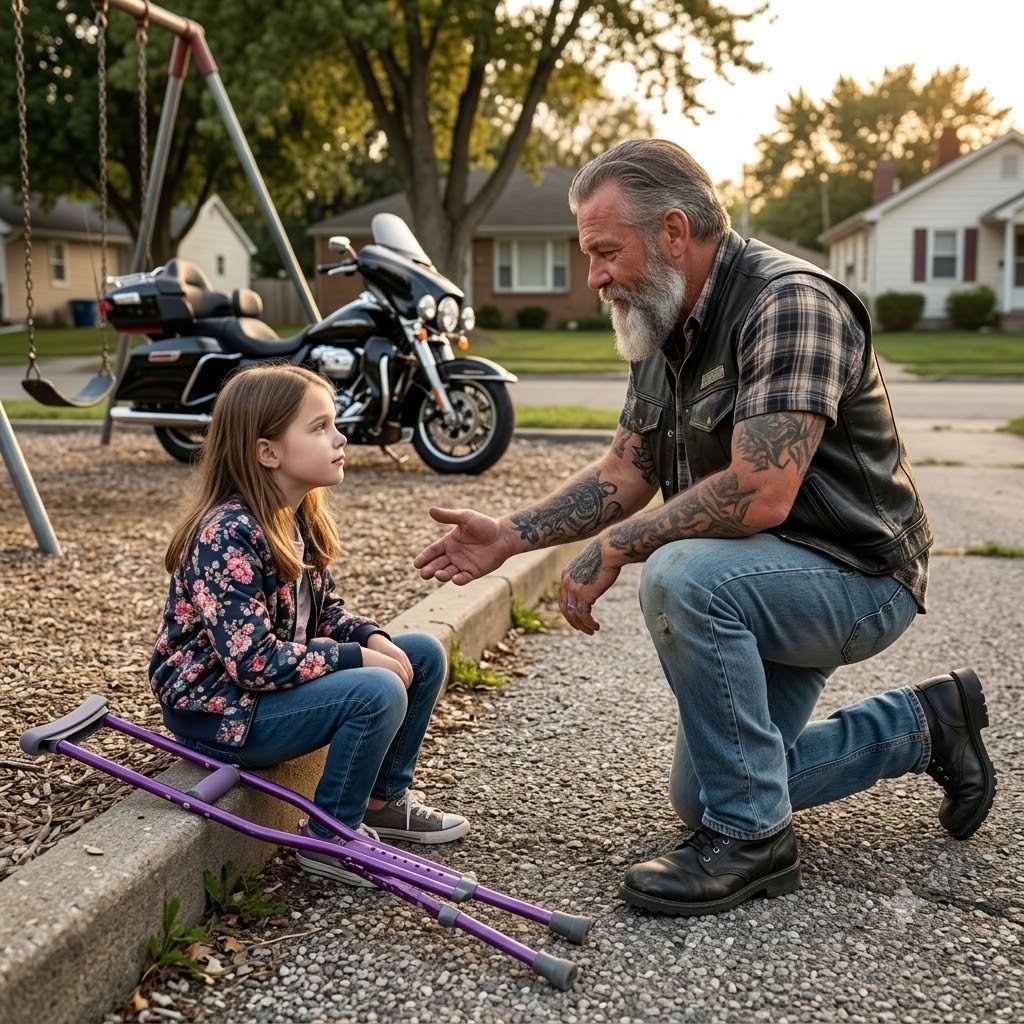
I had gone perhaps twenty feet when I heard the motorcycle. The sound grew louder until a huge black touring bike rolled over beside the park. The rider shut off the engine. Silence returned. Then he walked toward me. He was enormous. Gray beard. Tattooed arms. Heavy boots. Faded jeans. A black leather vest covered in patches from a local motorcycle organization called the Iron Harbor Riders. Every warning my mother had ever given me about strangers seemed to arrive in my head at once.
The man stopped several feet away. He looked at my hands. Then my knees. Then the destroyed crutches. “You hurt?” His voice sounded like gravel rolling inside a metal barrel. I shook my head even though everything hurt. He crouched. “Those yours?” That question broke me. I started crying. “They destroyed them.” His expression changed. Not dramatically. That made it more frightening. “Who?” “Mason Reed.” He glanced toward the street. “Older kid?” I nodded. “I can’t get home.”
The big man picked up both ruined crutches. Then he held out one hand. “My name’s Gabriel Mercer. Folks call me Bear.” I stared at him. He didn’t move closer. “You don’t have to trust me,” he said. “But nobody should be crawling home while I’m standing here.” Something about that sentence made me reach for him. Bear lifted me as carefully as if I were made of glass.
Mom nearly screamed when she saw us approaching our duplex. She rushed down the porch steps. “Maya!” Bear immediately explained what happened. When Mom saw my crutches, her face collapsed. “They won’t replace those,” she whispered. “Not this soon.” Bear looked at her. “How much?” “Please. You’ve already helped enough.” “Nearly twelve hundred dollars.” He nodded. Then he set the twisted crutches beside our porch. “Take care of her hands.” “Mr. Mercer—” But he was already walking toward his motorcycle.
I thought that was the end of it. I was wrong. Years later, Bear told me where he went next. Straight to the Iron Harbor clubhouse. He walked inside carrying my broken crutches. About thirty riders were there. Bear placed the twisted aluminum on a table. Then he told them what Mason had done. Nobody laughed. Nobody shouted. One man pulled out forty dollars. Another added twenty. Then another. Someone passed an old motorcycle helmet around the room. By the time it returned, there was more than enough money for replacement crutches.
But Bear told them money wasn’t the real problem. “A kid thinks he owns that neighborhood because everybody keeps looking away,” he said. Their president, an older man named Cal Brennan, studied the shattered crutches. Then he stood. “We don’t scare a fifteen-year-old,” Cal said. Bear nodded. “No.” “We make sure the adults stop pretending they don’t see him.” Exactly.
That evening Mom was cleaning gravel from my palms when a vibration moved through our bathroom floor. The medicine cabinet rattled. I looked at Mom. The rumble became thunder. We went to the front window. Motorcycles were turning onto our street. Not two. Not five. Dozens. Neighbors stepped onto their porches. Engines rolled through Benton Heights until the entire block seemed to breathe with them. Then the riders slowed. And every one of them stopped directly outside our house. Mom grabbed my shoulder. “Oh God, Maya…” The engines went silent. Bear removed his helmet. But instead of walking toward our porch — he turned around, looked three houses down at Mason Reed’s home, and started walking straight toward it.
Mason’s father opened the door before Bear reached the steps. I watched from our window, Mom’s arm tight around me. There was no shouting. That was the part I’ll never forget. Bear simply held up my twisted, purple-taped crutches so the whole street could see them, and spoke to Mason’s father man to man. Then Bear turned and pointed at three teenage boys who had come out onto their own porches to stare — Mason, Cole, and Tyler — and said something that made every one of them look at the ground.
What Bear said was this: “Your sons did this to a ten-year-old girl this afternoon. I’m not here to threaten children. I’m here to tell the grown-ups on this street that we’re done watching it happen.” Then he walked back to our porch, knelt so his eyes were level with mine, and said: “Your new crutches will be here Saturday. Custom ones. Purple. The whole club voted on the color. The taco charm stays.”
The new crutches arrived Saturday morning, exactly as promised — deep purple, my lightning stickers, and a brand-new taco charm Bear had picked out himself. But the crutches weren’t the biggest change that week. On Sunday, Mason Reed’s father walked his son to our door. Mason stood on our porch holding a written apology, his face red, his voice shaking. “I’m sorry, Maya,” he said. “I was cruel and it was wrong.” He meant it. You can tell when a kid means it.
Mason spent that summer doing community service through the Iron Harbor Riders’ new youth program — the one Cal Brennan started the week after my crutches were smashed. It’s called the Harbor Program now, pairing at-risk teenagers with club mentors who teach them mechanics, discipline, and the one rule Bear wrote on the clubhouse wall: nobody crawls home while we’re standing here. Mason became one of its first success stories. Cole and Tyler joined too, and Mason still won’t walk past our house without waving.
And Bear? Bear became the grandfather I never had. He taught me to ride in his sidecar — strapped in safe, purple crutches secured beside me — and every year we lead the Iron Harbor charity ride through Benton Heights together. The same street where I once crawled through gravel is the street where I ride tallest, holding on to Bear’s shoulder, laughing into the wind.
I’m older now, and my legs are stronger than the doctors once promised they’d ever be. But no matter how far I walk, I’ll always remember the afternoon a terrifying-looking biker crouched in the dirt, held out his hand, and told me the truest thing anyone has ever said to me: nobody should be crawling home while I’m standing here.