The first bullet hit me before I even heard the gunfire. The second one dropped me on top of a seven-year-old girl whose name I didn’t know. As my lungs filled with pain and the pavement turned red beneath me, I remember asking only one question. “Is the little girl okay?” My name is Noah Bennett. Back then, I was thirty-six years old and almost completely forgettable — and that afternoon outside a roadside diner in Oklahoma changed everything I believed about being invisible.
I worked inventory at a building-supply warehouse outside Tulsa. I rented a one-bedroom apartment above a laundromat. My parents were gone, I had never married, and the emergency contact on my medical forms was my landlord. I wasn’t miserable. I was simply the kind of man people didn’t notice — the man who holds the door and gets walked past anyway.
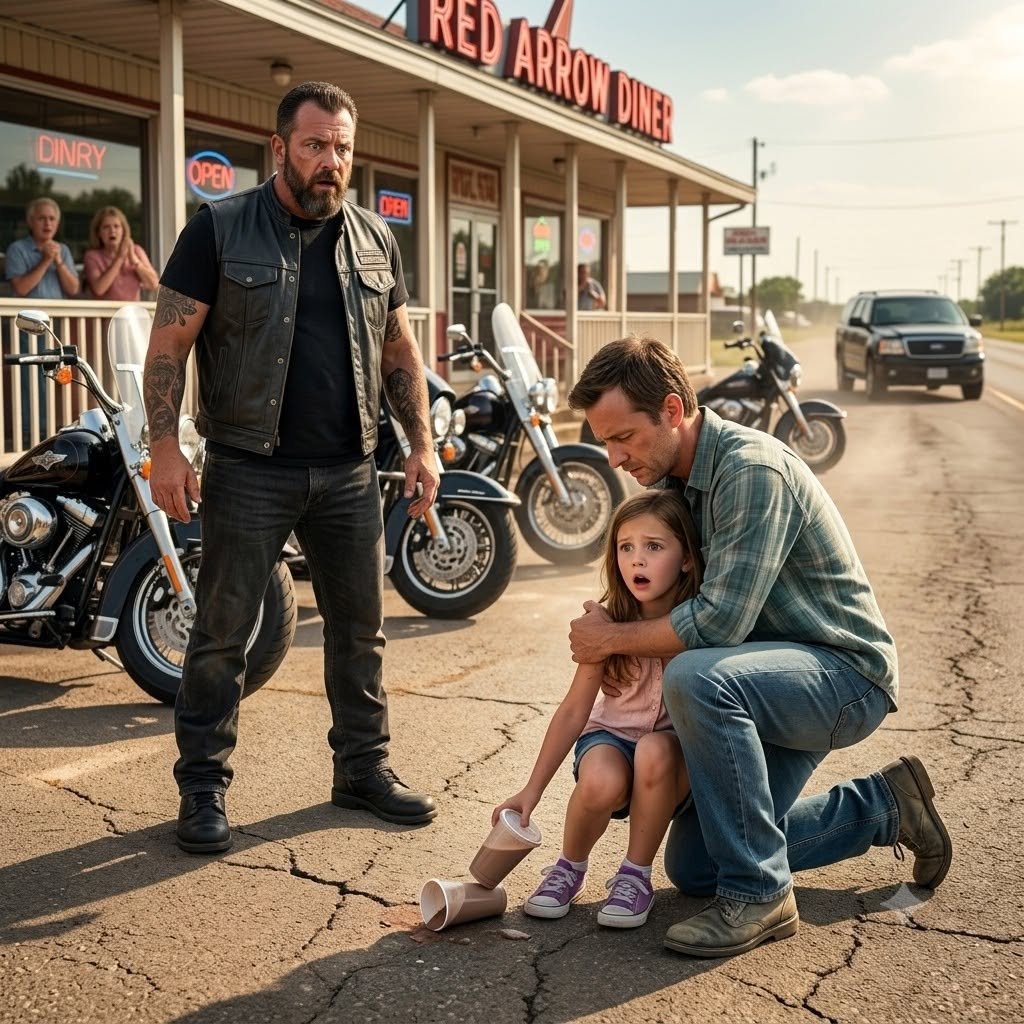
That August afternoon, I was waiting for the Number 14 bus outside a place called Millie’s Kitchen when six motorcycles rolled into the parking lot. The men riding them looked intimidating enough that conversations on the patio went quiet. Leather vests. Heavy boots. Tattoos. The patches on their backs said BLACK RIDGE MC. One man stood apart from the others — huge, maybe six-foot-three, broad across the shoulders, gray beginning to show in his beard. Later I learned his name was Caleb Rourke. That afternoon, I noticed only the tiny girl holding his hand. She wore purple sneakers and carried a chocolate milkshake almost as large as her head. Every time she spoke, this hard-looking man bent down to listen. She said something that made him laugh. And for some reason, watching them hurt — maybe because I remembered my father looking at me that way before cancer took him, maybe because I realized no one in the world looked at me that way anymore.
Then I heard tires scream. A dark SUV jumped the curb at the entrance. Its passenger window dropped. I saw an arm come out. Then a gun. Caleb had his back to the street. His daughter didn’t.
I didn’t think. I ran. I slammed into the girl just as the first shots cracked across the parking lot. Something punched through my right shoulder. Another impact exploded beneath my ribs. I landed hard with the child under me. Glass shattered. People screamed. Then everything became strangely quiet. I remember Caleb dragging me sideways and finding his daughter curled beneath me. She was crying, but she wasn’t bleeding. The blood on her dress was mine. Caleb looked down at me, and the terrifying biker suddenly looked like a frightened father. “Stay with me, man.” I could barely breathe. “The kid?” “She’s okay.” That was enough. I smiled. Then the world disappeared.
I woke up eleven days later at St. Catherine Medical Center. My right arm felt like it belonged to someone else. My ribs had been repaired. One bullet had damaged my lung; the other had torn through my liver. The doctors told me I had nearly died twice on the operating table. The first thing I saw when I opened my eyes was Caleb Rourke sitting beside my bed, looking as if he hadn’t slept in days. I croaked, “Your daughter?” His eyes changed instantly. “Maddie’s fine.”
He pulled a folded piece of paper from his jacket — a child’s drawing. Three stick figures stood beneath a crooked yellow sun. One was enormous and wore black. One was a little girl in purple shoes. The third had a cape. Underneath, in uneven handwriting, Maddie had written: MR. NOAH SAVED ME. I laughed, and it hurt so badly I nearly passed out again.
Then reality arrived. Doctors talked about months of rehabilitation, possible permanent nerve damage, a cane, occupational therapy, specialists. I had mediocre insurance and less than four thousand dollars in savings. I stared at the ceiling and whispered, “I’m going to lose everything.” Caleb stood. “No.” “You don’t understand.” “I understand exactly.” He leaned closer. “Your medical bills are covered. So is your rent. For as long as you need it.” “I can’t take your money.” His expression hardened. “You took bullets meant for my daughter.” “I didn’t do it for money.” “I know.” That answer silenced me.
He placed a small black card on my bedside table — only a phone number embossed in silver. “You call that number, someone answers. Day or night.” I started to protest. “You were alone when you hit that pavement,” he said, his voice softening. “You’re not alone anymore.” He meant it.
Over the next six months, Black Ridge members drove me to rehabilitation. A giant mechanic named Moose learned how I liked my coffee. Another member fixed the broken heater in my apartment without charging me. Caleb’s wife brought dinners. Maddie visited every Sunday, always with a new drawing. Slowly, painfully, I learned to walk normally again. My right hand never fully recovered — I used a cane on bad days. But for the first time since my parents died, somebody noticed when I didn’t come home. That frightened me almost as much as it comforted me, because Black Ridge had a reputation. Some members had criminal records. Federal investigators had apparently been watching them for years. I knew none of their business, and I wanted to know none of it. To me, Caleb was simply Maddie’s father.
Then one rainy February afternoon, I left physical therapy alone, and a gray sedan pulled across the sidewalk in front of me. Two men stepped out. One showed me federal credentials. “Mr. Bennett? I’m Special Agent Daniel Price. We need to talk.” “I haven’t done anything.” “We know.” They drove me to a federal office downtown, into a windowless room, where Price dropped a folder in front of me. Photographs spilled across the table: Caleb outside my apartment, Black Ridge members driving me to appointments, copies of payments made toward my rent and rehabilitation. Price tapped one photograph. “Six months ago, you were an anonymous warehouse clerk. Now one of the most closely watched motorcycle organizations in Oklahoma is financing your life.” “They helped me because I saved a child.” “That’s the story.” “It’s the truth.”
Price slid a tiny recording device across the table. My stomach dropped. “We want you to wear this around Caleb Rourke.” “No.” “You haven’t heard the consequences yet.” “I don’t care.” “You should.” He opened another folder. “We can petition to freeze the fund paying for your treatment while its source is investigated. We can examine every transfer, every person who transported you, every favor.” “You know I’m not part of their club.” “Then prove it by helping us.”
I stared at the recorder. Price leaned toward me. “You’re choosing between men who frighten you and the federal government, Mr. Bennett.” He was wrong. Caleb had never frightened me. What frightened me was losing my therapy, my apartment, the little bit of independence I had fought six months to regain. Price pushed the recorder closer. “Get Rourke talking. Finances. Weapons. Anything useful.” “And if I refuse?” His expression didn’t change. “Then your life becomes extremely complicated.” “How long do I have?” “Forty-eight hours.” He stood and opened the door. Then he said the sentence that followed me all the way home: “Decide whether Caleb Rourke saved you because he loves you like family — or because he bought you.”
I didn’t sleep that night. I sat in my apartment — the apartment Caleb’s people had kept warm, the apartment where Moose had fixed the heater — and I turned the little black card over in my fingers. Forty-eight hours. My therapy. My independence. Everything I had clawed back. All I had to do was wear a wire around the man who had sat beside my hospital bed for eleven days.
The next morning, I called the number on the card. Not to set Caleb up — to tell him the truth. He listened without interrupting. When I finished, there was a long silence. Then he said, “Noah. Come to the clubhouse tonight. Bring the recorder.”
I thought he was going to run. Instead, when I arrived, Caleb sat me down in front of his whole club and told me to turn the device on. Then he looked straight into it and said: “My name is Caleb Rourke. Six months ago this man threw himself in front of bullets meant for my seven-year-old daughter. Everything we have done for him since — every dollar, every ride, every dinner — was done because a debt like that doesn’t get repaid, it gets honored. If your investigation needs someone, take me. Leave him alone.”
Then he told me to give the recorder back to Agent Price with a message: Black Ridge’s books were already open to a court-appointed auditor, and had been for a year — something Price’s office knew perfectly well. The pressure on me wasn’t an investigation. It was leverage, an attempt to manufacture an informant out of a grateful man.
Price was furious. But the freeze never came — because there was nothing to freeze that a judge would touch, and because Caleb’s lawyer filed a complaint about coercion of a civilian witness that very week. The forty-eight hours passed. My therapy continued. My apartment stayed mine.
A month later, the drive-by shooters were caught — men with a grudge against Black Ridge who had decided a public parking lot was the place to settle it. Maddie testified by closed-circuit video, holding the purple sneakers she wore that day like a talisman. I testified too, from my chair, cane across my knees. When it was over, Caleb walked me out of the courthouse himself.
People ask me what Caleb’s promise really meant — the one he made beside my hospital bed. “You’re not alone anymore.” I used to think it meant protection, or money, or rides to therapy. Now I know it meant something simpler and harder: that when the whole weight of the world pressed down on me to betray him, he trusted me enough to hand me the recorder and say, “Tell the truth.” He didn’t buy me. He believed in me. And that is a rarer thing than gold.
I still have Maddie’s drawing, framed now, hanging in my hallway. Three figures under a crooked yellow sun. The little girl in purple shoes. The giant in black. And the third one — the forgettable man with the cape. Every Sunday, Maddie still comes to visit. She is thirteen now, and she rolls her eyes when I tell this story. But last month she brought me a new drawing. Same three figures. Underneath, in her grown-up handwriting, it said: MR. NOAH IS FAMILY.
I was the invisible man waiting for a bus. I am not invisible anymore.