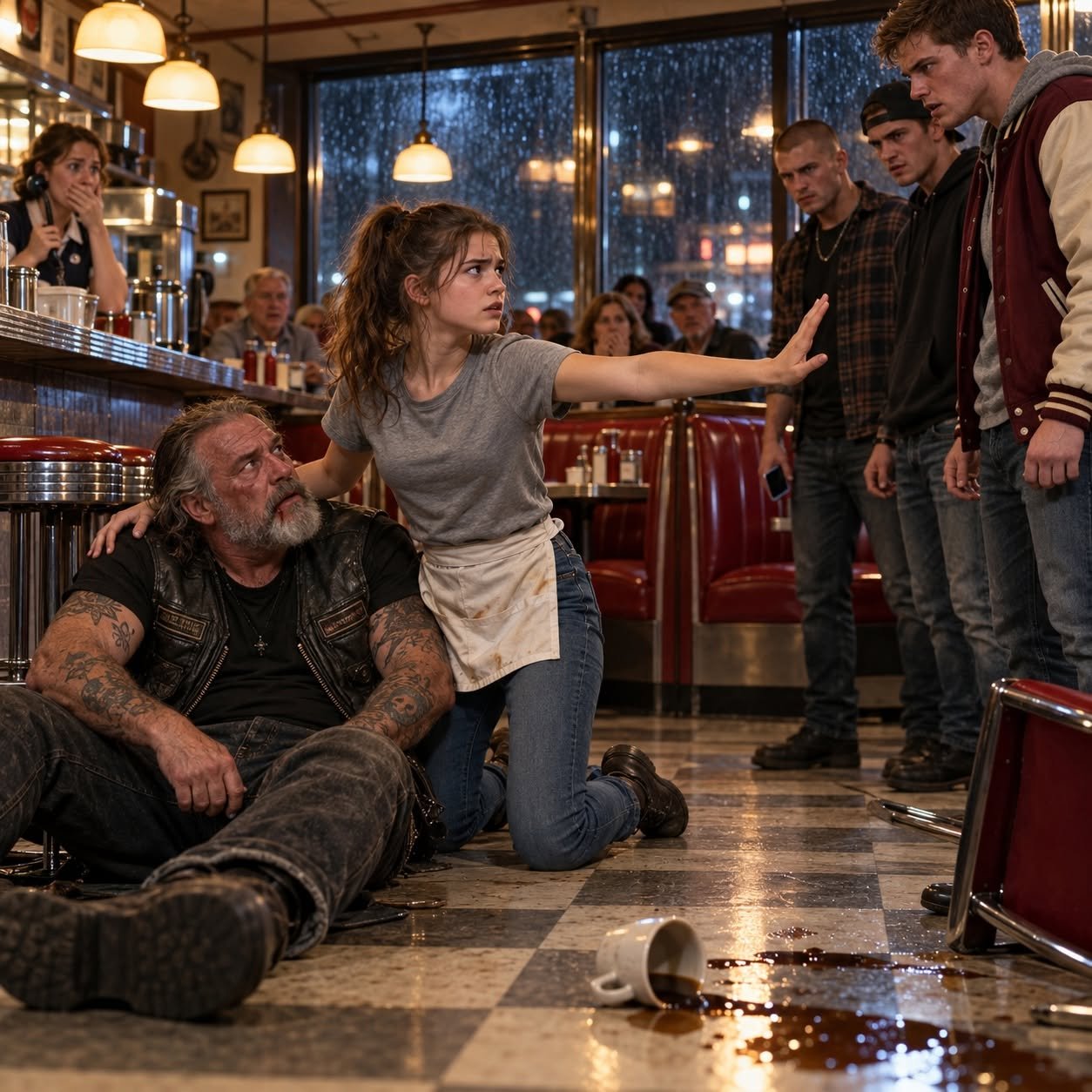
The boot was coming down again when I dropped to my knees on the diner floor. “Hit him again,” I told the three men standing over the biker, “and you’ll have to hit me first.” I was seventeen years old. I weighed barely a hundred and twenty pounds. The man bleeding beneath my hand was twice my size. And somehow, I was more afraid of the fists he refused to use than the boot hanging inches from my shoulder.
My name is Hannah Brooks. Back then, I worked evening shifts at the Cedar Grill in a small western Pennsylvania town where everybody knew your business and almost nobody wanted to get involved. My dad had injured his wrist at the machine shop, the workers’ compensation checks arrived late, and the utility bills did not wait. I went to school, waited tables, and counted tip money on our kitchen counter after midnight.
That Thursday, I was refilling ketchup bottles when three young men cornered a customer near the door. I recognized two of them from school. The oldest, Travis, still wore his old varsity jacket like graduation had been a temporary inconvenience. His younger cousin, Cody, sat two rows behind me in history class. They started with insults. Then Travis shoved the stranger’s coffee across the table.
The biker stood up slowly. He had a gray-streaked beard, a scar along his jaw, and hands that looked capable of breaking the edge off our counter. But he backed toward the door. Travis blocked him. One shove became three. A chair tipped. Someone hooked a foot behind the biker’s ankle, and he went down hard on the tile. Nobody moved. A trucker half stood, then sat again. My manager, Denise, froze with a coffeepot in her hand.
Then Travis drew back his foot.
I don’t remember deciding to cross the room. I remember the floor hurting my knees. I remember pressing my arm across a stranger’s chest. And I remember Travis saying my name. “Move, Hannah.” “No.” “This isn’t your problem.” “You made it my problem when you kept kicking.” Behind me, the biker whispered, “Kid. Get away.” His fists were closed so tightly his knuckles had gone white. I thought he was about to explode. Instead, he took a slow breath. Then another.
Travis leaned toward me. “You really want everybody watching what happens next?” I looked past him at the counter. “Denise. Call the police.” That finally broke the room open. Denise set down the pot. The trucker stood up. Another customer raised his phone. Travis glanced around, stepped back, and said, “This isn’t over.” The door slammed behind them.
Only then did I realize I was shaking. The biker sat up carefully, blood marking his lower lip. I brought him a damp towel and guided him into a booth. “What’s your name?” he asked. “Hannah.” “Wade.” When he turned to take off his jacket, I saw the patch on the back: HELL’S ANGELS. I glanced from the lettering to his face. He noticed. “Does that change anything?” “You’re still bleeding on our booth.” For a second, he almost smiled.
The police came. We gave statements. Denise copied the security footage. An officer asked Wade if he wanted medical attention, and he finally agreed to get checked. But while we waited, I asked the question that had been burning in me. “Why didn’t you fight back?” He studied the towel in his hands. “Because I know what happens when I stop stopping.”
He told me then that years ago, he had hurt a man in a fight — badly. “Were you defending yourself?” I asked. “At first.” His eyes met mine. “That doesn’t excuse what came after.” Something cold settled beneath my ribs. “I spent years making sure I never became that man again,” he said. “Tonight, I was running out of ways to keep that promise.” I looked at his big scarred hands. “You could’ve told somebody.” “So could everybody who watched.” That stayed with me longer than anything else he said.
On my drive home that night, a dark pickup pulled in behind me at a red light. I turned right. It turned right. I turned again. So did the truck. Instead of going home, I drove into a brightly lit gas station and called my dad. The pickup rolled past without stopping. I told myself it might have been a coincidence.
The next morning, someone had scratched my car door in the school parking lot. By lunch, Cody brushed the back of my cafeteria chair and whispered, “Should’ve stayed at the counter.” After school, a note waited beneath my windshield wiper: Next time, nobody gets between us. I photographed it before I touched it, then called Denise.
When I reached the diner, Wade was already there, a bandage under his beard. Denise took us into the office to review the footage. On the monitor, one attacker kept checking his phone while another glanced toward the window. Wade asked her to pause. Reflected in the glass was the dark pickup — and beside its open door, an older man. Wade went completely still.
“You know him?” I asked. He nodded. “That’s the brother of the man I hurt.” I looked at the frozen image again. Then Wade pointed at Travis. “And that’s his son.” My mouth went dry. “They weren’t trying to beat me,” he said quietly. “They were trying to make me hit him while the camera was running. And now you’re the reason they failed.”
It took me a moment to understand. The brother had spent years waiting for Wade to break his promise — to throw one punch, on camera, so he could drag him back into court and into prison. Travis and his friends were the bait. The beating was staged to force Wade’s hands. My knees on that diner floor had ruined a plan years in the making.
What happened next happened fast. Denise handed the footage and the note to the police. The older man — the brother — was picked up for conspiracy and witness intimidation. Travis and Cody faced assault charges. And Wade? The police told him plainly: had he thrown a single punch that night, the brother’s lawyer would have buried him. My interference hadn’t just saved him from a beating. It had saved him from himself.
Wade came back to the Cedar Grill one more time before he left town. He sat in the same booth, ordered coffee, and slid an envelope across the table toward me. Inside was a letter and a check — enough to cover my first semester of college, he said, though I argued with him about it for ten minutes. The letter said only this: “You reminded me why I made the promise. Some debts you pay with your whole life. Thank you for not letting me pay with mine.”
I finished high school, and yes, I went to college. I studied criminal justice, which surprises nobody who knows this story. Every year on the anniversary of that Thursday night, I get a postcard. No return address. Just a few words in rough handwriting. This year’s said: “Still keeping it. Hope the coffee’s better where you are.”
People hear this story and call me brave. Maybe I was. But the bravest person in that diner was the man on the floor with his fists closed and his promise intact — a man who had every reason to fight and chose, instead, to take the beating. He taught me something no classroom ever has: that strength is not what you can do to someone else. Strength is what you refuse to do, even when it costs you blood.


