Sheriff Curtis Vale gave me ten minutes to clear out the diner. I had buried my husband three days earlier. When I asked where I was supposed to go, he glanced at the cardboard box in my hands and said, “That isn’t the county’s problem.” Then his deputy chained our front doors while my husband’s coffee was still sitting behind the counter. My name is Evelyn Mercer. I was fifty-eight that October, and until that week, I thought the worst thing that could happen to me was losing Jack. I hadn’t understood how quickly someone could take advantage of the empty space he left.
For twenty-nine years, Jack and I ran Mercer’s Grill outside the little desert town of Juniper Wells, Arizona. He had turned an abandoned service station into a diner with six booths, twelve counter stools, and a neon sign he repaired more often than he admitted. He handled the grill. I baked the pies. When customers asked who made the better breakfast, he would say, “Depends which one of you is tipping.” We never had children. The diner became the place where our life accumulated: a trucker’s graduation photograph of his daughter, a Little League schedule taped beside the register, a crooked shelf Jack built for my recipe books. Every ordinary day left something behind.
Then, one Tuesday morning, he reached for a spatula and collapsed. The ambulance came. I followed. By noon, someone was asking whether I wanted his wedding ring removed. After the funeral, I reopened the diner because I couldn’t bear sitting in our house listening for a truck that would never pull into the driveway.
On Friday, I was sweeping beneath the stools when Vale arrived with two deputies. He dropped a folder beside the register. “Your husband left some unresolved obligations.” “Our bills are paid.” “Apparently not.” There were penalties I’d never seen, a debt to a company I’d never heard of, and paperwork claiming that company had obtained rights to our property. One page carried Jack’s signature. I knew immediately it wasn’t his. Jack had broken his right thumb years earlier, and ever since, the final stroke of his last name hooked upward. This signature lay straight and smooth across the page.
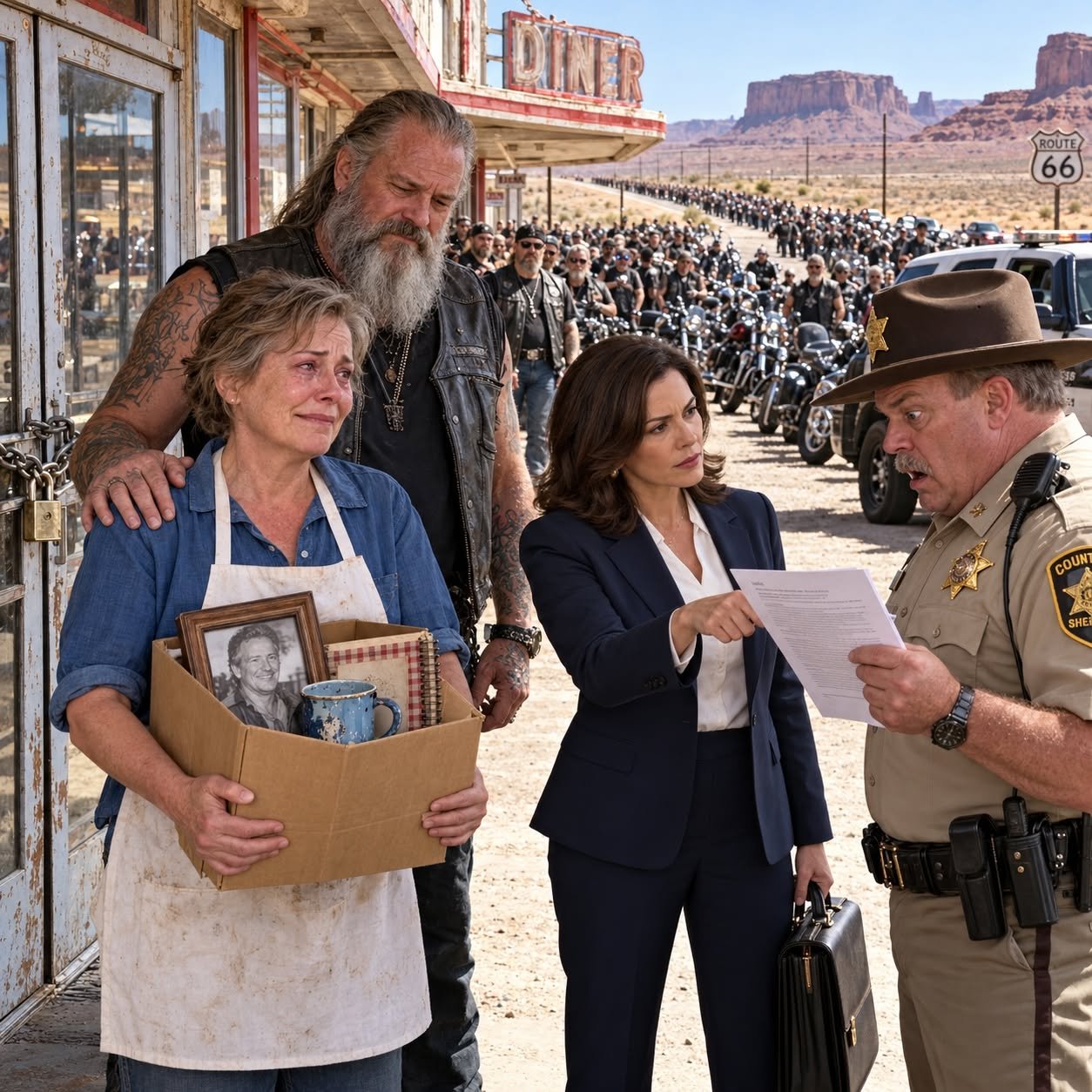
“That’s forged,” I said. Vale leaned against the counter. “Careful.” He had wanted our land for years. A highway interchange was being planned nearby, developers had begun buying roadside parcels, and our diner sat exactly where they wanted a new commercial entrance. Jack had refused every offer. “We’re still using it,” he always said. Now Vale was telling me we no longer owned it. “I want a lawyer.” “You can discuss that after you leave.” He showed me an order with a judge’s signature. I didn’t understand half the language, but I understood the deputy reaching for his handcuffs.
I packed our photographs, my recipe book, and Jack’s chipped blue mug. At the door, I turned back. “His apron,” I said. Vale sighed as though I were wasting his afternoon. The younger deputy fetched it from the hook beside the grill. He wouldn’t meet my eyes when he handed it over.
That night, I sat on our bed with the apron in my lap. It still smelled faintly of onions. I called the attorney who had handled our wills; his assistant said he was away until Monday. I left a message. Then I wandered into Jack’s workshop, because grief makes you search for someone in places you know they cannot be.
Against the wall stood his cedar chest. He kept old road maps and things from before we met in there, and I knew where the key was. Inside, beneath a folded leather vest, lay a photograph: young Jack standing beside a broad-shouldered man with a heavy beard, motorcycles lined up behind them. I turned over the vest. HELL’S ANGELS. Jack had told me he once worked as a mechanic in California. He hadn’t told me this.
Beneath the photograph was a little black notebook. One page held a phone number, a name — Bear — and a note in Jack’s handwriting: If you ever need help and I’m not there, call him. He’ll remember.
I sat on the workshop floor a long time. Then I dialed. A rough voice answered. I told him my name. The noise behind him stopped. “Jack’s wife?” “He died.” Silence. Then, quietly: “Tell me what happened.” I told him everything — the forged signature, the chained doors, the sheriff’s ten minutes. He asked for photographs of the documents and the diner’s address. Before hanging up, he said, “Your husband didn’t leave you without anyone, Evelyn.”
Two mornings later, I was standing outside the chained diner when I heard engines. Motorcycles crested the ridge — dozens became hundreds, three hundred by the count the local paper later printed. Bear stopped at the front of them, older now, his beard almost white, and he walked up to me and put his big arms around me like I was family. Because to him, I was. Jack’s wife. That was enough.
The sheriff arrived minutes later, shouting that everyone was trespassing. Then a woman stepped out of an SUV behind the motorcycles, carrying a briefcase. She was a lawyer — one Bear had called before he’d even hung up with me. She handed Vale a document. He looked at it. Then at her. “Before you threaten Mrs. Mercer again,” she said, “explain why the company taking her land lists your wife as its only officer.”
The color drained out of the sheriff’s face. The company with the forged paperwork, the mysterious debt, the “unresolved obligations” — it was a shell, and the only name on it was his wife’s. Within a month, the forgery was proven by a handwriting expert who took one look at the straight, smooth signature and then at Jack’s hooked stroke on thirty years of diner receipts. The judge’s order was vacated. Vale resigned before the state investigation finished, and his wife faced fraud charges of her own.
But that is the legal story, and it isn’t the one I carry. What I carry is the morning the engines came over the ridge. Three hundred men and women who had never met me stood in the desert sun because a promise made decades earlier — between two young men in a California garage, over engines and oil — still held. Bear told me later what Jack had done for him, back when they were barely more than boys: pulled him out of a wrecked car on a highway shoulder and stayed with him until the ambulance came, then visited him every day for six weeks in the hospital. “He never told me,” I said. Bear smiled. “That was Jack. He didn’t collect debts. He planted them, and let them grow in other people.”
I reopened Mercer’s Grill the following spring. The chains came off, the neon sign buzzed back to life, and Jack’s chipped blue mug went back on its shelf behind the counter. On opening day, the parking lot filled with motorcycles again — not three hundred this time, but enough. Bear cut the ribbon with a pocketknife. I cried into his shoulder, and he pretended not to notice.
People sometimes ask me whether I was angry at Jack for keeping that part of his life from me. The vest. The photograph. The name in the notebook. The truth is, I understood. The Jack I married was the man who fixed a stranger’s neon sign for free and slipped extra pie to the trucker who was short on cash. Whatever roads he rode before he met me, they had made him the man who would write down one phone number and trust it to protect his wife when he couldn’t.
Bear still calls every Christmas. He is slower now, his beard fully white, but his voice on the phone is the same rough warmth I heard that night on the workshop floor. Last year he told me the club keeps a copy of Jack’s photograph in their clubhouse, next to a plaque that reads: “He planted them, and let them grow in other people.” I asked him what that meant to the younger riders. He said, “It means they know what kind of man to be.”
The diner still stands on that corner outside Juniper Wells. The highway interchange was built a mile down the road, and the developers found another entrance. Every year, on the anniversary of the day the engines came, riders pass through town and stop for pie. They always leave a tip for Jack. I keep a photograph behind the register now, next to the Little League schedule: young Jack beside a broad-shouldered man with a heavy beard, motorcycles lined up behind them. Underneath it, in my own handwriting, I wrote the words Bear said to me on the phone that night: Your husband didn’t leave you without anyone.
He didn’t. He left me with three hundred.