What 300 Apache Warriors Did When He Saved Their Chief’s Daughter
The Arizona morning had turned the rocky hills gold after three days of storms, and Ethan Carter was riding alone above the swollen river the way he preferred to ride — solitary, unhurried, listening to birdsong and his horse’s steady steps. At thirty-eight, Ethan was a modest rancher, a man who had built his whole life around honest work and quiet mornings. Then something in the river caught his eye: what looked like driftwood, until he saw dark hair. Someone was drowning.
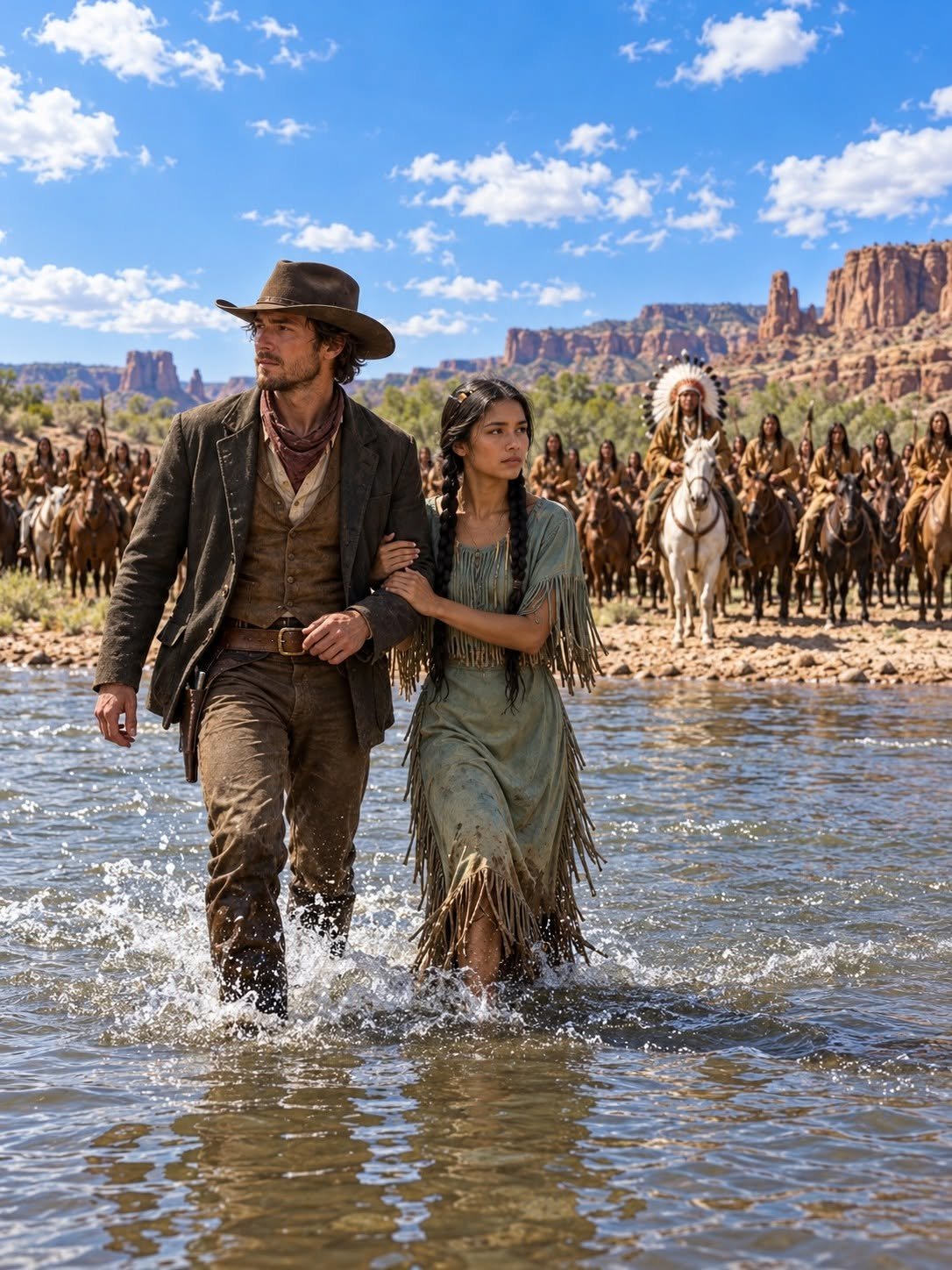
Ethan drove his horse down the bank, tied it to a cottonwood, and stepped into the freezing water without hesitation. His late father’s words were in his ears: “If you have the chance to save a life, you never walk away.” The current hammered his legs. Twice, hidden rocks nearly knocked him down. Water climbed to his chest. But he caught the young woman, held on for both of them, and carried her beneath a cottonwood on the far bank.
She coughed. Her eyes opened. As she drank from his canteen, Ethan noticed the turquoise necklace at her throat and her carefully made traditional clothing. “My father gave me this,” she whispered. Her name was Ayanna. And when Ethan offered to get her home to her worried family, she hesitated — then told him the truth: her father was an Apache chief.
Ethan had heard all the frontier stories meant to make one people fear another. None of them mattered now. He simply saw a frightened young woman whose family was searching for her. He offered his hand. “Let’s get you home.” When her legs weakened, he carried her.
Neither of them noticed the silent figures watching from the hills.
Horses sounded through the trees — one, then another, then dozens. Riders appeared along the ridge, between the pines, from the valley. Ethan slowly realized they were surrounded: not twenty warriors, not fifty, but nearly three hundred Apache warriors filling the hills and trails around them. His pulse quickened. But he did not reach for his gun. His only movement was to steady Ayanna when she stumbled.
A powerful older rider came forward and dismounted. Ayanna whispered, “My father.” The chief’s gaze moved over his daughter’s soaked clothing, her exhaustion, and finally Ethan. Warriors tightened their hands on their weapons. Ayanna spoke rapidly to her father, pointing at the river, then at Ethan. The chief walked toward the cowboy, stopped directly before him, and looked at Ethan’s wet clothes, his scraped hands, the blood on one palm from fighting the river.
Then the chief raised one hand — and one by one, across the whole hillside, the warriors lowered their weapons. Hundreds of Apache warriors stood silently before the lone cowboy who had carried their chief’s daughter to safety.
“What did he say?” Ethan asked.
Ayanna looked at him almost in disbelief. “He says you cannot return to your ranch yet. Because what you did created a debt that cannot be repaid here. He wants you to come with us.”
Ethan had no idea what three hundred Apache people were preparing to do for him.
The Feast of the Honored Stranger
Ethan walked into the Apache camp that afternoon between Ayanna and her father, and the whole village turned out to see the man the river had tested. Children ran alongside, laughing. The women brought him dry clothing — beautifully worked buckskin — and sat him by the central fire with the honor due a warrior.
That night, the chief — whose name Ethan learned was Dacodah — rose before the fire and spoke at length while Ayanna translated in a low voice. He told his people what his daughter had told him: that the cowboy had entered water that could have killed him, that he had held Ayanna above the current when his own feet were failing, that he had carried her for miles and never once looked at her as anything but a life to be saved.
“My father says,” Ayanna whispered, “that a man who risks his life for a stranger’s daughter has the heart of a brother. And so the tribe will make it true.”
What followed left Ethan speechless. Dacodah cut a strip of leather from his own wristband and tied it around Ethan’s wrist — the sign, Ayanna explained, of blood-brotherhood. The warriors who had surrounded him that morning came forward one by one and laid gifts at his feet: a fine bow, a painted shield, a blanket woven with the patterns of the mountains. The women sang. The whole camp feasted until the stars came out, and Ethan — a man who had eaten alone for twenty years — sat at the center of it all, humbled to his bones.
Later, by the dying fire, Dacodah took Ethan’s scarred hand in his own. “Tell him,” the chief said through Ayanna, “that the river gave my daughter back to me. But it gave me something else, too. It gave me proof that a good heart does not belong to one people.”
The Road Between Two Worlds
Ethan stayed three days. He learned to grind corn with the women, who teased him mercilessly about his clumsiness and then fed him until he could barely stand. He rode out with the young warriors, who respected his horsemanship and taught him the mountain trails in return. Ayanna walked with him every evening, and they talked of everything — the river, the ranch, the stories their peoples told about each other, and how small those stories looked up close.
On the third morning, Dacodah walked Ethan to the edge of the camp and gave him a gift that made Ayanna gasp: two of the tribe’s finest horses, a matched pair, dark as river stones. “For the ranch,” the chief said. “So you will remember that you have family on both sides of the mountains now.”
But the greatest gift came as Ethan was mounting up. Dacodah spoke, and Ayanna translated with shining eyes: “My father says that when the ranchers and the soldiers talk of the Apache with fear, you will tell them what you saw here. You will be the voice that says we are people. That is how the debt is repaid — not with gifts, but with truth.”
Ethan rode home a different man than the one who had ridden out.
A Friendship That Outlived the Frontier
Back at his ranch, Ethan kept his promise. When the county men gathered at the trading post and spoke of the Apache with the usual fear, Ethan told them about Dacodah’s camp — about the feast, the singing, the brotherhood band on his wrist. Some men scoffed. But others listened. And when a dispute flared the following spring over grazing land near the tribal hunting grounds, it was Ethan the ranchers sent to talk, and Ethan the Apache trusted to listen.
The agreement he helped broker held for years. Both sides kept to it, because both sides trusted the man in the middle.
Ayanna visited the ranch every season, riding in like a whirlwind with news of the tribe, and Ethan’s lonely cabin slowly filled with the warmth of two families. When she married a young warrior named Taza, Ethan stood beside Dacodah at the ceremony as an honored brother. When Ethan’s first grandchild was born years later — for he did eventually marry, a schoolteacher from Tucson who loved his stories — Dacodah sent a tiny turquoise necklace for the baby, “so she will know she has family in the mountains.”
Dacodah and Ethan remained brothers until the chief’s death, and Ethan rode to the mountains to stand with the tribe in mourning, the leather band still on his wrist, weathered now as old saddle leather.
Ethan Carter had ridden out that golden morning expecting nothing but a quiet day above the river. He came home with something no money could buy: proof that courage speaks a language every people understands, and that a single act of decency — a man stepping into freezing water for a stranger — can echo across a frontier for a lifetime. The river had tried to take a daughter that day. Instead, it gave two peoples a brother.