She Was Certain She Would Die There — Then He Said Four Words
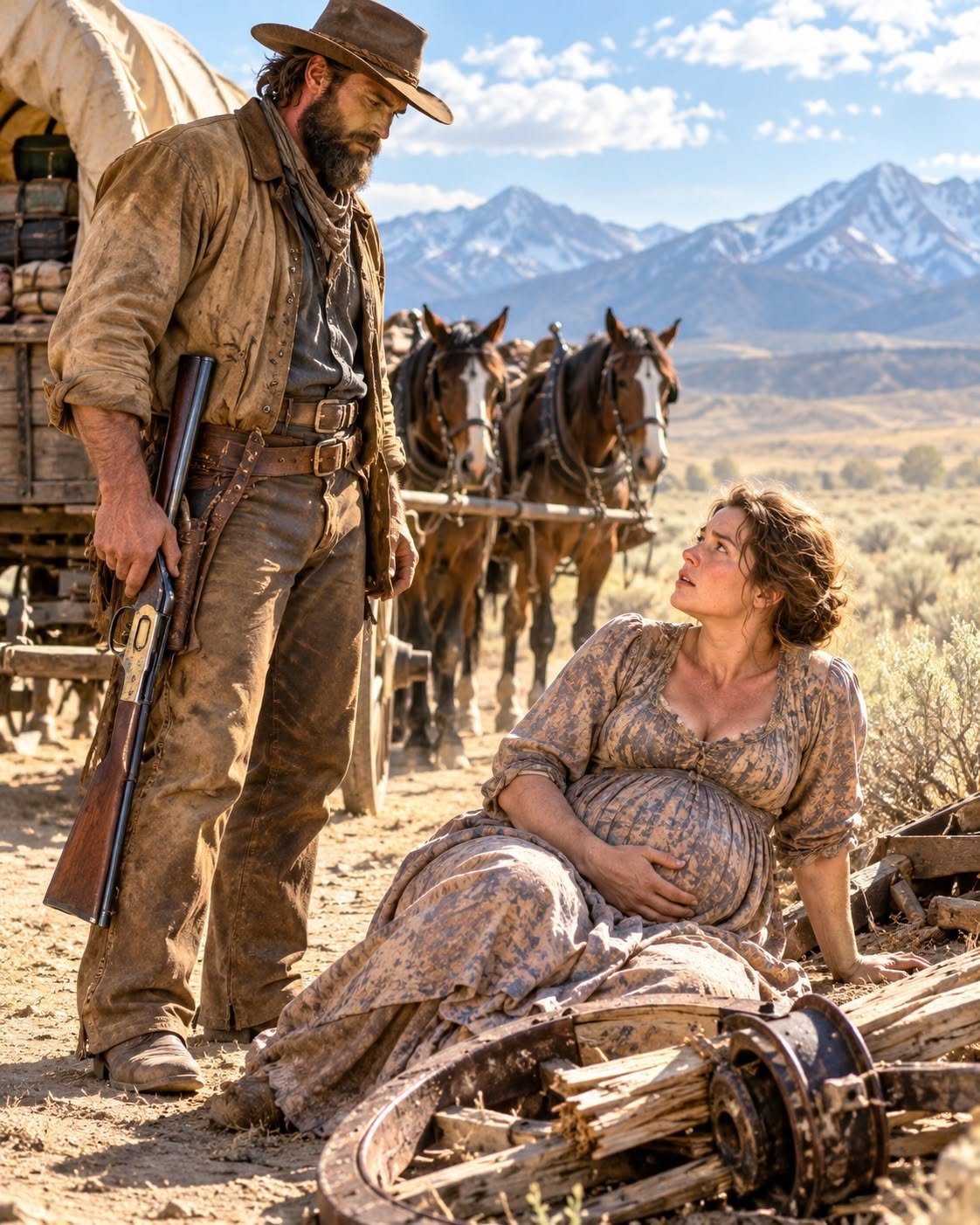
Under a Wyoming sun that seemed determined to burn the earth bare, Martha sat beside a shattered wagon wheel and accepted the quiet thought that she was going to die. The rear axle had twisted beyond repair, her husband Jeb lay buried a hundred miles back near the Platte River — cholera had taken him in two days — and she was seven months pregnant, with two exhausted mules, a nearly empty canteen, and a baby kicking fiercely beneath her ribs.
Martha was a broad, strong-built woman, the kind who had spent her life enduring hard work rather than expecting comfort. Jeb used to joke there was simply “more of her to love.” Now there was only more of her to hurt. Her faded calico dress was soaked with sweat and dust. Fort Laramie was days away on a good wagon, and she had no wagon at all.
Then the earth trembled under her boots. A cloud of dust grew along the trail until a massive freight wagon emerged, pulled by four powerful draft horses. A huge man climbed down — dust-covered canvas trousers, a hide shirt, a battered felt hat, a Henry rifle loose in one hand, a thick beard covering most of his face.
He did not go to Martha first. He went to the axle, kicked the twisted iron, and said, “Axle’s shot.” He checked the mules with a rough, knowing hand. Only then did he look at her — at her exhaustion, her swollen belly, her ruined journey — with no pity in his face. Only calculation. What was broken? What could still be saved?
“Was planning on sitting right here until the coyotes decide I look appetizing,” Martha told him, with the dry humor of a woman past fear.
The stranger shifted his rifle to his other hand. “Get in my wagon.”
“I didn’t ask for charity.”
“Ain’t charity,” he said, in a voice low and rough. “It’s math. You stay here, you die. I got room.”
For the first time since Jeb’s burial, Martha looked at someone who was not asking what she could offer in return. The mountain man was already unhitching her exhausted mules. He had not even told her his name. But sometimes survival does not arrive looking like a miracle. Sometimes it arrives as a silent stranger with a freight wagon and room enough for one more.
The Name He Finally Gave
He got her up into the wagon bed among the crates and flour sacks, spread his own bedroll for her, and drove on without another word. For the first mile Martha simply breathed — the air moving, the mules behind them, the wagon swaying under her like a promise that she did not have to die today.
When the sun dropped and he made camp, he handed her a tin cup of coffee and a biscuit, and finally said, “Amos. Amos Hartwell.” He said it the way a man hands over something he rarely gives.
“Martha Quinn,” she said. “My husband’s name was Jeb.”
Amos nodded once, as if that settled all the introductions the trail required, and went back to tending the horses. But over the next days, in the slow rhythm of the freight road, the silence between them began to fill. He told her he hauled goods between the railhead and the forts — flour, salt, nails, whiskey for the sutlers. She told him about Ohio, about the farm she and Jeb had sold, about the dream of Wyoming land that had carried them west and the cholera that had ended it.
He listened the way he did everything: completely, without interruption.
On the fourth night, sitting by the fire with her hands wrapped around a cup of broth, Martha asked the question she had been holding. “Why did you stop, Amos? Freighters pass broken wagons every day.”
He was quiet so long she thought he would not answer. Then he said, “Nine years ago, on the Oregon road, my wife went into labor two days from the nearest settlement. Nobody stopped. We lost her and the boy both.” He poked the fire. “I don’t pass broken wagons anymore.”
Martha looked at this massive, silent man and understood his math at last. It was not cold calculation. It was a debt he had been paying for nine years, one rescue at a time.
Born on the Trail
The baby decided not to wait for Fort Laramie. It came three nights later, in a sudden rainstorm, miles from anywhere — her water breaking in the wagon bed while thunder rolled across the sagebrush and Amos held a lantern in one hand and her hand in the other.
“You have done this before?” she gasped.
“Once,” he said grimly. “Didn’t go well. So this time it will.”
For hours he worked beside her — boiling water, tearing strips from his spare shirt, speaking to her in that low rough voice, steady as a rock in a river. When the baby finally came, wailing and furious, Amos caught him in those huge hands as gently as a man catching a falling bird.
“A boy,” he said, and his beard could not hide the grin. “Lungs like a mule skinner.”
Martha held her son against her chest, weeping and laughing, and when she could speak she said, “Jeb Amos Quinn. After his father — and after the man who gave him a road to be born on.”
Amos looked away quickly, but not before she saw the shine in his pale blue eyes.
Room Enough for One More — Forever
They reached Fort Laramie with the baby ten days old, and Amos did something Martha did not expect: he stayed. He sold his freight contract to a younger man, saying the road had given him back what it owed. He found work as a blacksmith’s partner in the fort town. He built Martha a small cabin with his own hands — a real floor, glass in the window, a cradle he carved from cottonwood.
The town talked, of course. A widow barely buried her husband, a rough freighter with no family to speak of. Martha heard the whispers and ignored them. She had learned on the trail that the world’s opinions weighed nothing against a man who shows up.
Little Jeb grew strong and loud, with his father’s dark hair and Amos’s stubborn chin. Amos was there for his first steps, his first tooth, his first winter cold — there the way a mountain is there, solid and certain. And slowly, the way spring thaws a frozen creek, Martha felt her heart begin to move again.
It was a year to the day after the broken axle when Amos asked her to walk with him out to the place on the trail where her old wagon had stood. The wheel ruts were long gone, washed away by wind and rain. He took her hand — rough, calloused, sure — and said, “Martha Quinn, I got room. In my cabin, in my life. Not charity. Math.” A smile touched his beard. “You and that boy are the best thing that ever happened to my arithmetic.”
She said yes before he finished, and laughed through her tears the way she had not laughed since Ohio.
They were married in the fort chapel that Sunday, with the blacksmith’s family and half the sutlers standing witness, and little Jeb asleep in a basket at the altar, snoring through the whole ceremony.
Years later, when travelers asked Amos Hartwell how a rough old freighter came to have such a fine family, he would give the same answer every time: “Stopped for a broken wagon.” And Martha would add, with the dry humor that had carried her across Wyoming, “He said it was math. Turned out it was love all along — he just needed a woman to show him the sum.”


