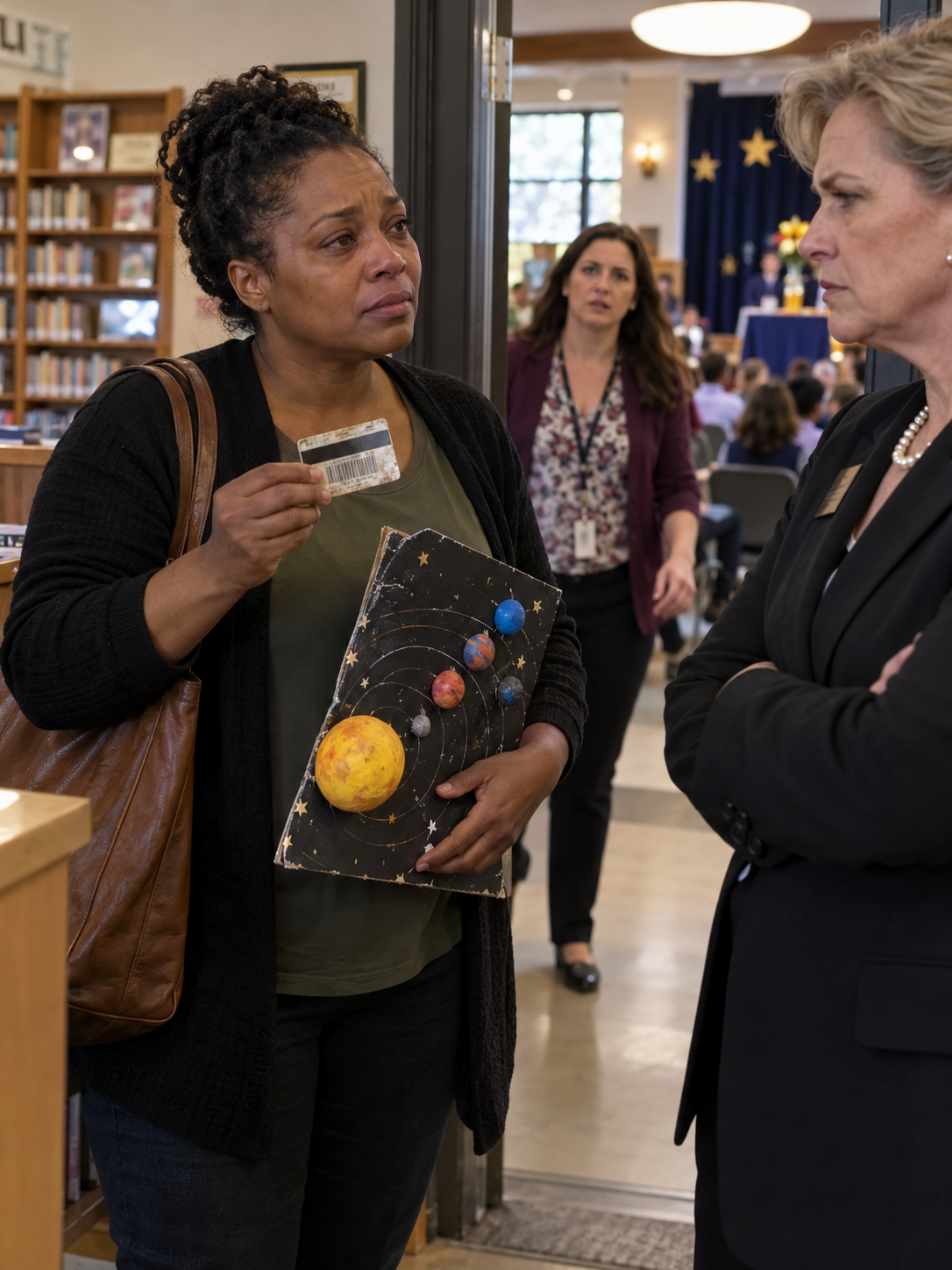
Monique Carter stood at the library doorway holding a model of the solar system her son had built from painted foam balls. A board member said only invited families could enter the scholarship ceremony. Monique held up her worn library card, then lowered it. Behind the woman, a teacher spotted the model and hurried toward them.
Her son, Avery, was seventeen and had earned a science scholarship. He had asked his mother to bring the project that started everything, the one they assembled at a kitchen table when he was nine. The invitation had been sent to his school email. Monique had copied the time onto a grocery receipt but forgotten to print the message.
The board member, Mrs. Harlan, said her list did not include Carter. Monique explained that Avery was already inside, likely rehearsing near the stage. Mrs. Harlan said students often brought extra guests and the room was at capacity. People arriving behind Monique presented their names and walked past her while she balanced the fragile model against her shoulder.
Monique had cleaned offices at night while Avery studied. The library had been their warm place during winter afternoons before she could afford to run the heater freely at home. She knew its shelves and its creaking front steps. Being stopped at the entrance to celebrate her own son felt stranger than any ordinary mistake with a guest list.
The teacher, Ms. Nguyen, recognized the blue planet with one side repainted after a childhood spill. “That’s Avery’s first project,” she said. Mrs. Harlan asked her to wait while another list was checked. Ms. Nguyen answered that Avery had invited his mother and that she would take responsibility for finding an appropriate place.
Monique did not want to force her way into a full room. She suggested leaving the model and watching from the hallway. Ms. Nguyen shook her head. Avery’s speech included a thank-you to the person who had found library books about space every week. A hallway would mean Monique could hear applause but not see his face.
Mrs. Harlan looked again at the list. One line read “M. Carter,” but it appeared under donors rather than family, and she assumed it was a different person. Monique had donated no money. She could not understand why her name would be there. Ms. Nguyen’s expression changed when she read the note beside the initials.
It said “Avery’s first science partner.” The phrase had been entered by Avery himself on the form for the ceremony. Mrs. Harlan had received a summary that stripped away the relationship column. Ms. Nguyen showed Monique the original form on her phone. Monique recognized her son’s way of calling the kitchen-table experiments their shared work.
Mrs. Harlan apologized and called for an extra chair. There was room along the side aisle, though the seating chart had marked it as reserved for equipment that had already been moved. The problem had never been a locked door or a full room. It was a condensed list and a decision made before anyone asked what the initials meant.
Monique carried the model inside. Avery saw it before he saw her face. He came off the stage steps, careful not to wrinkle his borrowed jacket, and took the base from her hands. He had thought the old project might make the ceremony feel less like something happening to a stranger in a suit.
During his speech, Avery described painting the planets with a kitchen sponge because they did not own proper brushes. He thanked Ms. Nguyen for lending him books and his mother for asking questions she did not always know the answers to. Monique remembered the nights she had fallen asleep while he explained gravity; she hoped he remembered the nights she stayed awake.
He held up the model, its planets uneven and its orbit lines crooked. It received louder applause than the polished displays by the stage. Monique laughed at that. The project had survived two moves, one leaky closet, and Avery’s early conviction that Pluto needed a much larger place in the solar system.
After the ceremony, Mrs. Harlan approached them both. She said the board would change its guest process to include students’ chosen relationships, not just names imported into categories. Monique thanked her for correcting the error. She did not pretend the wait at the doorway had been harmless simply because the ending was good.
Ms. Nguyen introduced Monique to the scholarship coordinator, who explained the summer orientation and housing paperwork. The practical information mattered more than the applause. Monique asked questions about travel costs and deadlines, and the coordinator wrote the answers down for both of them. Avery listened, realizing how much work came after a celebration.
On the ride home, the model occupied the back seat with a seat belt around its cardboard base. Avery told Monique he had listed her as his science partner because she was the one who made him curious. “I just brought the library books,” she said. He reminded her she had also turned a kitchen table into a place where asking questions was welcome.
The next week, Avery returned the model to the library for a small display. Monique insisted they add a note that the project was made when he was nine. She did not want another child to compare a beginner’s work to something polished and think curiosity had to look perfect from the start.
Mrs. Harlan stopped by the display. She asked Monique what books Avery had loved first, and Monique named three without hesitation. The conversation did not erase the day at the entrance. It showed that Mrs. Harlan was willing, at last, to learn more than a single letter and surname could tell her.
Avery left for college with a photograph of the model, not the fragile original. Monique kept the little planets on the library shelf for a season and visited them after work. She saw children point at the crooked orbit lines and ask how he made them. Staff kept glue and cardboard nearby for anyone who wanted to try.
The scholarship opened a door for Avery. The ceremony nearly closed one for his mother. What changed it was a teacher recognizing a handmade solar system and a student’s words on a form that should never have been shortened into an unexplained initial.
Monique saved the grocery receipt with the ceremony time written on it. Later she tucked it behind a photograph of Avery onstage, holding their old project. When she looked at the two papers together, she remembered the doorway, but she also remembered his first words when she finally walked inside: “You made it.”