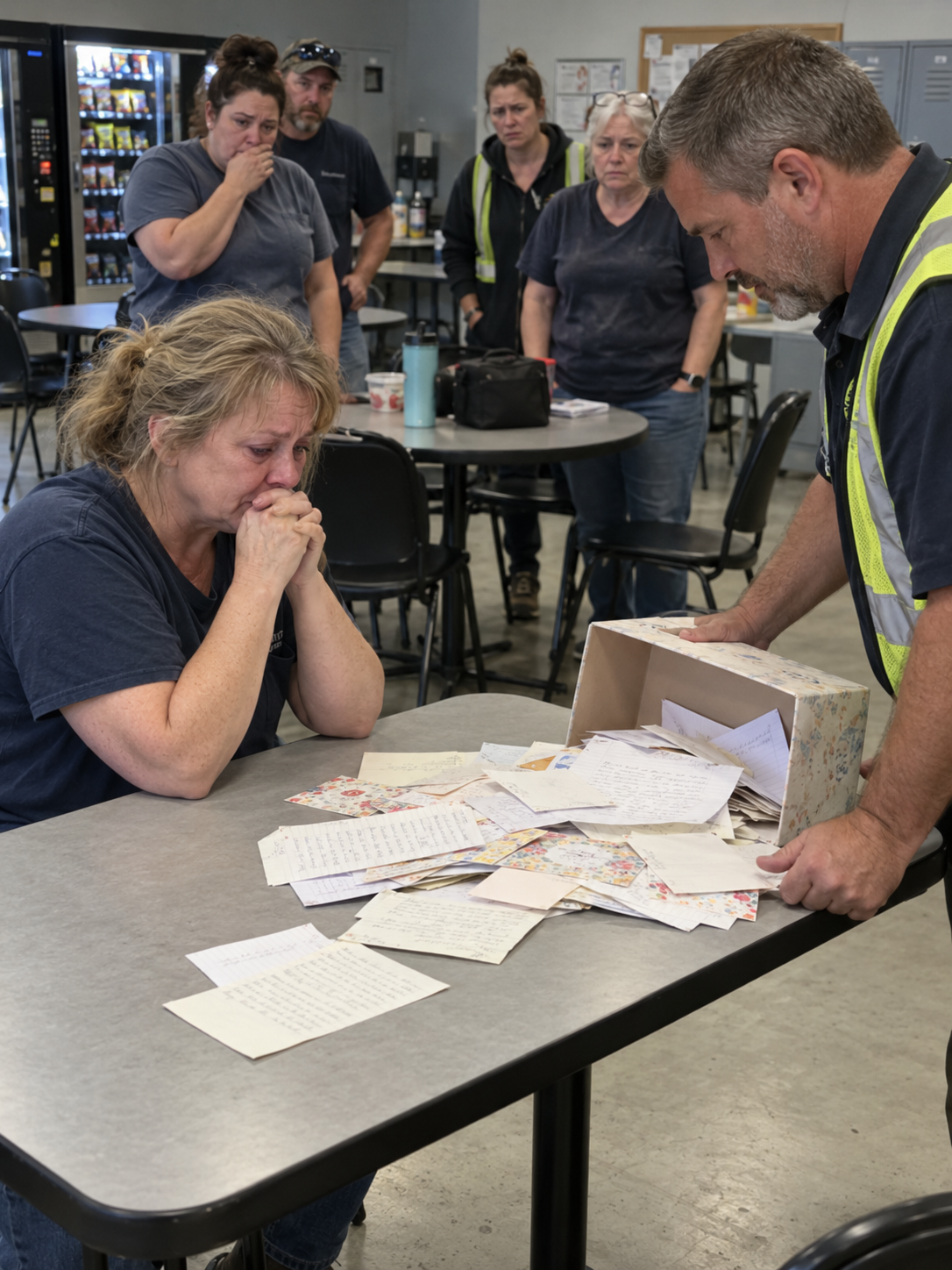
In the factory breakroom, a supervisor tipped a shoebox onto the table. Handwritten letters scattered around June Miller’s lunch. He said personal mail had no place near the production line. June, fifty-four, reached for the oldest envelope while four coworkers watched from the coffee machine, unsure whether they were allowed to intervene.
June had brought the letters to show one to a colleague whose son was leaving for military training. Her own father had written to her every Sunday during his years away from home. She kept the envelopes because his ordinary questions about school and dinner had become precious after he died. The shoebox stayed in her locker, not on the line.
That morning a safety inspection included lockers. Supervisor Grant found the box, said the locker needed clearing, and carried it into the breakroom. June asked him to let her put it in her car. He said personal clutter had to be documented. When he overturned the box, paper slid under the table and near the door.
June was angry, but she could barely speak. Some letters were held shut with yellowed tape. One had a pressed leaf inside and another bore a drawing she had made as a child. Grant treated them as an obstacle to efficient work. To her, each envelope held a voice she could no longer call.
Her coworker Ada knelt to pick up a letter before someone stepped on it. Grant told her to leave the items for inventory. Ada asked whether there was an actual rule against keeping mail in a locked personal compartment. He pointed to a safety notice about combustible material near machines. The locker room was on the opposite side of the building.
June said she would comply with any written policy and take the box home. Grant responded that she was refusing inspection. It sounded official enough to make the others hesitate. Ada kept holding the envelope by its edges. She had known June for eight years and had never seen her arrive late or leave a work station unsafe.
On the back of the envelope was a small sketch of a bird. Ada asked who drew it. June said her father had drawn one on every letter because she loved birds as a child. She had chosen the factory job years later partly because it let her stay near him during his illness. Grant stopped writing for a moment.
Then Ada noticed that the safety notice carried a date from five years before the lockers were installed. She asked the shift steward to bring the current handbook. June waited beside the table, holding the shoebox upright so no more papers would fall. The break bell ended, but nobody rushed to leave.
The steward, Leon, found the actual locker policy. It prohibited chemicals, open food, and items extending into the hallway. It did not prohibit paper keepsakes in a closed box. Grant had interpreted a rule for the production floor as if it applied to every object workers owned inside the building.
Leon asked Grant to write the alleged violation on a form. Grant could not cite a current section. He acknowledged that he had been trying to prepare for inspection, not punish June personally. June answered that the reason had not changed what he did in front of her coworkers. She wanted him to help gather the letters before anyone returned to work.
Grant did. Ada checked beneath the vending machine for a missing envelope while Leon counted the letters with June. One was not in the pile: the one with the pressed leaf. June found it under the chair where Grant had stood. The leaf had broken inside, but the letter was still readable.
The plant manager reviewed the incident that afternoon. She agreed the box was allowed in the locker and reminded supervisors that inspections did not authorize public displays of employees’ personal possessions. Grant received coaching and apologized directly to June. He offered to replace the box, but she wanted something sturdier than an object he could purchase.
She asked for the correction in writing, including that no safety violation had occurred. The manager provided it. June put the statement beside the letters at home. She did not expect a piece of paper to make her feel better immediately. She wanted a record that would outlast the embarrassment and protect anyone else whose locker was questioned.
Ada came by after work with a clear storage sleeve for the damaged letter. They read a few lines together. June’s father had written about a robin outside his window and asked whether she still watched the birds in the yard. Ada understood why the bird on the envelope mattered more than any expensive keepsake could.
The coworker with the son leaving for training finally saw the letter June had intended to share. It was about staying connected through ordinary details instead of trying to find perfect words. She went home and wrote her son about the weather, the dog, and a meal she planned to cook when he visited. June’s father’s advice found another household.
For a while, June left the shoebox at home. She did not want the breakroom incident repeated in a different form. Ada never pressed her to bring it back. They talked about their families over lunch and allowed the memory of the public spill to lose some of its power through smaller, kinder conversations.
Grant changed the inspection checklist. It now directed supervisors to discuss disputed items privately and verify the current rule before moving an employee’s property. June saw the updated form months later. She did not need Grant to become a hero. She needed the workplace to learn a precise lesson from what happened.
On the anniversary of her father’s birthday, June opened the box at home. She repaired the torn envelope and placed the broken leaf between two fresh sheets of paper. She read the letter aloud, hearing the rhythm of his voice in the ordinary sentences. The bird on the back still looked ready to take flight.
The factory continued to run on schedules, inspections, and rules. June respected the need for all three. She also knew a rule could be invoked carelessly by someone who had never asked what an object was or where it had been stored. That afternoon, Ada’s simple question made room for the truth.
June kept the letters. She sometimes brought a photocopy to share with a friend, leaving the originals safe at home. The image of papers scattering across a breakroom table stayed with her, but so did the sight of Ada kneeling to rescue one before it was lost under a stranger’s shoe.


