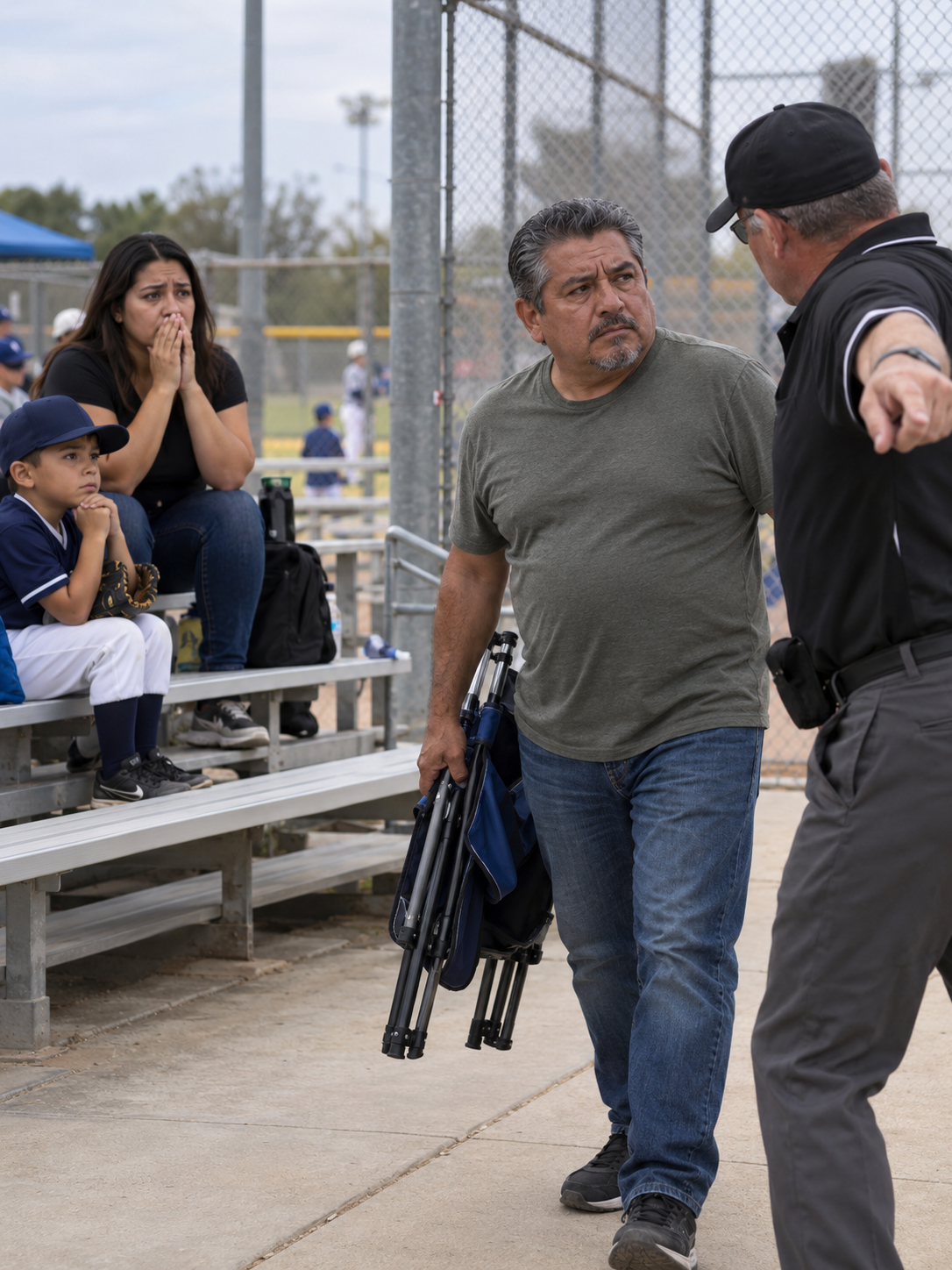
Luis Moreno carried a folding chair to the edge of the youth baseball field when an official told him to move beyond the fence. His grandson, Mateo, had already spotted him from the bench. Luis’s daughter Elena rose from the bleachers, unsure why a man who had attended every game was suddenly being asked to leave.
The official said only registered volunteers could stand near the players. Luis agreed and moved his chair toward the spectator area. Then the official said the folding chair was also blocking access. Luis folded it without arguing. He had brought it because standing for a full game made an old knee injury difficult to manage.
Elena had registered Luis as an approved family helper the previous season, but the team changed leagues over summer. She assumed the approval had carried over. The official was enforcing a real boundary, yet his impatient tone made it sound as if Luis himself were unwelcome. Mateo watched, fingers gripping the bench railing.
Luis asked where he could sit and still see the game. The official pointed across the parking lot, away from the bleachers already full of families. Elena said there were open spaces beside her. He replied that the chair was a trip hazard, then waved toward the lot again without checking the accessible path.
Mateo called, “Grandpa, did I do something wrong?” Luis shook his head. He had helped Mateo practice catching after school for months, tossing soft balls in a patch of grass behind the apartments. He wanted the boy to think about the game, not about a public disagreement over where someone with a bad knee could sit.
Elena asked the official for the site coordinator. He warned that delaying the game would affect every child. She said he could start on time while they found a safe seating spot. Her words were calm, though she was furious at the sight of her father holding a folded chair like contraband.
Another parent offered Luis a place on the bottom bleacher. He tried to climb the narrow step, then paused when his knee buckled. The parent reached to steady him. Across the field, Mateo stood halfway up. The official had assumed the bleachers solved the problem without seeing that Luis could not use them safely.
The site coordinator arrived with a laminated map. Elena noticed a shaded area marked for accessible spectator seating beside the first-base fence. No one had opened the side gate. The official looked at the map as if it had appeared overnight, although it had been attached to every field packet that season.
The coordinator unlocked the gate and measured enough clearance for Luis’s chair without blocking the walkway. She apologized for sending him toward the parking lot. The official said he had been worried about safety. Luis answered that safety included helping people use the area provided for them, not guessing where they belonged.
Mateo ran to the fence between innings. Luis held up two fingers to signal he had seen the boy’s last hit. Mateo asked again why the official had wanted him gone. Luis said there had been confusion about the rules and a gate that should have been open. He did not ask the child to carry adult anger onto the field.
Elena checked the volunteer records. Luis was not on the new league list, as the official had said. She completed the updated paperwork for future practices, but the seating issue was separate. A spectator did not need volunteer status to watch a grandson play from a designated area.
The official came over after the game. He apologized for mixing those two issues and for telling Luis to go to the parking lot. Luis accepted the words but asked that the side gate be open before the next game, whether or not he attended. The coordinator made a note and assigned that check to the field setup team.
The team lost by one run. Mateo still declared it his best afternoon because his grandfather had seen his double. He asked Luis to show him the two-finger sign again. Elena took a photograph of them at the fence, the folding chair visible but no longer the center of anyone’s attention.
At home, Luis admitted he had almost left rather than make a fuss. He worried the disagreement might embarrass Mateo. Elena told him the boy had learned something useful: adults can question an instruction respectfully, and the person holding a clipboard can be mistaken about what the clipboard says.
The next Saturday, the accessible gate was unlocked before the players arrived. Two other spectators used the shaded space, including a woman with a walker whom nobody had noticed struggling with the bleachers before. Luis said hello and moved his chair to leave room. The change helped people whose names had never appeared in the argument.
Mateo had a difficult game that day. He struck out twice and spent the car ride staring at his glove. Luis asked if he wanted to practice tomorrow. Mateo said yes, then added that he was glad his grandfather could sit close enough to hear him ask. Luis did not need a winning game to understand why the seat mattered.
Elena kept the field map in her phone. She was grateful the coordinator had responded, but she did not want to depend on catching the same problem every season. The league added the gate to a pregame checklist. It was an unglamorous line, easy to miss until someone needed it.
The official became more careful when addressing families. He still protected the player area, and Luis respected that. The difference was the question he began to ask before pointing anyone away: what did they need, and was there a safe place already planned for it? Most conflicts eased when he took ten seconds to ask.
At the final game, Mateo handed Luis the ball from his first clean catch. Luis put it beside the old glove they used for practice. The memory of being sent toward the parking lot remained, but it no longer defined the field. It was now also the place where the gate had opened.
Years later, Mateo would remember his grandfather in a folding chair near first base, waving two fingers whenever he looked up. He might forget the official’s words. Luis hoped he would remember the larger lesson: a rule should protect people without making someone feel they have to disappear to comply with it.


