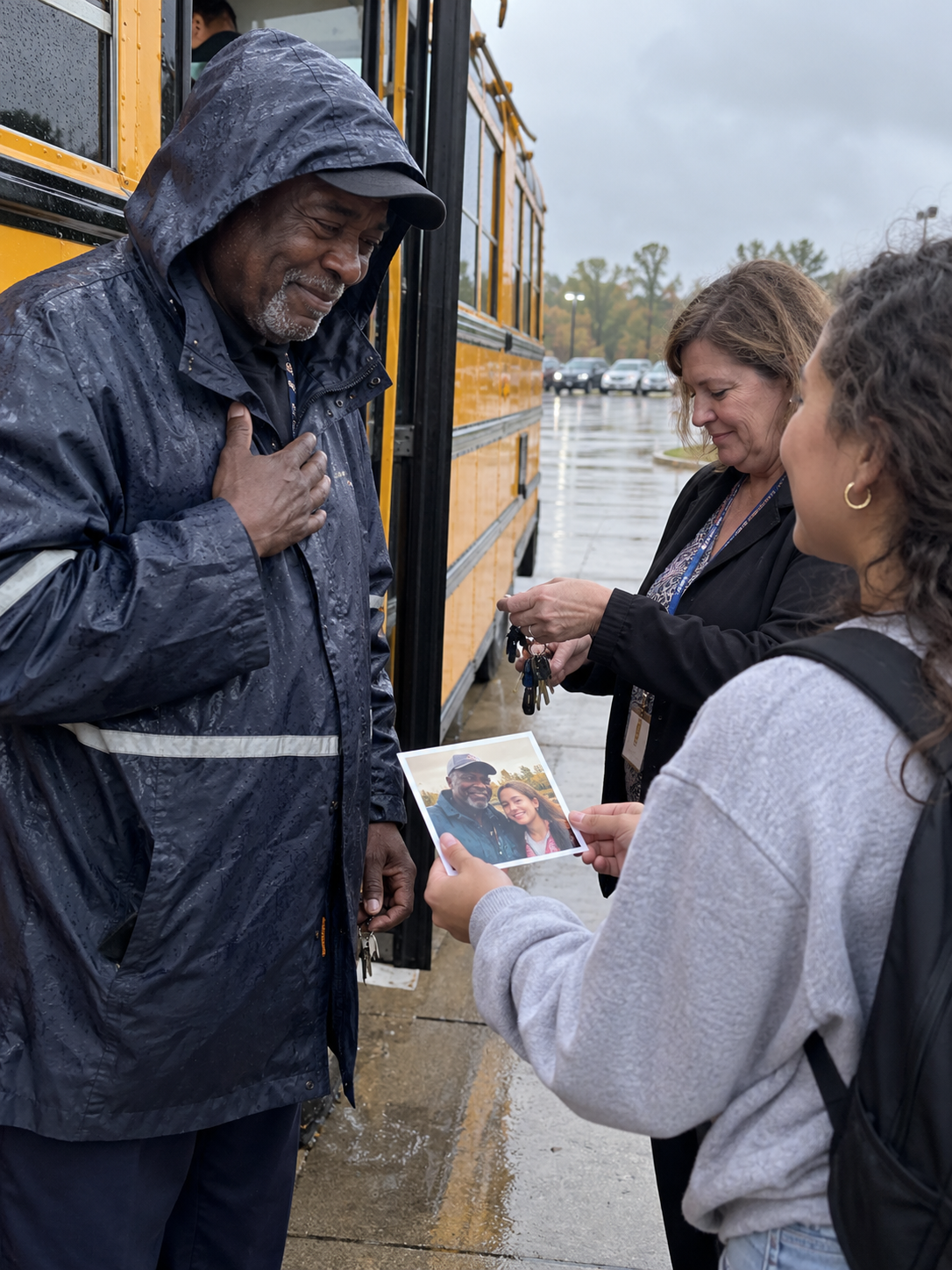
In the rain outside the elementary school, supervisor Karen Pike held out her hand for Harold Reed’s bus keys. He had driven the same yellow route for twenty-seven years. Parents waiting near the curb saw the exchange, but only one young woman stepped from the shelter with a photograph she had carried there on purpose.
Harold was accused of abandoning a stop. A parent had called after a child stood outside for nearly forty minutes the previous afternoon. He understood the anger. He had a grandchild that age. But the stop listed in the complaint had been moved during roadwork, and Harold had followed the temporary route the transportation office supplied.
Karen said the district would review everything later. For now, she needed the keys. Harold asked her to check the dispatch messages sent to drivers at 6:12 that morning. She said a formal investigation had already begun. The parents heard enough to assume he had left a child behind, and the rumor moved faster than the rain.
The former student, Alicia, had come to speak at a school assembly. In the photograph she held, she was nine, smiling through two missing front teeth beside Harold’s bus. She remembered him waiting in a snowstorm when her mother’s car would not start. Seeing him surrender the keys on a sidewalk felt painfully unlike the man she knew.
Harold did not ask Alicia to defend him. “Let them check,” he said. He was more worried about the child who had waited at the wrong stop. The temporary notice should have reached every family, and clearly it had not. He wanted to know where the communication had broken before another morning began.
Karen repeated that he was off duty pending review. A substitute driver climbed into the bus while Harold stood in his raincoat holding an empty key ring. Someone photographed the exchange. Harold imagined the image circulating without the map, the road closure, or the phone calls he had made to dispatch that morning.
Alicia stepped beside him and asked for the date of the route change. He gave it to her, then asked her not to argue with parents. She agreed. Instead, she went inside to find the assembly coordinator, who also kept the school’s message archive. An ordinary email, she thought, might matter more than an argument in the parking lot.
The coordinator found the temporary route map. At the bottom was a distribution list. The child’s family had joined the district after the list was exported, and no one had added them. Alicia stared at the missing address. The child had waited; the driver had gone where he was told. Both things could be true.
Karen was called inside. The dispatch log showed Harold had asked twice whether all families had received notice. The response said the school office had confirmed the list. He had also reported seeing nobody at the closed stop, which he was not permitted to enter because construction barriers blocked the lane.
The child’s mother arrived while they were reviewing the messages. Harold faced her first. “Your son should not have been left waiting,” he said. She answered that he had come home cold and frightened. She wanted someone to take responsibility, not a technical explanation that made the child’s experience disappear.
The coordinator showed her the missing address. Karen explained that the district had failed to update its contact list and that Harold had followed instructions. The mother looked from the map to Harold’s wet coat. Her anger did not vanish, but it shifted toward the part of the system that had actually failed her son.
Karen returned the keys in a private office. Harold declined. “You took them where everyone could see,” he said. “The correction needs to be where people can hear it.” He did not ask for a ceremony. He asked the district to tell families why the stop had been missed and what it would change before tomorrow.
That afternoon, the school sent a clear notice. It acknowledged the outdated contact list, gave the safe temporary stop, and said Harold had driven the approved route. The district called the family separately and arranged a staff member at the new stop for the rest of the roadwork. The correction arrived later than it should have, but it arrived.
Alicia returned to the parking lot as the rain eased. She finally showed Harold the photograph. He remembered her, though not the missing teeth. He remembered that her mother worked nights and sometimes hurried to the curb in slippers. Alicia laughed, then told him she had become a teacher partly because adults like him noticed when children needed patience.
Harold accepted the keys from Karen outside the bus, in view of the same parents who had witnessed him lose them. Karen apologized for making the investigation look like a verdict. She did not excuse the missed notice. She promised a review of every family on the temporary route, and Harold asked for the results in writing.
The next morning, the child stood with his mother at the marked stop. Harold opened the door and greeted him by name. The boy hesitated, then climbed aboard. Harold did not ask him to forget the long wait. He showed him the route sheet and told him which adult to call if anything ever seemed wrong again.
At the school assembly, Alicia spoke about the adults who had helped her when she was young. She did not turn Harold’s ordeal into a speech about heroes. She said that good systems require good people and that good people still deserve a fair process. Harold listened from the back, damp cap resting on his knee.
For weeks afterward, parents asked whether the route notices were current. The district began checking new enrollments against transportation lists daily. It was a small administrative repair, the kind that rarely earns a photograph. For the child who had waited at a stop no bus would reach, it mattered much more than the public argument.
Harold kept Alicia’s photograph in the bus visor for a while, then took it home so the sun would not fade it. His wife put it near family pictures. He sometimes thought of the empty key ring in his palm and the ease with which an incomplete story had made him look guilty.
On clear mornings, the route felt ordinary again: backpacks, sleepy greetings, the squeak of the door. Harold still checked the updated roster before leaving the lot. Alicia’s photograph reminded him that children remember who shows up for them. The day in the rain reminded the district that showing up begins with telling families where to stand.