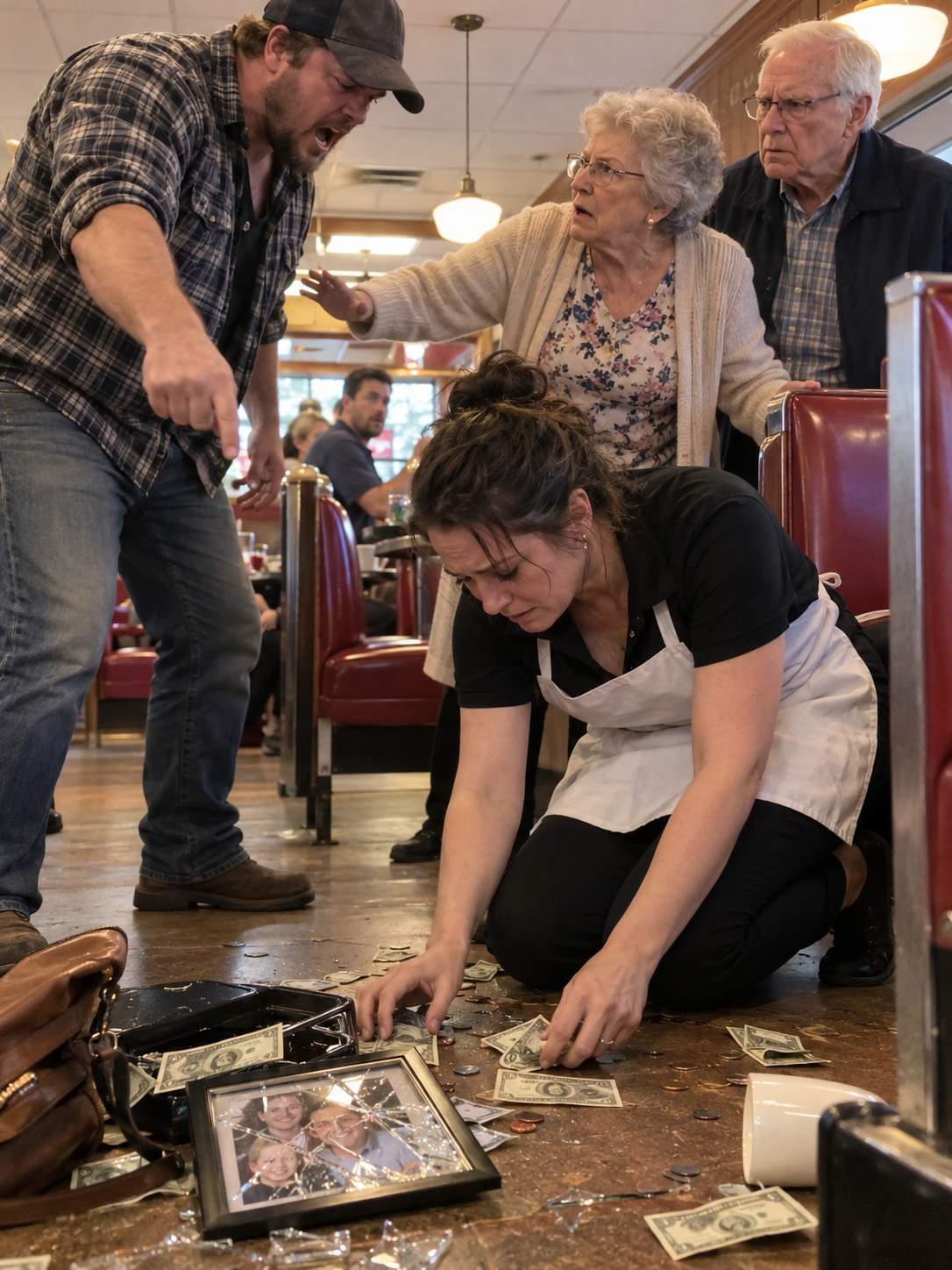
The customer swept a stack of bills off the diner counter, sending tips across the tile. When server Mara Ellis bent to retrieve them, her old framed photograph slipped from her apron pocket and struck the floor. An elderly couple in the next booth stood up before anyone at the counter offered to help.
Mara had worked breakfast shifts since her husband died two years earlier. The photograph showed him with their two daughters at the county fair, each holding a paper cup of lemonade. She carried it on difficult mornings, not because it made the work easier but because it reminded her why she still got up before sunrise.
The customer had complained that his eggs were cold. Mara offered to replace the plate, then brought a fresh one from the kitchen. He insisted she had charged him twice, though the receipt showed a voided first order. When she asked him to look at the final total, he shoved the tip jar with the back of his hand.
“Count it now,” he said, pointing to the scattered bills. The cook appeared in the kitchen doorway. Mara could feel everyone watching while she knelt beside the booth. A cracked corner of the frame cut a shallow line across her thumb. She wrapped it in a napkin and reached for the photograph before it could be stepped on.
The elderly woman, June, bent to help, despite Mara’s embarrassed protest. June’s husband, Walter, stood between the customer and the money without touching him. “You had a complaint about breakfast,” he said. “That doesn’t give you the right to do this.” The customer demanded to speak to the owner.
Mara wanted to disappear into the kitchen. She had rent due Friday, and she knew that customers sometimes complained loudest when they believed workers could not answer back. June placed the photograph face up on a clean table, far from the glass. Something about the younger girl’s smile made her pause.
“Who is this?” June asked softly. Mara explained only that it was her family. She did not tell the room how often her eldest daughter had offered to quit her training program to help pay bills. She had promised the girl she could finish. The tips on the floor had already been divided in Mara’s mind into groceries and bus fare.
Then Walter looked at the photograph and said a name Mara had not heard from a stranger in years: “Daniel Ellis?” She turned. He pointed to her husband’s face, almost hidden behind the girls. “I knew him,” Walter said. The customer was still complaining, but for a moment the noise seemed far away.
Walter had been trapped in a car after an icy-road collision a decade earlier. Daniel, driving behind him, had stopped, called for help, and stayed until firefighters arrived. Walter had never learned where the man lived. He had written a thank-you letter to the county office, hoping someone could forward it, but the letter had come back unopened.
Mara remembered the accident. Daniel arrived home with a torn coat and said a man had needed help. He never told the children that he had spent hours in the cold. Walter described him holding the door steady and talking about baseball until the rescue crew got there. Mara touched the cracked frame as if it might answer.
The diner owner came from the kitchen and asked the customer to leave after reviewing the receipt and hearing the witnesses. The second charge had been voided; the total on the bill was correct. Mara did not ask for an apology from the man who scattered her tips. She wanted the money counted, and she wanted him away from her workplace.
June and another customer collected every bill they could see. The owner checked beneath the neighboring booths, then replaced the broken frame from the diner’s small office supply cabinet. He also wrote down the incident and told Mara she could take a paid break. She sat in the back room with her thumb bandaged and the photograph in her lap.
Walter asked whether he could speak with her again after her shift. He returned at noon with the old letter, folded inside an envelope marked with a return stamp. It described Daniel’s calm voice and the odd comfort of hearing someone argue about a baseball game while the windshield filled with snow.
Mara read it once, then again more slowly. Daniel had died before hearing how much his choice had mattered to Walter. She asked permission to show the letter to her daughters. Walter said it had always been meant for their family. He had kept it because throwing it away felt like abandoning a debt he could not repay.
Her eldest daughter called that evening. Mara told her about the breakfast rush, the scattered tips, and the stranger who had known her father. She tried to leave out the worst part, but her daughter heard it anyway. “Mom, you don’t have to carry every hard thing alone,” she said. Mara promised to think about that.
The diner owner changed a few things too. He mounted the tip jar where it could not be knocked down so easily and told staff to call him when a customer tried to intimidate them. Those changes did not erase the humiliation. They made it less likely that the next server would have to handle it while on her knees.
June began stopping in on Wednesdays. She ordered tea and a slice of toast, then asked Mara how the girls were doing. Their friendship grew out of an ugly morning, but it did not stay trapped there. Sometimes they talked about Daniel. More often they talked about ordinary plans, which Mara had missed sharing with another adult.
On the anniversary of Daniel’s death, Mara brought the letter home and read it with her daughters at the kitchen table. The younger one remembered almost nothing about the county fair except the sticky lemonade. She asked Mara to tell the story of the photograph again, and then the story of the snowy road.
Mara kept working at the diner. She put the photograph behind the register where it would be safe, and the owner added a small hook for the frame. It no longer had to live against her heart in an apron pocket to stay close. On busy mornings she could glance up and see all three faces smiling back.
The customer’s words eventually faded. The sound of tips striking the tile did not disappear entirely, but it was joined by another memory: an old man recognizing Daniel in a photograph. That morning had exposed how easily a worker could be humiliated. It had also delivered a thank-you her family had been waiting ten years to hear.


