My son’s name disappeared from the honors program twelve minutes before the ceremony began.
Jamal stood beside me in the school hallway wearing the navy tie his grandfather had taught him to knot. He had earned the highest mathematics score in the district, but a staff member quietly removed the gold cord from his shoulders.
“There has been a verification issue,” she said.
Jamal looked at me, not angry yet—only embarrassed.
For months, he had woken at five to study before basketball practice. He tutored younger students after school and worked weekends at his uncle’s grocery store.
His achievement was not an accident.
“What issue?” I asked.
The assistant principal, Mr. Dalton, approached with a printed spreadsheet. “The final list shows another student as the district winner. Jamal can still sit with his class.”
“But not walk across the honors stage?”
He lowered his voice. “Please don’t disrupt the ceremony.”
That request felt familiar. Stay calm. Stay quiet. Do not make other people uncomfortable while your child is being diminished.
Jamal touched my arm. “Mom, it’s okay.”
It was not.
Before I could respond, his math teacher, Ms. Elena Ruiz, hurried down the hallway carrying a sealed brown envelope.
“Nobody starts without this,” she said.
Mr. Dalton frowned. “The district already sent the corrected list.”
“No,” she replied. “Someone sent an altered list.”
Inside the envelope were the original score certification, the testing center’s timestamped report, and an email chain showing that Jamal’s student identification number had been replaced after results were finalized.
The student placed above him was the superintendent’s nephew.
Mr. Dalton stopped speaking.
Parents were entering the auditorium. Music had begun. The superintendent stood near the stage greeting donors.
Ms. Ruiz handed me the documents. “I found the discrepancy yesterday. When I asked questions, I was told it had already been handled.”
Jamal stared at the floor.
“Do you still want to walk?” I asked him.
He looked toward the auditorium doors. “I want them to say what happened.”
We entered together.
The ceremony began seven minutes late. The superintendent stepped to the microphone and announced a “clerical correction.”
Ms. Ruiz stood from the front row.
“It was not a clerical error,” she said clearly.
The room became silent.
She did not accuse the other student. She explained that an adult had changed a verified record and that both children deserved the truth.
Then she asked the district testing coordinator, who was watching online, to confirm the original result.
Jamal’s name appeared on the screen.
The applause began with the students. Then parents stood. Finally, even the officials on stage rose.
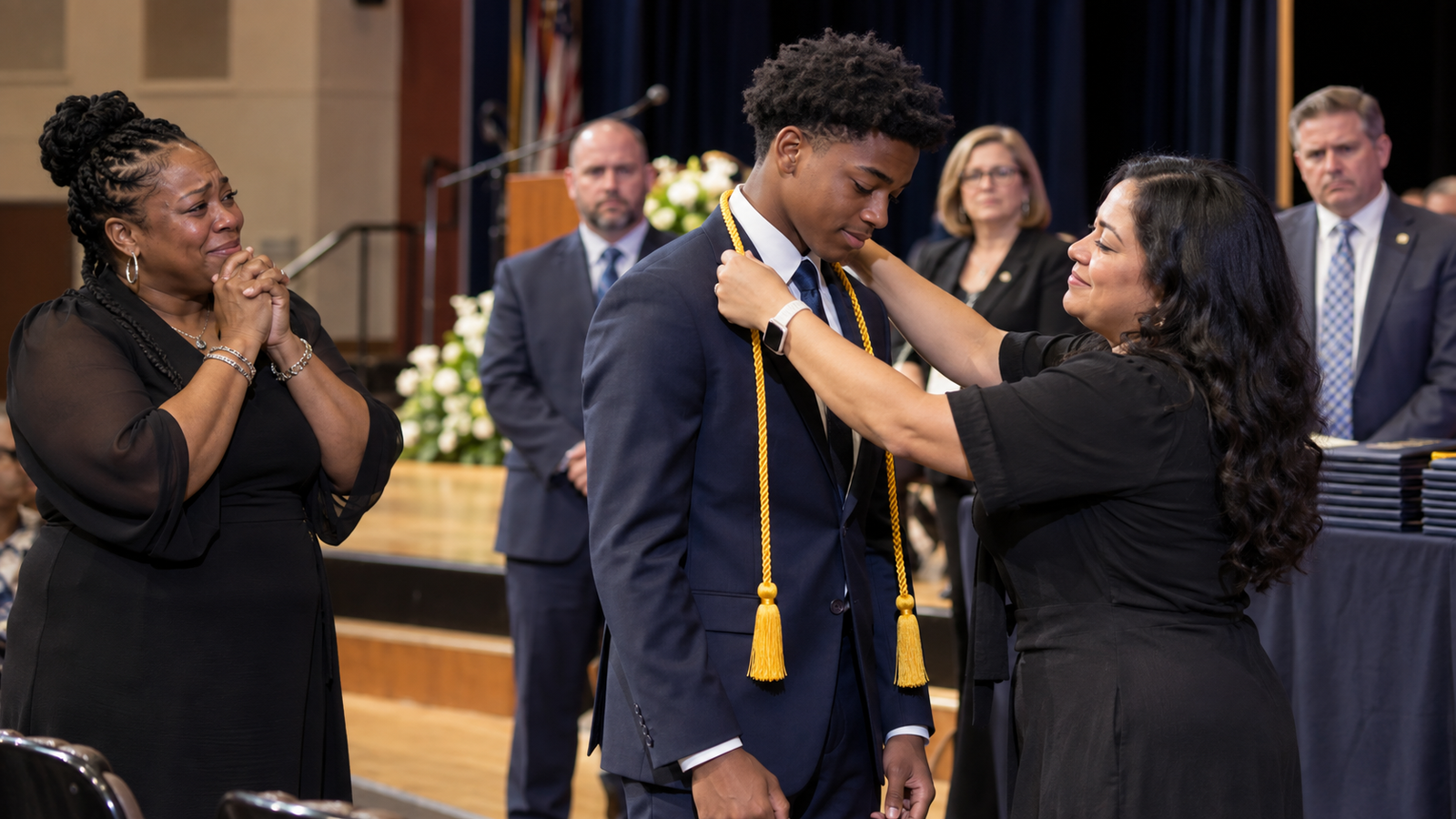
Jamal walked across slowly. Ms. Ruiz placed the gold cord over his shoulders herself.
But the story did not end with applause.
Our family filed a formal complaint. An independent review confirmed the alteration. The superintendent resigned, and the district created a rule requiring two-person verification for award changes.
The other student visited our home a week later with his mother. He had not known what his uncle had done.
“I’m sorry,” he told Jamal.
Jamal surprised all of us by inviting him inside. They spent an hour comparing robotics designs at the kitchen table.
“He didn’t change the score,” Jamal told me afterward. “An adult did.”
That maturity made me prouder than the medal.
At graduation, Jamal was asked to speak. He could have used the moment to shame the people who failed him.
Instead, he spoke about records, fairness, and the teachers who refuse to look away.
“Achievement does not become real when somebody in power recognizes it,” he said. “It was real when the work was done.”
Ms. Ruiz cried in the front row.
Years later, the gold cord still hangs above Jamal’s desk at engineering school. Beside it is a copy of the original score report.
Not because he needs proof of his intelligence.
Because every young person deserves adults who protect the truth before a child is forced to defend it alone.


