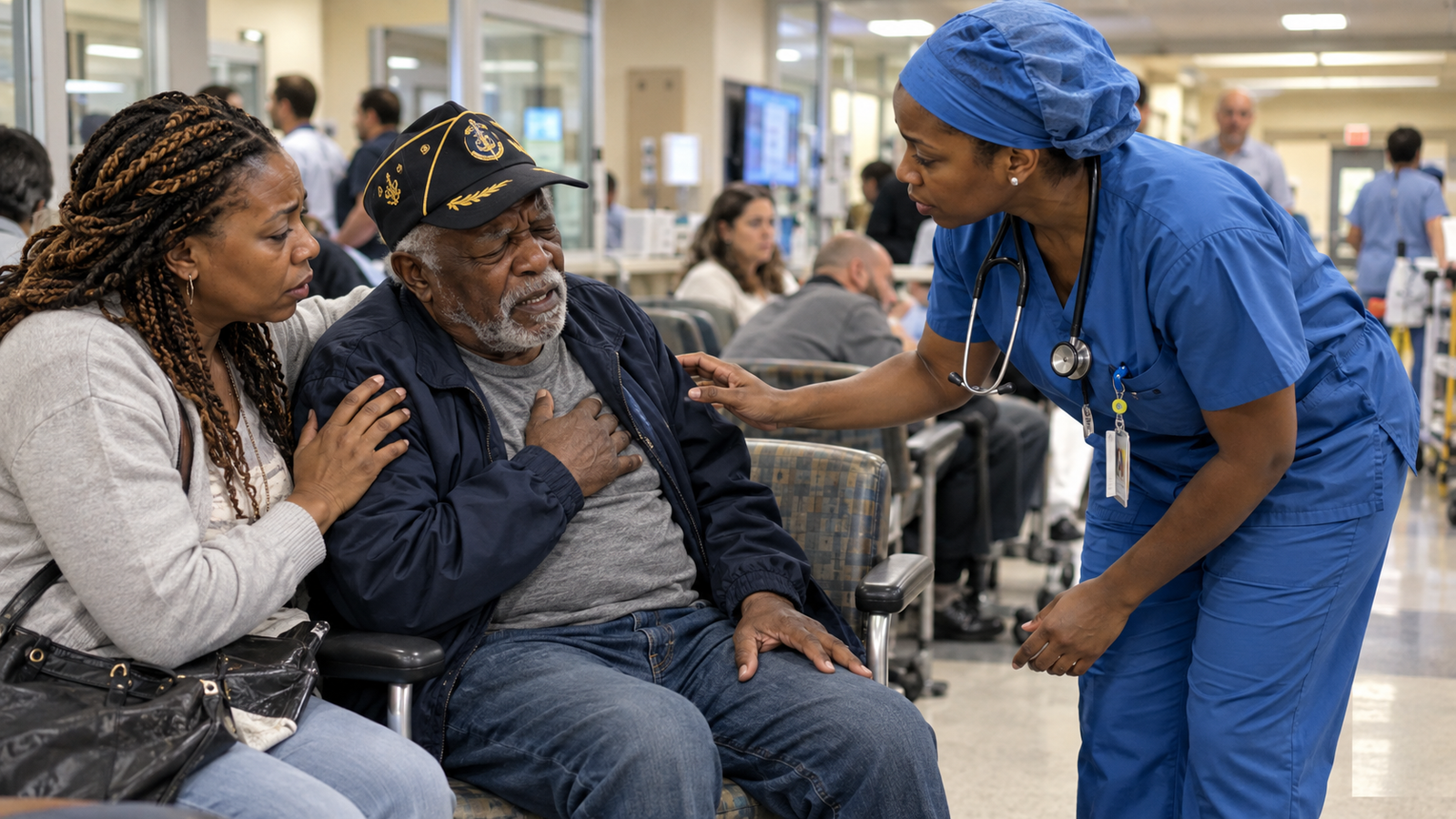
My father had been sitting beneath the emergency room television for nearly four hours when the clerk pushed his papers back across the counter.
“You’ll have to wait like everyone else,” she said, loud enough for the crowded lobby to hear.
Dad pressed one hand against his chest. With the other, he carefully gathered the forms.
“I understand,” he replied.
I did not.
My father, Isaiah Brooks, was seventy-three and rarely complained. He had worked forty years as a city bus mechanic, buried my mother, survived prostate cancer, and still cut the grass for three elderly neighbors every Saturday.
If he admitted he was in pain, something was wrong.
I returned to the desk. “His chest pressure is worse. Can someone check him again?”
The clerk barely looked up. “A nurse already evaluated him.”
“That was hours ago.”
She pointed toward the chairs. “Please sit down.”
Dad touched my elbow. “Keisha, don’t make trouble.”
That sentence made my anger sharper. He had spent his whole life making himself smaller so other people would not call his dignity aggression.
Then a woman in blue surgical scrubs crossed the lobby, stopped, and stared at him.
“Mr. Brooks?” she said.
Dad looked up slowly.
The woman removed her mask. She was perhaps forty-five, with tired eyes and a silver stethoscope looped around her neck.
“It’s Dr. Lena Carter,” she said. “From Jefferson High.”
My father studied her face. Then he smiled. “Little Lena with the red backpack.”
The surgeon’s eyes filled immediately.
Twenty-eight years earlier, Lena had been a teenager riding the number 14 bus after school. One freezing evening, the driver reported engine trouble near the maintenance depot. My father found Lena crying alone at the stop after the other passengers left.
She had been accepted into a summer science program, but her mother could not afford the registration fee. The deadline was the next morning.
Dad drove her home in his rusted pickup. Before she got out, he handed her an envelope containing the overtime money he had been saving for a new refrigerator.
“Science can buy me another refrigerator someday,” he told her. “A refrigerator cannot become a doctor.”
He never told our family.
Dr. Carter turned toward the clerk. “How long has he been waiting?”
The answer changed the entire room.
Within minutes, nurses moved Dad onto a stretcher. Tests showed a dangerous blockage. Dr. Carter called the cardiology team herself and stayed until he was taken upstairs.
Before the procedure, Dad apologized for causing everyone trouble.
Dr. Carter leaned close. “You caused no trouble. You gave me my future. Let me help protect yours.”
The surgery lasted ninety minutes. I spent every one of them remembering how many quiet kindnesses my father might have carried without ever mentioning them.
Dr. Carter emerged just after midnight. “We caught it in time,” she said.
I began crying before she finished the sentence.
Dad recovered slowly. On his third day, a group of people gathered outside his room: a firefighter, two teachers, a postal worker, a city councilwoman, and a dozen former students from Jefferson High.
Dr. Carter had shared his name in an alumni group—not his medical details, only that the man who once helped students needed encouragement.
One by one, they told us what he had done.
He had repaired a teacher’s car for free after her husband died. He had purchased work boots for a student’s first job. He had spent lunch breaks helping teenagers complete trade-school applications.
Dad looked embarrassed by every story.
“I just did what people are supposed to do,” he said.
The hospital administrator visited that afternoon and apologized for the delay. The clerk also came to the doorway, struggling to meet his eyes.
Dad did not humiliate her. He simply said, “The next quiet person may not have a doctor who recognizes him. Please listen before someone has to prove he matters.”
Those words changed more than an apology could.
The hospital later revised its chest-pain reassessment procedure. Dr. Carter created an emergency scholarship in Dad’s name for students entering health care.
At the first ceremony, Dad sat in the front row wearing the navy suit he had worn to my wedding.
The recipient was a shy young man whose mother drove a city bus. When Dad handed him the award, the boy whispered, “I won’t waste this.”
Dad smiled. “Kindness is never wasted. It just takes the long road home.”
That night, as I drove him back to his house, he asked whether I thought anyone would remember the ceremony.
I told him the truth.
They were not remembering a ceremony. They were remembering a man who had spent decades seeing people before the world decided they were important.


