My mother called on a Tuesday morning and said the bank was taking her house.
Not might take it. Not had sent another warning. She said a man had taped a final notice to the front door while she watched from behind the curtain.
“Nia,” she whispered, “I need you to come home.”
I had not slept in that house for twenty years. Still, by sunset I was driving south from Chicago toward the narrow brick place in Gary, Indiana, where my mother had raised my younger brother and me.
The porch light flickered exactly as it had when I was seventeen. The hydrangeas were gone. The brass numbers my father installed before he died hung crooked beside the door.
My mother, Loretta, looked smaller than I remembered. She hugged me quickly, then began explaining missed payments, rising taxes, and a loan she had taken to help my brother start a business that never opened.
I listened without interrupting. Numbers were easier for me than memories. I had spent fifteen years helping families restructure debt through a nonprofit housing organization. Saving homes was what I did.
But saving this home meant opening every drawer my mother had spent years keeping closed.
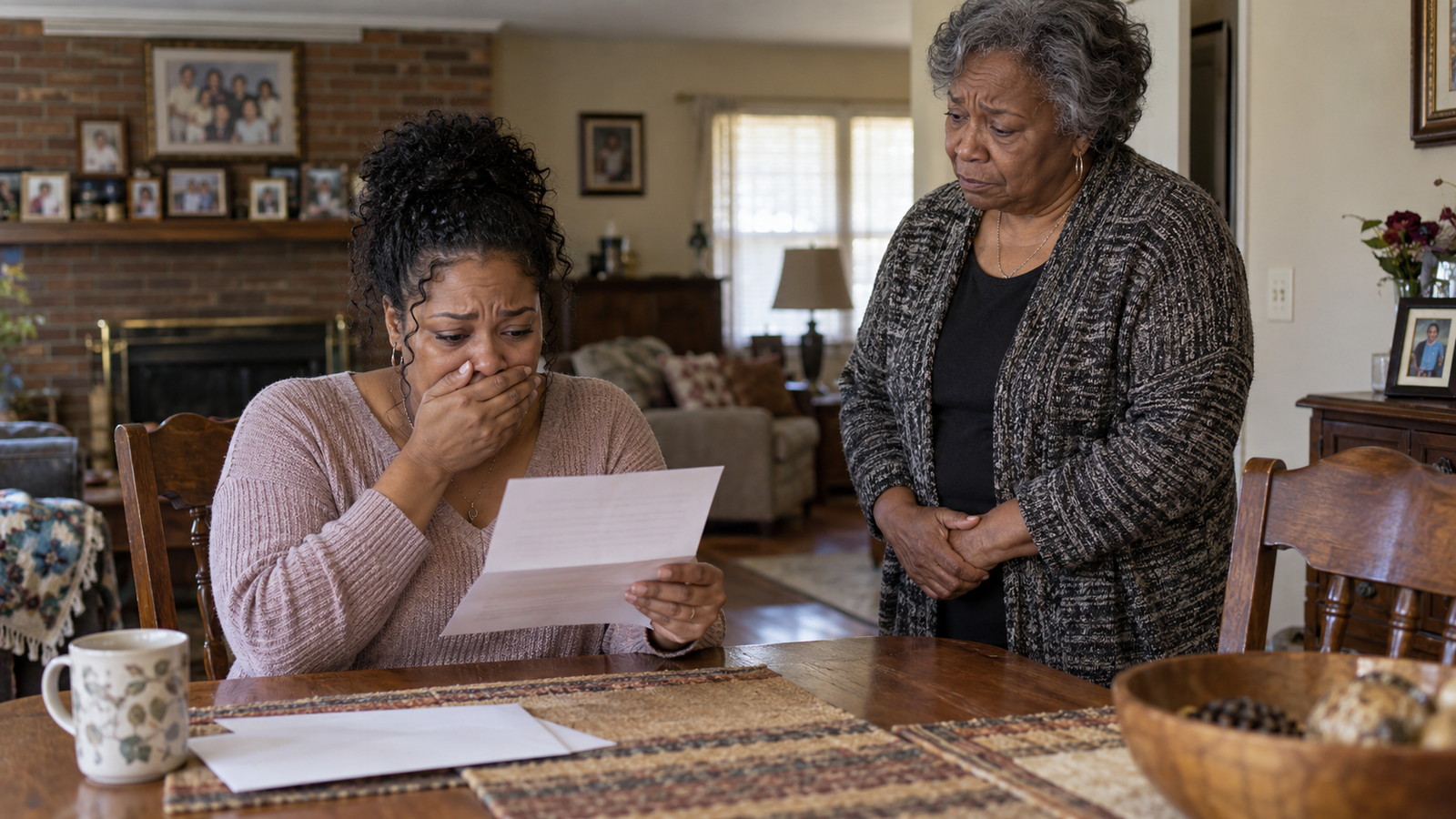
The next morning, I carried three cardboard boxes from the hall closet to the dining table. Bank statements filled the first two. The third held old tax documents, my father’s union papers, and a cracked blue folder marked NIA—SCHOOL.
My mother reached for it too quickly.
“That’s nothing,” she said.
I opened it anyway.
Inside were report cards, scholarship applications, and an envelope from Northwestern University dated March 2005. It had already been opened.
My hands began to shake before I pulled out the letter.
Congratulations, it began.
I read the first paragraph twice. Then a third time.
I had been accepted with a scholarship covering tuition, housing, and books.
At seventeen, I had waited beside the mailbox every afternoon. When no answer came, my mother told me the university had probably chosen students from “better schools.” I enrolled at the local community college, worked nights, and spent years believing I had not been good enough.
Now the proof sat in my hands.
“Why?” I asked.
My mother stared at the table. “Your father had just died. Your brother was twelve. I couldn’t lose you too.”
“So you decided for me.”
“I was scared.”
“You let me think I failed.”
Her eyes filled, but I could not comfort her. For twenty years I had blamed myself for a rejection that never existed.
I walked outside and sat on the porch steps until the sky turned purple. I remembered every extra shift, every bus ride to evening classes, every time I had introduced myself as someone who had “almost gone away to college.”
My brother Marcus arrived after dark. When he saw the letter, his face changed.
“You knew?” I asked.
He nodded once. “I found it when I was sixteen. Mom made me promise not to tell.”
That confession hurt differently. My whole family had protected the decision that changed my life, and they had called their silence love.
I packed my suitcase before midnight.
At the door, my mother did not ask me to stay. She simply said, “I understand if you never come back.”
I drove three blocks before stopping.
The foreclosure notice was still photographed on my phone. The sale date was eleven days away. If I left, the bank would take the only home my father had ever owned.
I returned, not because the past was repaired, but because I refused to let another frightened decision define our family.
For the next week, I worked at the dining table where I had once completed scholarship essays. We challenged improper fees, negotiated a repayment plan, and documented my brother’s agreement to repay the money he had borrowed.
On the ninth day, the bank approved the modification. My mother could stay.
She cried when I told her. I did not say everything was forgiven. It wasn’t.
Instead, I placed the acceptance letter in a new frame and set it in the center of the mantel.
“This stays here,” I said.
My mother nodded. “It should have always been there.”
Six months later, she attended a ceremony at my nonprofit. I was receiving an award for helping one thousand families remain in their homes.
When my name was called, my mother stood before anyone else did.
Afterward, she handed me a small envelope. Inside was a check marked EDUCATION FUND and a note written in her careful handwriting.
I cannot return the choice I stole from you. I can only help another girl keep hers.
We used the money to establish a scholarship for Black high school seniors whose families were facing housing insecurity.
The first recipient left for college that fall. My mother and I stood beside her family at the bus station, watching until the bus disappeared.
Some wounds do not vanish because someone apologizes. They heal through truth, boundaries, and years of different choices.
The house was saved, but that was not the greatest rescue. The greater rescue was finally naming what had happened—and making sure it did not happen to another daughter.


