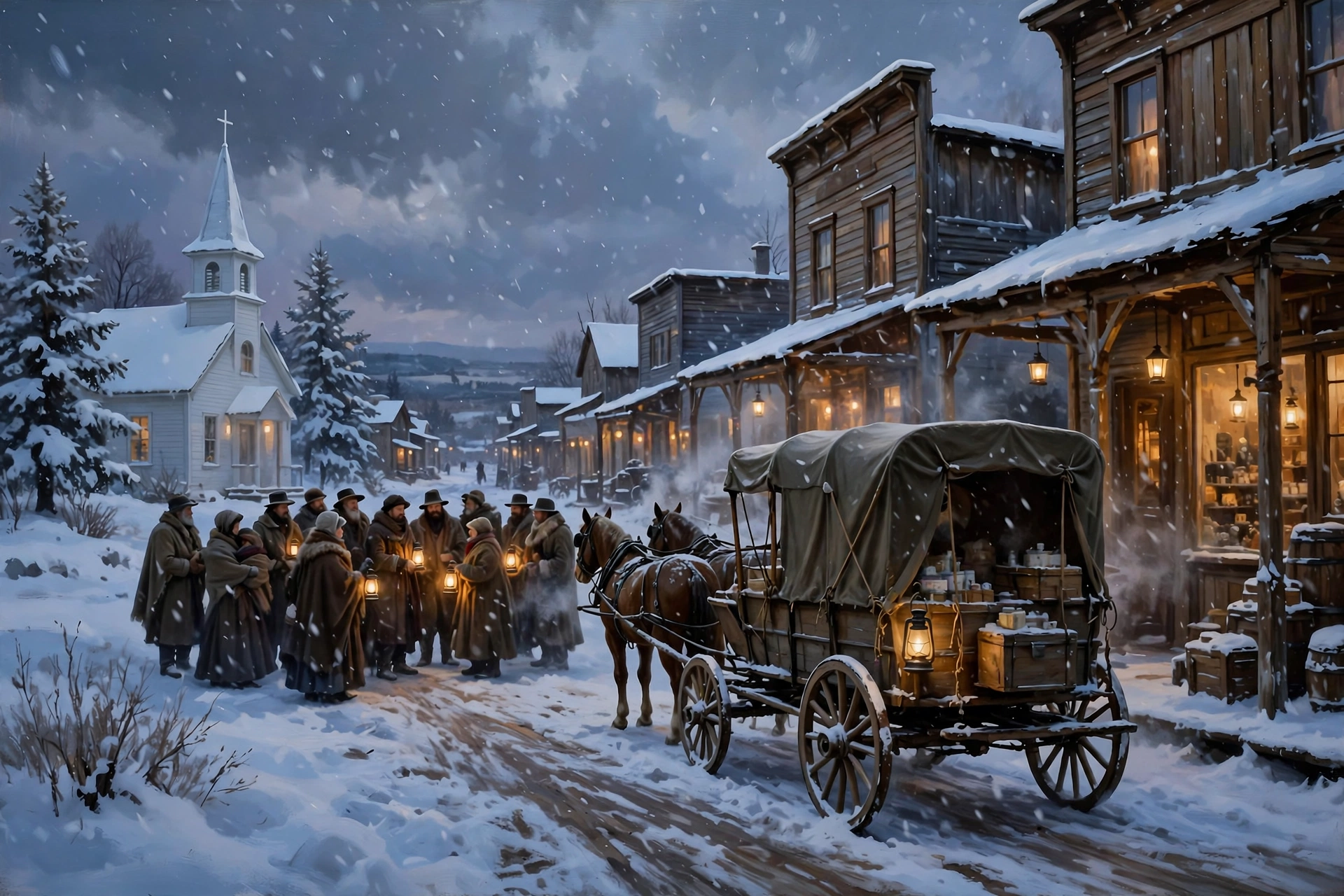
The winter of 1893 came early to Ash Hollow, Nebraska, and it brought a stranger with it.
Dr. Elias Ward rolled into town just after the first snow, his medicine wagon rattling over the frozen ruts of Main Street, a thin man in a patched coat with kind eyes and a leather satchel full of glass vials. He was a traveling doctor, the kind who went where the railroad didn’t bother to go, and he said he’d come because he’d heard the town had no physician of its own.
For three days, nobody thought much of him. He took a room above the harness shop. He mended old Mr. Okafor’s swollen knee. He gave the liveryman’s wife something for her headaches. Folks said he was decent enough, for an outsider.
From the window of the one-room schoolhouse, Miss Hannah Cole watched him too, and she watched with a teacher’s careful eyes. She had seen the cough starting among her pupils — a dry, barking cough that came in the night and left the little ones pale by morning. She had read the newspapers. She knew what that cough could mean, and she knew that Ash Hollow, with no doctor and no medicine, would be helpless if it came.
Then little Ruthie Calloway woke up in the night with a throat like fire and a cough that sounded like a hinge rusting shut.
By the end of that week, eleven children in Ash Hollow were burning with fever, their throats coated white, their breathing shallow and rasping. The word spread through town faster than the sickness itself: diphtheria.
And then came the second word, uglier than the first. The sickness had started the very week the stranger arrived. Somebody had brought it to Ash Hollow. Somebody had to pay.
Mayor Amos Pike stood on the steps of the church that Sunday and pointed a shaking finger at Dr. Ward. “That man rode in here with his city bottles and his city sickness,” he thundered, “and now our babies are dying!” The crowd that had been frightened became furious, and fury is easier to carry than fear.
They gave the doctor until sundown to leave town.
Elias Ward stood on the porch of the harness shop and looked at the faces — men he’d treated, women he’d helped — and he did not argue. He asked for one thing only: permission to see the sick children once more before he went. They refused. He bowed his head, hitched his wagon, and rode out into the falling snow at dawn, alone.
Hannah Cole watched him go from her schoolhouse window, her hand pressed to the glass, the diary already open on her desk. She wrote that morning, in ink that blurred with her tears: They have driven out the best man I ever knew, and they do not know what they have done. But the children are living, and someday the living will speak.
But here is what Ash Hollow did not know, and what nobody in that angry crowd had bothered to ask: Dr. Ward had not come to Ash Hollow by accident.
Six months earlier, the town’s schoolteacher, Miss Hannah Cole, had written a letter to a doctor she’d once read about in a St. Louis newspaper — a man who had carried the new diphtheria antitoxin across three territories and never charged a poor family a cent. Her letter had said simply: Our children are coughing, and I am afraid of what is coming. Please come.
Elias Ward had sold his father’s pocket watch to buy the train ticket. He had pawned his late wife’s wedding ring in Omaha to pay for a full case of the precious serum — the most expensive medicine in America. And he had come.
And in the nights before the town turned on him, while Ash Hollow slept, Dr. Ward and Miss Hannah Cole had gone from house to house in the dark, waking children gently, giving each one the serum by lamplight, and swearing the parents to secrecy — because Ward knew that frightened people would rather blame a stranger than believe a needle could save their child.
Nor did he work alone in those night hours. Waiting in the shadows of each cabin stood Winyan, the old Cheyenne woman who had ridden with his medicine wagon for years, and she brought her own medicine: tents of hot steam from willow bark and sage, which she wrapped around the smallest children so they could breathe through the terrible nights. Between the white man’s serum and the old woman’s steam, not one of those children slipped away.
There was one more secret, too. The sickness had not come from the doctor at all. Ward had traced it in his first three days to the new shallow well behind the livery stable, dug that summer beside the old privy ground. The water was poisoned. He had told the liveryman, Deacon Frye, to close the well at once.
And Deacon Frye, terrified of being blamed for poisoning the town’s children, had pointed his finger first — at the stranger.
The cruelest part came with the mayor’s own boy. Little Micah Pike was among the sickest, and when Hannah Cole came in the night with Dr. Ward and the serum, Mayor Pike barred his own door. “I’ll trust in prayer, not in witchcraft,” he said, and sent them away into the snow. Micah died three days later, and his father’s grief curdled into something that needed a villain. So Amos Pike gave the town one.
Elias Ward never defended himself. He rode forty miles to a ranch in the Sandhills, where a Cheyenne woman named Winyan — who had once ridden with his medicine wagon and taught him more about the healing of lungs than any medical college — took him in. Together they tended the ranch families through the winter, and Ward never once spoke of Ash Hollow, except to ask Hannah Cole, in the rare letters they exchanged, whether the children were well.
They were well. Every child who had received the serum in the night lived. Only Micah Pike, the one child kept from the doctor, had died. And Hannah Cole wrote it all down in a diary, year after year, because she knew the truth would matter someday.
Ten years passed. The children Dr. Ward had saved grew tall and strong. Ruthie Calloway became a teacher herself. And then, on a spring Sunday in 1903, Mayor Amos Pike — old now, and dying — asked to be carried to the front of the church, and there, before the whole town, he confessed everything. The congregation wept. And the next morning, a wagon left Ash Hollow carrying Hannah Cole’s diary and a letter signed by every family in town, addressed to a doctor in the Sandhills.
Elias Ward was seventy-one years old when he read it, and his hands shook so badly that Winyan had to hold the pages for him. The letter begged his forgiveness. It told him the town had built a small white clinic on the hill, and that above its door they had carved two names: his, and Hannah’s. It asked him to come home.
He came in the autumn, riding in a wagon this time, too old and too tired to drive one himself. The whole town was waiting at the edge of the road — men and women who had once shouted for him to leave, standing silent now, holding the hands of the children he had saved in the dark. Deacon Frye was there, head bowed, and he was the first to step forward and take the old doctor’s hand in both of his.
Ruthie Calloway stepped forward and pinned a small brass star to his coat — the kind the county gave its heroes. And Elias Ward, who had been run out of Ash Hollow in the snow ten years before, wept like a child as the town he had loved in secret finally loved him back.
He lived three more years in the little house beside the clinic, and he never charged a patient a cent. When he died, they buried him on the hill where he could watch over the town, and on his stone they carved the words Hannah Cole had written in her diary on the night they ran him out: He came in the dark, and he saved them in the dark, and he never asked for the light.