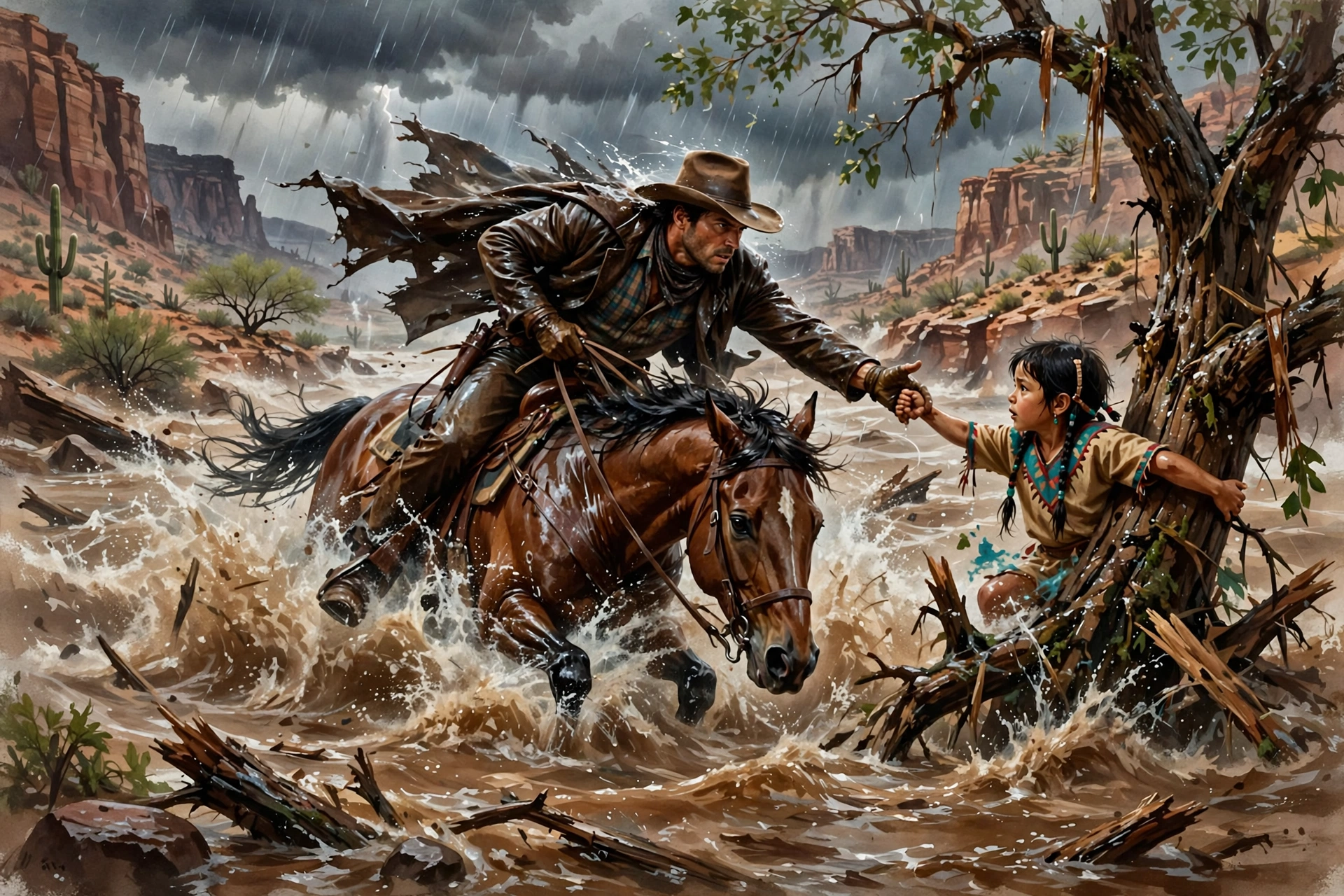
The summer of 1875 brought the worst monsoon season anyone in the Arizona Territory could remember. Jake Calloway was riding fence line on his small ranch along the San Pedro River when the sky over the Dragoon Mountains turned the color of a bruise, and the air went still in that particular way old desert men learn to fear.
Jake was thirty-four, a former cavalry scout who had traded his Army pay for forty acres, a dozen head of cattle, and a dream most folks said was too big for one man with a single good horse. He had built his ranch log by log with his own hands, and he guarded it the way a mother guards a child.
That afternoon he was checking the far fence where it crossed the dry wash the Mexicans called the Arroyo Seco — a dust-choked crack in the earth, no wider than a wagon bed, dry all summer long. Jake rode along it out of habit. He never expected trouble there. Trouble found him anyway.
The first sign was a low thunder that seemed to rise from inside the ground itself. Birds burst from the cottonwoods in a panic, and the hair on Jake’s neck stood up. He turned his mare toward high ground — and then it came around the bend: a wall of brown water carrying whole trees and boulders like kindling. The storm had broken far up in the mountains, miles away, and the dry wash was dry no longer.
Jake had nearly reached the bank when he heard it — a thin cry, barely louder than the roar. He pulled up and stared into the churning flood. Clinging to a half-submerged cottonwood was a boy, no more than ten, soaked to the skin, his small hands white on the bark as the tree shuddered under the current.
The boy was Apache — dark braid plastered to his neck, a red cloth band around his arm. The settlers whispered that the Chiricahua camped in the foothills, but Jake had never seen one this close. None of it mattered. The tree was breaking apart branch by branch, and the boy had perhaps a minute left.
Jake tied one end of his lariat to the saddle horn, wrapped the other around his waist, and rode his mustang mare Pepper straight into the flood. The water struck his legs like a hammer. Pepper squealed and fought for footing on the sliding gravel, but she held. Jake leaned from the saddle, stretched his arm to its limit, and shouted at the boy to grab hold…
The boy stared with wide, terrified eyes, and for one awful moment fear held him frozen. Then the tree cracked, his branch snapped clean, and he had no choice — he lunged, caught Jake’s forearm, and Jake hauled him out of the water and across the saddle as Pepper lunged for the bank. They made it. Barely. On the bank Jake found the boy’s left arm broken at the forearm and a gash on his forehead. He tore strips from his shirt, splinted the arm with two straight sticks, and wrapped the boy in his duster against the cold.
The storm raged all night. Jake built a fire under a rock overhang, fed the boy sips from his canteen, and kept him warm until the shaking stopped and he slept. In the firelight Jake saw the small carved bear on a leather cord around the boy’s neck. At first light he lifted the boy onto Pepper’s saddle, climbed up behind him, and rode three rough miles toward the smoke rising from the Chiricahua camp. Every step, he knew he might be riding into an arrow. He went anyway. A boy belonged with his people.
The camp went silent as he rode in. Warriors rose with rifles, women pulled children behind them. Jake stopped at the camp’s edge, raised both empty hands, and spoke the only Apache words he knew — “I bring a son home.” An old woman screamed and came running. Then the elder they called Tahzey stepped forward, leaning on a carved staff, and took the boy — Daklu — from the saddle, holding him close while his voice shook. What passed between the old man and Jake needed no words at all.
Jake tried to leave without ceremony, but Tahzey pressed into his hand a small stone, polished smooth as river glass, with a bear scratched into its face — the twin of the one around Daklu’s neck. A trader later told Jake what it meant: a blood-debt. The Chiricahua did not forget a life owed. Jake put the stone in a tin box under his bed and did not think of it for years.
Thirteen years passed. Forty acres became four hundred; a dozen head became six hundred. Jake married Mary, a schoolteacher from Tucson, and they raised two daughters in the ranch house he built with his own hands. The tin box stayed under the bed, and the little stone bear gathered dust inside it.
Then came the winter of 1888 and the Vane brothers — three rustlers out of New Mexico with fast horses and no conscience. They started with calves at night; when Jake confronted them, they burned his north fence. The sheriff rode out and came back with nothing but an apology.
By spring Jake was bleeding cattle by the dozen — the Vanes rebranding his stock in a box canyon and selling it across the border. His bank note came due in June, and Hollis the banker told him plainly: pay in full, or the ranch goes on the auction block.
The last raid came in May. Jake woke to smoke — his barn burning, his corral empty, nearly two hundred head gone, his best cutting horse shot dead in the dirt as a message. Mary stood beside him in her nightdress, watching the barn burn, and neither of them spoke. That afternoon Jake rode to town to tell Hollis he would sell. On the way home he sat on his bed, opened the tin box for the first time in thirteen years, and closed his fist around the little stone bear, feeling like a fool. What use was an old Indian promise against the Vane brothers and a banker’s ledger?
He got his answer at dawn. Mary shook him awake, trembling. “Jake. You need to see this.” On the eastern ridge, black against the rising sun, sat twenty riders — Apache warriors, painted for war, still as statues. At their head rode a young man with a red cloth band around his arm and a small carved bear on a leather cord at his neck. Daklu had grown into a warrior, and he had not forgotten. He rode down alone. “My grandfather has gone to the spirit land,” he said in careful English. “But his promise lives. We followed the men who steal your cattle. We know where they hide.”
What happened in that box canyon three days later, the valley talked about for years. The Vanes had the stolen herd bunched in a canyon with one way in and one way out, safe as kings — until they woke to find both ends held by silent riders they never saw coming. Faced with twenty Apache warriors and Jake Calloway’s rifle, they dropped their guns and rode out of the territory with nothing but the shirts on their backs.
Every head of cattle came home. The sheriff arrived two days late, as usual, and found enough evidence to put all three brothers in the territorial prison at Yuma. Hollis got his money with interest and never troubled Jake again.
On the last morning, Daklu stood in Jake’s yard and held out his hand. In it lay the little stone bear. “The debt is paid,” he said. “But a debt paid is not a friendship ended. Ride to our camp whenever you wish, brother. You will always find meat on our fire.” Jake tried to speak and could not. He gripped the young warrior’s forearm the way warriors do, and that was enough.
Jake Calloway lived to eighty-one, and he told that story a hundred times on his porch in the evenings, his grandchildren at his feet. He always ended it the same way, looking toward the eastern ridge. “Some debts get paid in cattle and coin,” he would say. “The best ones get paid in riders on a ridge at dawn.” And the little stone bear sat on his mantel until the day he died — a reminder that a life saved is never a life forgotten.