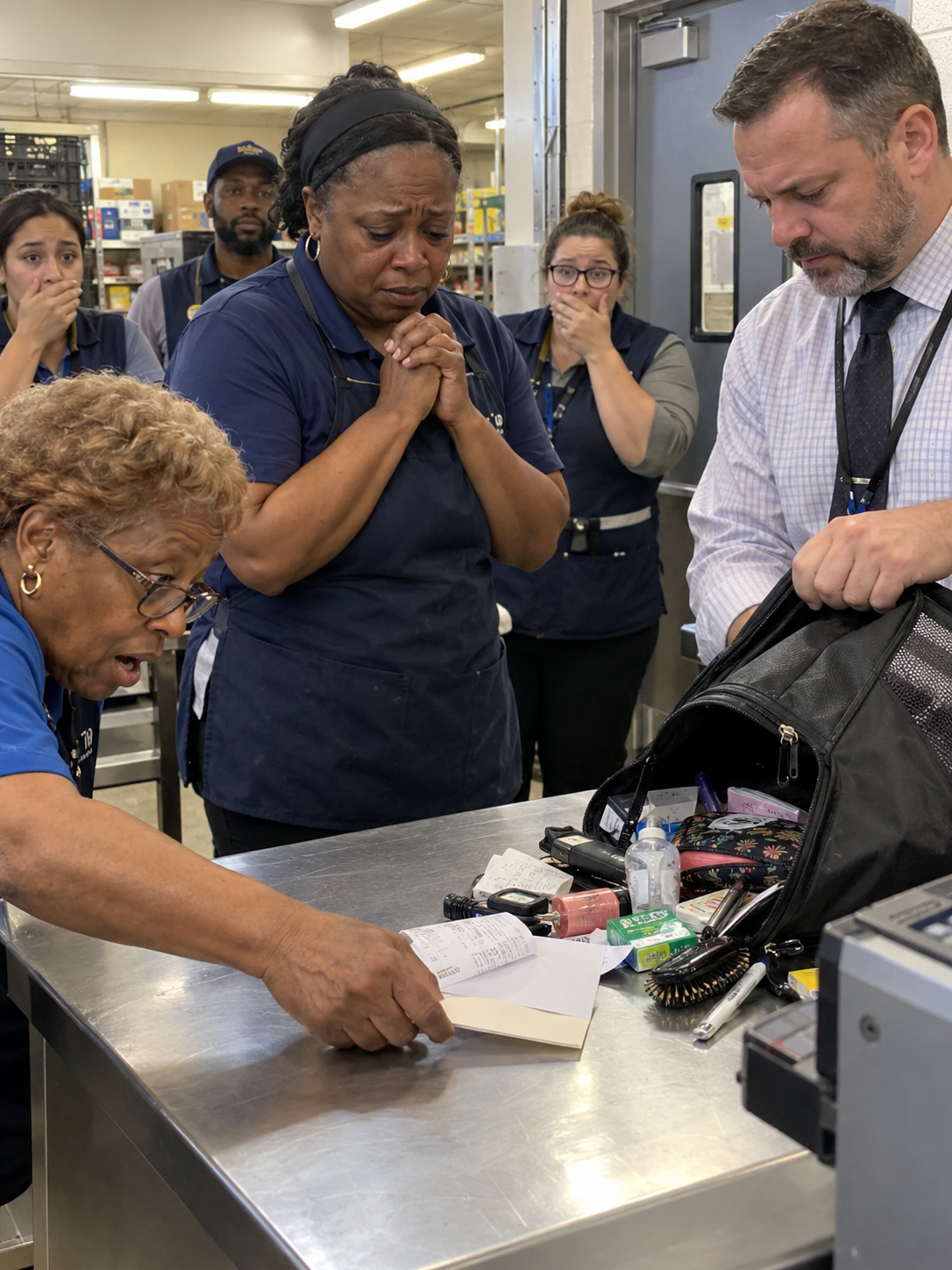
The manager turned Denise Walker’s purse upside down on a stainless-steel counter while five coworkers watched. A hairbrush, a bus pass, and an envelope slid out beside a stack of receipts. Denise had worked that grocery store’s evening shift for fourteen years. She had never imagined leaving through its back door would feel like a public trial.
“We’re missing money from register four,” Carl said. He had stopped her at the employee exit, where people could hear him over the humming freezer units. Denise asked him to check the camera before opening her belongings. Instead, he kept searching. Her friend Ruth reached for a fallen envelope, then stopped when Carl told everyone to stay back.
Denise was fifty-eight and had spent the week covering an absent cashier’s hours. Her knees hurt by closing time, but the overtime meant she could repair the heater before November. That morning she had tucked her daughter’s school photograph into the bag. Now she watched it slide across a counter beneath a stranger’s hand.
The missing cash was exactly forty dollars. Carl said the register report showed the shortage after Denise covered a break. She remembered a customer who had asked for cash back, then changed her mind when the card terminal froze. She tried to explain the transaction, but Carl interrupted before she could finish a sentence.
Ruth, who had worked the neighboring register, pointed toward the crumpled receipt. “That’s the customer,” she said. The thermal paper was faint, and Carl had already decided what it meant. Denise did not ask for special treatment. She asked him to call the customer-service desk and read the transaction history from the beginning.
Carl told her to clock out and wait in the stockroom. Nobody said she was fired, which somehow made the silence worse. Her coworkers stepped around the spilled belongings without looking directly at her. Denise gathered each item slowly, leaving the envelope because Ruth still held one corner between her fingers.
Inside was a letter Denise had written to her daughter after the girl’s first week of college. It said how proud she was, and how the grocery job had helped them reach that day. Ruth folded it before anyone else could read it. Then she noticed a second slip of paper stuck to the envelope’s back.
“Don’t go home yet,” Ruth whispered. She pointed at a tiny handwritten number beside the timestamp on the receipt. It belonged to an override, the kind a supervisor entered when a cash-back request had to be reversed. Denise looked toward the office. Carl was already closing its door behind him.
Ruth brought the receipt to the customer-service lead, a woman named Monica who had not witnessed the search. Monica pulled the register journal and found the forty-dollar cash-back request. The terminal had marked it approved, but a supervisor reversal appeared three minutes later. The drawer had been counted before the reversal posted.
That did not prove who had taken any money, because no one had. The system had shown a temporary shortage that vanished when the end-of-day correction completed. Monica printed both entries and called Carl back into the stockroom. Denise stood by the shelves of paper towels, holding her coat but refusing to leave without an explanation.
Carl read the second printout twice. He said he had been trying to protect the store. Ruth asked how turning out a worker’s purse in front of colleagues had protected anybody. He looked away, suddenly more interested in the stapled sheets than the woman whose daughter’s photograph was still lying on the counter.
Denise asked Monica for a written record. She did not trust a quiet apology that could disappear by morning. Monica documented the incorrect count, the public search, and the time the reversal appeared. The store’s owner, called at home, asked them to preserve the camera footage and requested that Denise be paid for the time she had been held.
The next morning the owner met Denise before opening. He apologized plainly, without asking her to excuse Carl’s decision. He told her the store would change how it handled register discrepancies: a second person would verify the journal before any employee was accused, and private belongings would not be searched on a manager’s hunch.
Denise listened, then asked a question nobody expected. “What are you going to tell the people who saw it?” The owner paused. A mistake made publicly could not be repaired entirely in an office. He agreed to tell the entire evening team what the records showed and to correct the accusation by name.
At the shift meeting, Ruth stood beside Denise. Carl said the shortage had been a timing error and that Denise had done nothing wrong. His voice shook. Denise did not smile or offer him a way out of the discomfort. She wanted the coworkers who had avoided her eyes to hear every word clearly.
Afterward, Monica handed over the envelope and the photograph. Denise checked the paper for damage, then tucked both into a safer pocket. Ruth offered to walk her to the bus stop. Denise said yes. She had spent the night worrying that one ugly moment would become the only thing people remembered about fourteen years of work.
On the sidewalk, Ruth admitted she had almost remained silent. Carl was her manager too, and she needed her paycheck. She said that looking at Denise’s letter made the accusation suddenly feel less like a procedure and more like a choice. Denise thanked her for the receipt, but also for staying beside her when staying mattered.
The store did not become perfect because of one meeting. Some coworkers apologized; others avoided the subject. Denise kept copies of the journal and the owner’s statement at home. She also returned for her scheduled shift, because the job was hers and she would not let a false accusation decide when she left it.
That winter, her repaired heater clicked on before dawn. Her daughter called from campus to say the letter had arrived and that she had read it twice. Denise had rewritten the note rather than mail the one that fell from her purse. This time, she added a line about a woman named Ruth who had chosen to speak up.
Years later, Denise still remembered the cold steel counter and the sound of her belongings striking it. But she remembered something else just as clearly: the small receipt Ruth refused to ignore. The forty dollars had never been missing. The dignity taken from Denise that evening needed people, not accounting software, to put it back.