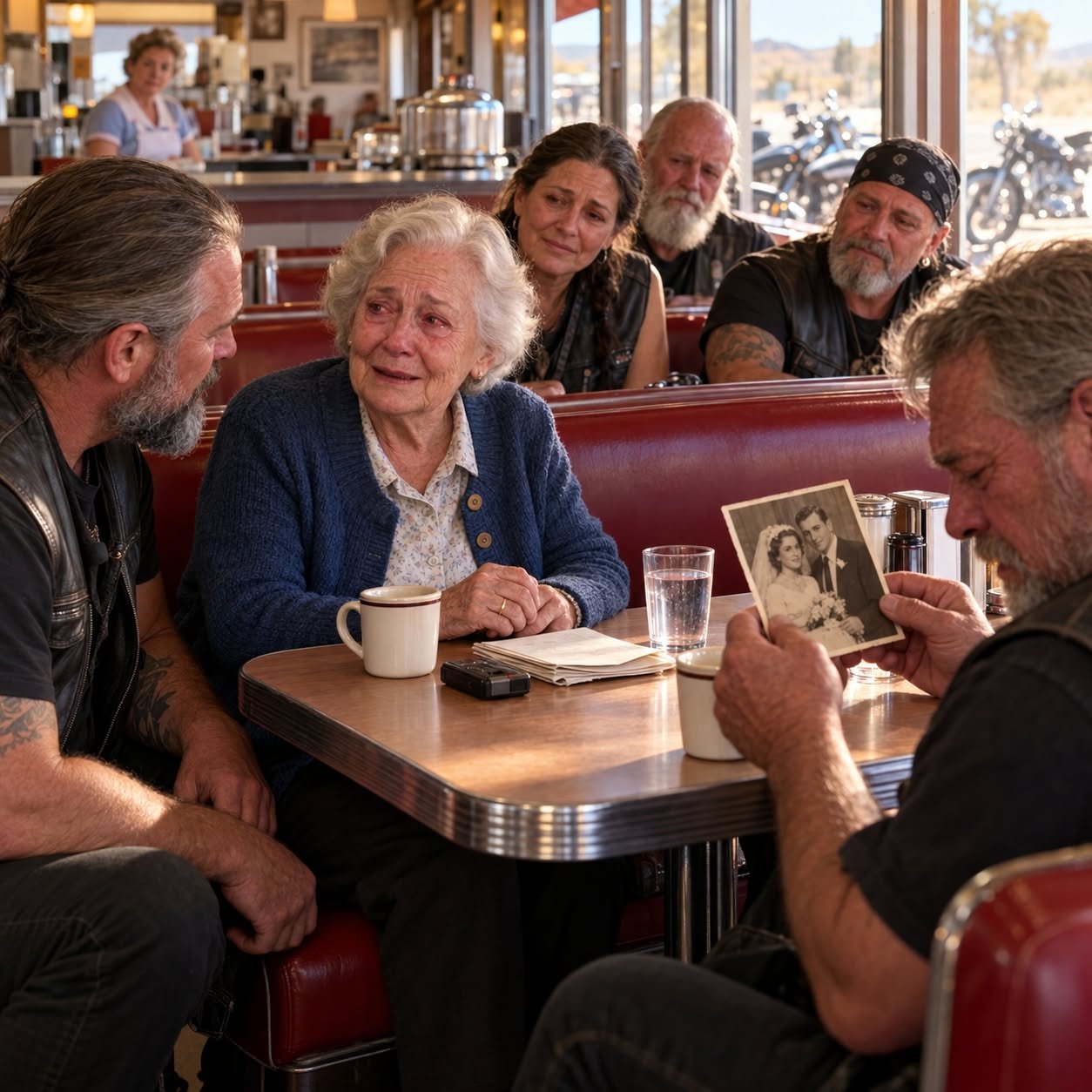
“Please don’t call my caregiver.” Those were the first words I said to the men in leather vests. Then I pulled back my sleeve. “She says I’ll regret it if I tell anyone. But I don’t think I’ll survive another month in that house.”
My name is Margaret Ellis. I was seventy-eight, and walking the two blocks to Rosie’s Diner had taken almost half an hour. At the door, I nearly turned around. There were eight motorcycles outside and eight men eating lunch in the back booth — men who looked like people who knew what to do when someone frightened them. I no longer did. The largest man stood before I finished speaking. “Would you like to sit down?” I nodded. He moved his plate and waited while I lowered myself into the booth, then crouched beside it, giving me room. “I’m Ben. What would you like us to do?” Nobody had asked me that in months. I looked at my hands. “I need someone to believe me.”
My husband, Robert, had died fourteen months earlier. We had been married fifty-three years. He was an Army veteran who repaired anything with moving parts and grew more tomatoes than two people could reasonably eat. After he died, his blue coffee mug stayed beside the sink. I stopped making proper meals. I missed appointments. Once, I couldn’t remember whether I had taken my morning pills. That frightened me enough to hire help, and the agency sent a woman named Dana Holt.
The house had gone quiet in a way I hadn’t expected. Robert had filled it without trying — humming in the garage, calling out the baseball scores, leaving his boots where I’d trip over them. After he was gone, I found myself talking to the rooms. I told the kitchen I missed him. I told his blue mug, still beside the sink, that the coffee didn’t taste right. When Dana arrived, bright and capable, I was so grateful for the noise of another person that I didn’t notice, at first, how quickly she began rearranging my life.
At first, Dana seemed wonderful. She made eggs the way I liked them, drove me to appointments, asked about the photographs on the mantel. For a while, I thought having someone listen was worth the fee by itself. Then she offered to handle the bills. Then the telephone. Then she suggested signing papers so she could help “if anything happened.” By the time her voice changed, she had my checkbook, my cards, and most of my confidence. When I asked about a withdrawal, she said I had forgotten authorizing it. When I asked to telephone my daughter, she reminded me how busy Laura was.
Laura and I had been speaking less since Robert’s illness. She wanted more professional help for me, and I heard that as criticism. We said the things frightened people say when they cannot bear the thing they are actually frightened of. After the funeral, our calls became brief and awkward. Dana found the space between us and widened it. “She doesn’t want the responsibility,” she told me. Then my number changed, and friends stopped visiting because Dana said I needed rest. At night, she locked my bedroom door from the outside. When I objected, she said it was safer.
The first bruise appeared after I asked for my bank card. She held my wrist until I stopped asking. I began measuring my days by her moods.
Once, I tried to call Laura from the kitchen phone while Dana was in the garden. My hands shook so badly I misdialed twice. On the third try, the line went dead — Dana had picked up the extension and, hearing my voice, simply hung up both receivers. When I confronted her, she smiled. “You must have imagined it, Margaret. You know how confused you get.” I went to my room and sat on the bed and wondered, for the first time, whether she was right about me. Then, on a Monday afternoon, I found an envelope behind Robert’s tool chest — receipts, statements, purchases I had never made. Jewelry. Hotel reservations. Payments on a car I had never sat inside. I didn’t know the full amount. I knew it was more than I had left. That night, I looked carefully at the pills Dana handed me. They were different from the ones I remembered. She saw me hesitate. “Swallow them, Margaret.” I did.
The next morning, she went shopping, and for once she left me in the living room instead of putting me back to bed. I found Robert’s little voice recorder in a drawer — he had used it for reminders after his hearing started failing. When Dana returned briefly for her wallet, I asked about my money, and the recorder was running inside my cardigan. Her answer was still on it when I reached the diner: her voice, cold and clear, saying the withdrawals were her “fee for putting up with” me, and that if I told anyone, she’d say I was confused and have me placed somewhere I “couldn’t cause trouble.”
I had hidden the recorder in my cardigan pocket with hands that wouldn’t stop trembling, certain she would hear the tiny click when I pressed the button. She hadn’t — she’d been too busy counting the cash in my wallet. Walking to the diner, I kept one hand pressed over the pocket the whole way, as if I could keep the truth from falling out. When Ben asked what I needed, I realized the recorder had been my plan all along — I just hadn’t admitted it to myself until that moment.
Ben listened without interrupting. Another rider, a former paramedic named Pete, asked whether I was feeling faint. “A little.” “Any chest discomfort?” “My heart’s been fluttering.” He looked at Ben. “We need medical help.” I grabbed Ben’s wrist. “Not if they send me back.” “We’ll tell them exactly what you’ve told us,” he said. “Would you like me to stay?” “Yes.” He called for an ambulance while the diner owner brought water. I took out the folded statements, and my wedding photograph slipped from between them. A quiet man at the end of the table picked it up and looked at Robert’s face for a long time. “Ellis,” he said. “Was your husband in Vietnam?” I nodded. “Did he have scars across his left hand?” I stared at him. The man sat down slowly. “My father kept a photograph of a soldier named Bobby Ellis.” His voice broke. “He said that man pulled him out of a burning truck — and that without him, I would never have been born.”
His name was Jack, and he did not leave my side for the rest of that day. The paramedics checked me over — my heart was fluttering from stress and the wrong medication, they said — and two police officers arrived, and Ben played them the recorder. I will never forget the silence in that diner when Dana’s voice came out of that little machine, threatening a seventy-eight-year-old woman. One of the officers took off his cap. “Ma’am,” he said gently, “you did exactly the right thing.”
Pete rode in the ambulance with me, holding my hand and telling me about his grandchildren to keep me calm. At the hospital, the nurses were gentle, and a doctor with kind eyes listened to my heart and said the flutter was stress and the wrong pills, nothing more. Ben waited in the hallway the entire time — all six-foot-four of him, in his leather vest, perched on a plastic chair built for smaller men. When they finally let him in, he said, “You did good, Margaret.” I cried then, because nobody had said I did anything good in a very long time. They asked if I wanted to press charges. I thought of the locked bedroom door, the bruise on my wrist, the money gone. “Yes,” I said, and eight bikers nodded like a jury.
Ben found Laura’s number in my phone and called her himself. My daughter arrived at the hospital that evening, and the awkwardness of our recent calls melted the moment she saw the bruise. She wept, and I wept, and we held each other the way we hadn’t since Robert died. “I thought you didn’t want me,” I whispered. “I thought you didn’t want me,” she whispered back. Dana had stolen more than money from us — she had stolen months we could have had together. We promised each other, right there in that hospital room, that no one would ever come between us again.
The doctor confirmed what I had suspected: the pills Dana had been giving me were not mine. Mine were for my heart; hers were something that made me drowsy and confused — confused enough, she had hoped, that no one would believe me. “She said nobody would believe a confused old woman,” I told the doctor. He shook his head slowly. “Somebody believed you,” he said. “Eight somebodies.”
Dana Holt was arrested at my house that night, packing a suitcase. The investigation uncovered thefts totaling more than forty thousand dollars, and evidence that she had done this before, in another county, under another agency’s nose. At the trial months later, I testified — my voice shook, but I told the truth, all of it — and the courtroom benches were filled with men in leather vests who had taken the day off work to be there. Dana was sentenced to prison, and the judge ordered restitution. I don’t know if I’ll ever see the money again. I know I got something worth more: my life back.
Choosing the senior community was my decision — Laura showed me three places and I picked the one with the garden and the porch rockers. The first night there, I locked my own door from the inside, with my own key, and stood in the quiet of my own small apartment and felt something I hadn’t felt in two years: safe. I slept ten hours. In the morning, I made my own eggs, exactly the way I liked them, and ate them watching the sun come up. Dana had taken so much. She hadn’t taken that.
The months after the trial were the sweetest I had known since Robert died. Laura moved me to a bright senior community ten minutes from her house — my choice, my decision, with a properly vetted aide who knocks before entering and never locks anything. The bikers repaired my old house before it was sold: fixed the porch steps, painted the shutters, planted Robert’s tomatoes. Every Sunday, eight motorcycles roll slowly past my new front porch, horns giving a friendly honk-honk, and I wave with Robert’s blue coffee mug in my hand. The neighbors have gotten used to it. Some of them wave too.
Last Veterans Day, Jack asked me to speak at the memorial service. I stood before the crowd — my hands shook, but my voice didn’t — and told them about Bobby Ellis, who pulled a burning man from a truck in Vietnam and came home and repaired everything with moving parts and grew too many tomatoes. I told them that fifty years later, that man’s kindness came back to save his widow, carried by the son of the man he’d saved. Jack framed my wedding photograph, and it hangs in the veterans’ hall now, beside his father’s. Two soldiers, two families, one unbroken chain.
Jack comes to Sunday dinner every week. He calls me Mom, and I let him, because in every way that matters, Robert’s rescue made him family. Laura’s children — my grandchildren, who I had been too “tired” to see when Dana controlled my days — come too, and the house is loud and full the way it was when Robert was alive. Last month, I dug out Robert’s little recorder, the one that saved me. I pressed the record button and spoke into it: “Bobby, it’s Margaret. You’d be proud. The boys take care of me. Laura’s here. I’m all right.” Then I laughed — a real laugh, the first in longer than I can say — and let the tape keep running, because some recordings aren’t evidence. Some are just proof that a confused old woman was never confused at all. She was just waiting for someone to believe her.


