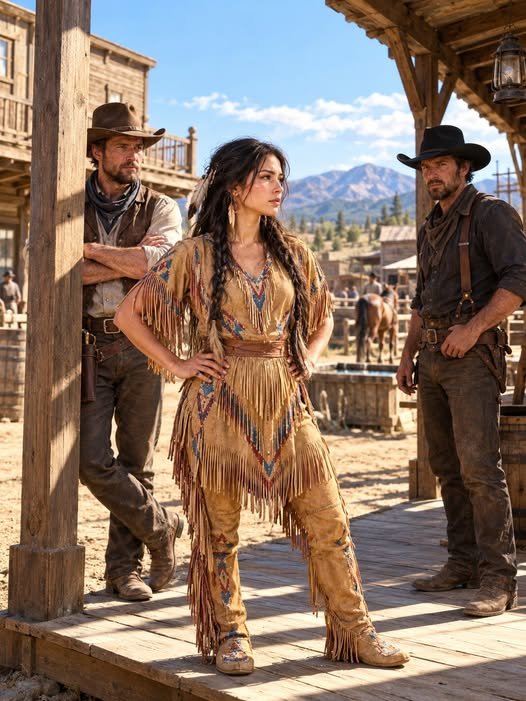
The dust had not yet settled over Red Creek when the chief spoke the words that would change Ethan Cole’s life forever.
He had ridden into town that morning the same way he had ridden in a thousand times before — boots worn thin, hat pulled low, asking for nothing more than a hot meal and a bed that didn’t move. But fate had other plans for Ethan Cole. It began the moment he saw the young Apache woman kneeling in the dirt beside the trader’s storage yard, a rope binding her wrist to a post like she was some stray animal.
Her name was Naheema, and she was eighteen years old.
She had been captured months earlier near the mountains and forced to labor for a cruel trader who barked orders and grabbed her arm without a second thought. Ethan watched the crowd gather and do nothing. He watched the older ranchers look away. And something in him — something older and deeper than fear — refused to look away with them.
“That’s enough,” he said, and the whole yard went quiet.
The trader told him to mind his own business. Ethan walked away that afternoon, but the image of the girl’s swollen hands followed him home, sat with him at supper, and kept him awake long past midnight. Conscience, he was learning, was a poor companion for a man trying to sleep.
Near midnight he returned to the yard. Naheema sat alone under a thin blanket, her eyes wary but not broken. Exhausted, frightened — but not defeated. That look decided it for him.
Before dawn he came again, and this time he brought a knife. He cut the rope from her wrist, pressed dried meat and water into her hands, and led her to two waiting horses.
“You’re free,” he told her.
“They’ll come after me,” she whispered.
“That’s why you leave now.”
Before she mounted, Naheema removed a small leather pendant from her neck and placed it in Ethan’s palm. A carved symbol marked its surface — two hands clasped around a single flame.
“What’s this?” he asked.
“A promise.”
“Of what?”
She looked directly into his eyes. “My people remember kindness.”
Then she rode toward the mountains, and Ethan stood in the darkness watching until she was gone, not knowing he had just set in motion the most extraordinary week of his life — or of Red Creek’s.
By sunrise the town erupted. The trader discovered Naheema missing and demanded answers, and it didn’t take long before someone remembered seeing Ethan near the yard. A group of men confronted him outside the livery.
“Tell us you didn’t help that Apache girl.”
Ethan met their eyes without flinching. “I helped someone who needed help.”
“You fool! They’ll come back!”
He understood their fear. He simply didn’t regret what he had done. But Red Creek didn’t see it that way. For days the town treated him like an outcast. Conversations died when he entered a room. The blacksmith suddenly had no time for his horse. Even the saloon keeper, who had poured him whiskey for six years, served him in silence.
Only one man refused to turn away. Walter, an elderly rancher with silver in his beard and decades of frontier wisdom in his eyes, sat beside Ethan one evening on the porch.
“Most people think you caused trouble,” Walter said.
“And you?”
“I think you followed your conscience.”
“Then why is everyone terrified?”
Walter sighed and looked toward the distant ridges. “Because fear is easier than trust.”
Before leaving, the old man placed a hand on Ethan’s shoulder. “There’s something else you should know.”
“What?”
“The Apache don’t forget debts. Bad ones or good ones.”
Far beyond the desert ridges, beneath a sky full of stars, a council fire was already burning. And Naheema — free, alive, home — was telling the tribal elders about the cowboy who had cut the rope from her wrist and asked for nothing in return.
Five days passed. Then came the sixth morning.
“Riders!”
The warning tore through Red Creek like a gunshot. Ethan rushed outside and his heart stopped. A massive dust cloud rose beyond the town. Dozens of Apache warriors were approaching in a long, silent line.
Panic exploded. Women pulled children indoors. Shopkeepers slammed their shutters. Men grabbed rifles and took positions behind water troughs. The church bell rang wildly, and the trader appeared with his weapon raised, shouting, “We stop them here!”
Nobody followed him. There were simply too many riders.
The warriors reached the edge of town and stopped. They did not charge. They did not raise a single weapon. They simply waited, still as stone, while the whole town held its breath.
Then one rider moved forward — an older man with weathered skin and eyes like dark glass. The chief. And beside him rode Naheema. Alive. Free. Proud.
She looked directly at Ethan, and in that look he saw everything: gratitude, courage, and something else he couldn’t yet name.
The chief dismounted. Several townsmen raised their rifles. Ethan stepped forward and said the bravest words of his life: “Put them down.”
“Are you crazy?” the trader snapped.
Ethan ignored him.
Naheema dismounted and spoke quietly to her father. The chief studied Ethan for a long moment, and then his eyes dropped toward Ethan’s hand. Ethan suddenly remembered the pendant. He pulled the small leather circle from his pocket and held it up.
A murmur moved through the Apache riders like wind through grass.
The chief walked toward him, and Red Creek became completely silent.
Then the chief spoke, and Naheema translated. “My father says you returned something that belonged to his people when everyone else treated her as property.”
Ethan shook his head. “I only gave her freedom.”
Naheema’s voice softened. “To him, that is not a small thing.”
The chief spoke again, longer this time, and Naheema’s expression changed. She stared at her father. Then at Ethan. Then back at her father, as if she couldn’t believe what she was hearing.
“What did he say?” Ethan asked.
Naheema hesitated, and when she finally spoke, her voice trembled. “He says a debt this great cannot be answered with horses, cattle, or silver.”
The chief stepped closer, and made Ethan an extraordinary proposal.
He offered him the pendant’s true meaning. The carved symbol — two hands clasped around a single flame — was not a thank-you gift. It was the mark of an ancient Apache covenant of the Shared Fire: an invitation, extended perhaps once in a generation, for an outsider to be adopted into the tribe as kin. To accept it meant Ethan would be bound to the Apache not as a guest, but as a son — with all the honor, protection, and responsibility that came with it.
And there was more. The chief’s proposal was peace itself. If Ethan accepted the covenant, the chief would declare a lasting truce between his people and Red Creek — an end to the raids, the suspicion, the fear that had poisoned both sides for years. One man’s act of decency, the chief said, had proven that not all settlers were enemies. The town would be under the tribe’s protection, and the tribe would trade openly at Red Creek’s market, as neighbors instead of shadows.
But the covenant required Ethan to leave Red Creek behind and live among the Apache for one full year — to learn their ways, share their fire, and prove that the hands that freed Naheema were hands the tribe could trust forever.
The townspeople stared, stunned. Even Naheema seemed stunned — because she understood what her father was really offering, and what it would cost them both.
Ethan looked at the pendant in his palm. He looked at Naheema, standing free beside her father. He looked at the terrified faces of Red Creek behind him — the same people who had shunned him for a week.
He thought of Walter’s words: The Apache don’t forget debts. Bad ones or good ones.
And he thought of the rope, and the knife, and the girl who had ridden into the dark with nothing but dried meat and a promise.
“I accept,” Ethan said.
Naheema translated, and a sound rose from the Apache riders — not a war cry, but something warmer, something like joy. The chief placed his own hand over Ethan’s, closing the cowboy’s fingers around the pendant, and spoke words Naheema did not need to translate. Some things need no language.
That evening, something happened in Red Creek that no one had seen in years. The warriors did not leave. They camped at the edge of town, and their fires burned beside the settlers’ fires, and slowly — cautiously at first, then with growing wonder — the townspeople came out of their homes. Children peeked from doorways. The blacksmith, who had refused Ethan’s business all week, brought out bread. Someone started playing a fiddle.
Ethan sat beside Naheema near the largest fire, the pendant warm in his pocket.
“Did you know?” he asked her. “When you gave me this — did you know what it meant?”
She smiled, and for the first time since he’d met her, the fear was completely gone from her eyes. “I knew what I hoped it meant.”
Over the year that followed, Ethan kept his word. He lived among the Apache, learned their language, rode their trails, and sat at their council fires. He taught them to shoe horses the settler way; they taught him to read the desert like a book. And slowly, the truce the chief had declared grew roots — trade flourished at Red Creek’s market, and the raids that had haunted both peoples faded into memory.
Naheema was often at his side through it all — no longer a captive, no longer a fugitive, but a free woman whose courage matched his own. What began as gratitude deepened into something neither of them had dared to imagine that first night in the storage yard. When the year ended, Ethan was offered the choice to return to Red Creek as a settler again.
He chose to stay.
They were married beneath the same desert sky where the council fire had once burned, with settlers and Apache celebrating side by side — Walter, the old rancher, weeping openly in the front row, and the trader conspicuously absent. The chief himself placed a second pendant around Ethan’s neck: the mate to the first, carved with a single flame now ringed by two hands joined as one.
Years later, travelers passing through Red Creek would hear the story of the cowboy who cut a rope at midnight and changed the fate of two peoples. The town kept the peace. The tribe kept its word. And on Ethan’s cabin wall, beside Naheema’s weaving loom, hung the two leather pendants — a reminder that the smallest act of courage can carry the weight of history.
Ethan Cole had gone looking for nothing more than food, sleep, and perhaps a whiskey. Instead, he found the truth Walter had tried to tell him all along: that fear is easy, but trust — trust is the bravest thing of all.
And all it took was one man, one knife, and one rope cut in the dark.