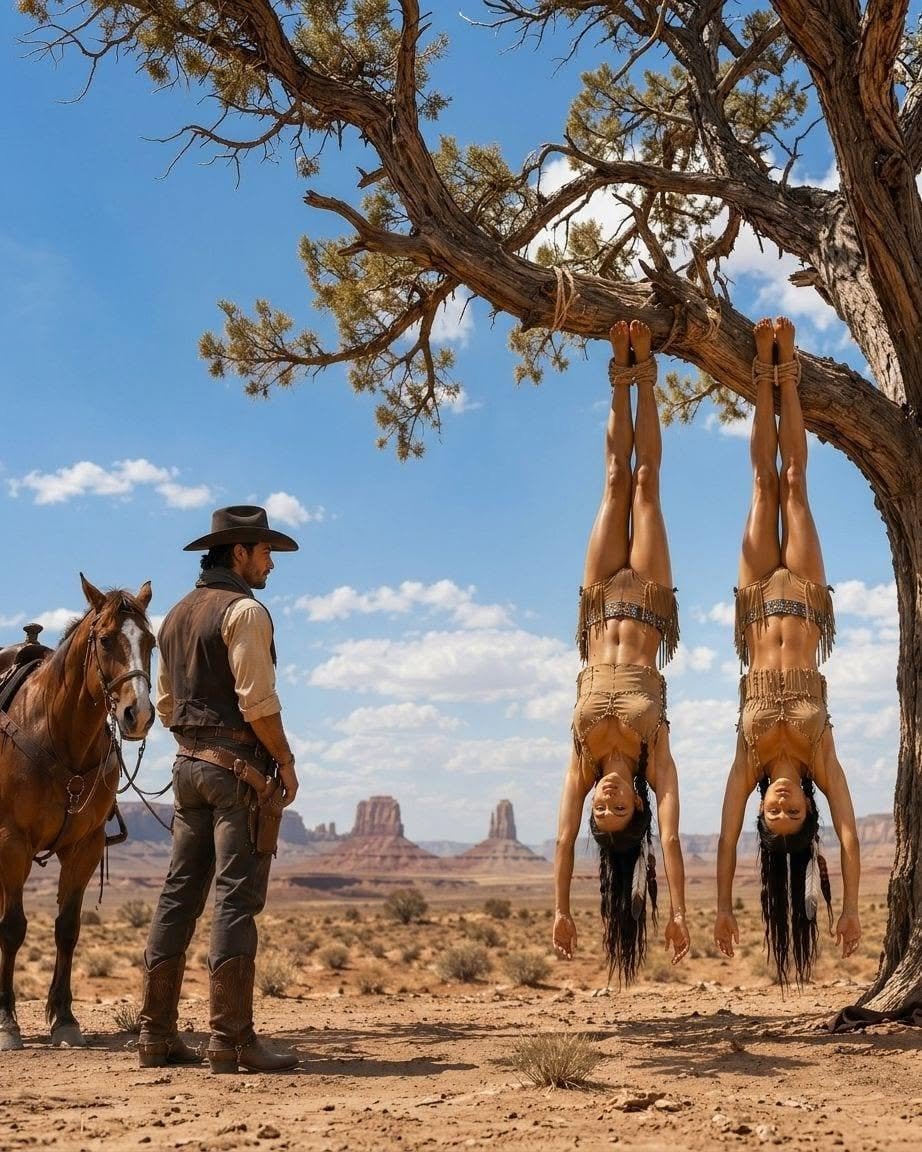
The rope was already swinging when Callan Draice rode into Cuervo Creek, and the first thing he thought — before any thought of courage or mercy — was that somebody had hung their laundry from the big cottonwood outside of town. Then one of the dark shapes moved. Laundry does not fight.
He drove his heels into Chester’s sides and reached the clearing with his stomach somewhere down around his boots. Two Apache women stood on the flatbed of a wagon with their hands tied and ropes around their necks. The wagon’s rear wheels sat barely six inches from a ditch. One frightened mule, one hard shove, and both of them would be hanging. Seven men stood around them, the kind of men who needed someone weaker nearby before they could feel strong.
Callan was not a young man anymore. He had ridden straight from Amarillo with an aching back, eleven dollars in his pocket, and more empty years behind him than he cared to count. Cuervo Creek meant nothing to him. His first honest thought was: Lord, not today. Then the women looked at him. Not at the ropes. Not at the men. At him. Like he was the last unanswered question left in the world. So he dismounted.
The man with the red mustache and the crooked deputy’s star told him to ride on. It was lawful, he said. Callan asked what the charge was, and a heavyset man with flour on his boots said they were Apache brides, bought proper out of Mescalero country, both turned out barren after three years, and the husbands wanted their bride price returned. So they were hanging them. Callan asked somebody to show him the law that let a man hang a woman because she did not give him a son. Nobody moved. Nobody could.
That was when the older woman spoke his name, though she had never met him. Her name was Naiche, and the younger one was Luz, and Naiche said the deputy had told his men last winter: if Callan Draice ever came through Cuervo Creek again, he wanted to know. Red Mustache’s face changed, just slightly, but she saw it, and so did Callan. A moment later three hands dropped toward gun belts, and Callan stepped between the women and the seven men with his Colt at his hip and said, “Let’s all think carefully about the next sixty seconds.”
Naiche whispered behind him that there were more men coming, hoofbeats from the south, fast. And then she said the words that turned a bad situation into something much worse: “They are not coming for us. They are coming for him.” Her eyes were fixed on Red Mustache.
The deputy went the color of old paper. And in that moment, ten years of buried history came up out of the ground like a root.
Red Mustache had not always worn a star. Ten years before, he had been a skinny drifter named Red Mallory with a stolen horse under him and a mob with a rope around that very same cottonwood. The town was ready to hang him for horse thieving. Callan Draice had ridden in by accident, the same way he had ridden in today, and he had talked the mob down with nothing but plain words and a steady hand. Then he had fed the boy supper, given him back his own worn-out boots, and told him, “A man can outrun everything except the look in his own mirror.” Red had never forgotten it. He had pinned on the deputy’s star hoping to become the kind of man Callan believed he could be.
But Cuervo Creek had a way of bending straight things. The broad husband was Harlan Hale, who owned the bank and half the land in the county. The thin one was his clerk. Last winter, an Army payroll shipment had vanished on the south road, and Red had helped cover it up — not for money, though there was money, but because Hale owned the note on his mother’s house and had made the terms very clear. The strongbox was buried in the arroyo south of town. And the one witness was a quiet Apache woman gathering winter herbs, who had seen three men digging by lamplight and had the misfortune of being seen in return.
That was Naiche’s secret, and it was the real reason for the rope. The barren-bride story was a lie from first word to last. Hale and his clerk had never intended their “marriages” to be marriages at all — the brides were purchased so the men could put Apache wives’ names on disputed water claims, and once the claims were settled, the women became a problem with eyes. Luz had to hang too, because she was Naiche’s younger sister, and a sister carries word back to Mescalero country. A hanging for “barrenness” would look like a husband’s right. Nobody would dig into it. Nobody except the one woman who had seen the strongbox go into the ground.
Red Mustache had been sick with it for months. He had stalled the hanging again and again — a mule that would not stand still, a ditch dug a little too deep, a “lawful” proceeding that never quite got lawful enough. And he had given his men one standing order: if Callan Draice ever rode through again, he wanted to know. Not because he meant Callan harm. Because Callan was the only man Red had ever known who would stand between a rope and an innocent person without counting the odds. Red’s last, desperate hope was that Callan would arrive before the men Hale had hired to finish the job.
Now those men were here. Five riders came up the south road at a gallop, dust rolling off their horses, led by a scar-faced gunman named Cobb who worked for Hale when Hale needed things done quietly. Cobb reined up, looked at the cut ropes lying on the wagon bed, looked at the freed women, and smiled a smile with nothing warm in it. “Restring them,” he said. “And Red — Hale wants your star. He says you’ve gone soft.”
Callan’s hand settled near his Colt, but he did not draw. He had learned long ago that the fastest gun in a clearing is not always the man who walks out of it. “Nobody’s restringing anybody,” he said. “This hanging was never about barren brides. It was about a payroll strongbox in the arroyo, and everybody standing here knows it.”
You could have heard a mule blink. Hale’s face went purple. The clerk started to edge toward his horse. Cobb’s hand hovered over his revolver, and for three heartbeats the whole clearing balanced on a knife’s edge.
Then Red Mustache did the bravest thing he had done in ten years. He tore the deputy’s star off his vest, threw it in the dust at Cobb’s feet, and said, “I buried it. Me and Hale and the clerk. Naiche saw us. I stalled this hanging all spring because I couldn’t stomach it, and I’m done.” His voice shook, but it did not stop. “Callan Draice saved my life under this tree when I was nineteen. I have spent ten years trying to be worth it. I failed. But I won’t watch two innocent women hang for what I did.”
Cobb stared at him. A confession in front of a dozen witnesses changes the arithmetic of murder. Killing the women now would not bury the secret — the secret was standing in the open, spoken aloud. And an Army payroll is the kind of theft that brings soldiers with rifles, not just a territorial marshal. Cobb looked at Hale, looked at the townspeople who had begun gathering at the edge of the clearing with hard eyes, and slowly lifted his hands away from his gun. “This ain’t my fight no more,” he said, and he and his riders turned their horses and rode back south, to tell Hale the job was finished in a way he had not ordered.
What followed was quieter than anyone expected. Naiche led Callan, Red, and half the town to the arroyo, to a patch of disturbed earth under a mesquite, and they dug up the Army strongbox with its seals unbroken. The territorial marshal rode in from Amarillo two days later, and Harlan Hale and his clerk were taken away in irons. The water claims signed in the women’s names were declared void, which meant Naiche and Luz owned nothing and owed nothing and were free in a way paper could finally prove.
Red Mallory surrendered himself and expected the worst. Callan spoke for him at the hearing — told the marshal about a nineteen-year-old horse thief under a cottonwood, and about a deputy who had thrown away his star rather than watch an injustice done. The marshal gave Red thirty days in the county jail and a clean recommendation afterward. Red served every day of it, then took the stage to Santa Fe, where a man with a past can still find honest work. He writes to Cuervo Creek twice a year. His letters are short. They always end the same way: “Trying to be worth it.”
And Callan? He had told the clearing, “If your rules say they need a household, then they’ll have one.” He meant it. He rode Naiche and Luz out to his small spread past the territory line — not as wives, but as family, because that was what the moment required and because his house had been empty far too long. The first winter was hard. Naiche’s knowledge of herbs eased the old ache in his back. Luz, who had barely spoken on the wagon, learned to read by lamplight and laughed for the first time at one of Callan’s terrible jokes about Chester the horse.
By spring, the spread had a garden, two milk goats, and a porch that caught the evening sun. The town of Cuervo Creek, shamed and grateful in equal measure, sent a wagon of lumber to help raise a proper barn. And on a warm evening in May, with Luz dancing and the whole town eating pie at long tables, Callan Draice married Naiche under the cottonwood tree — the same tree, where someone had long since cut down the rope and where Luz had planted wildflowers in the dirt the wagon had scarred.
Naiche had once been the calmest person in a clearing full of guns. She became, as she had somehow known she would that first day, the most important person in Callan’s life. Not because he had saved her. Because she had saved him right back — from the empty years, the eleven dollars, the house with no laughter in it. That is the thing about standing between a rope and an innocent person. Sometimes you walk away with your life. Sometimes, if you are very lucky, you walk away with a family.


