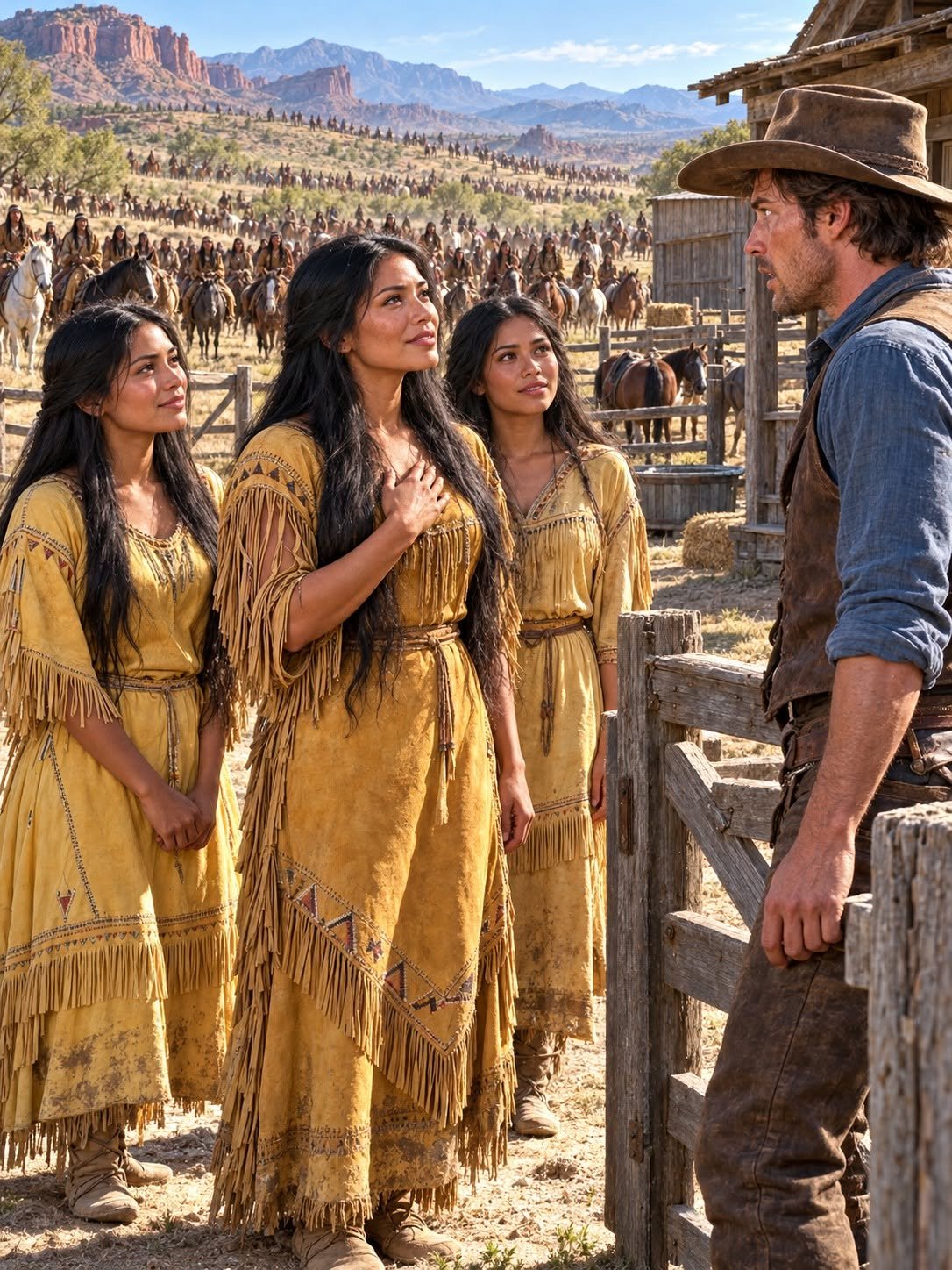
My name is Luther Morgan, and I was thirty-five years old when three Apache sisters arrived at my ranch, exhausted and hungry. I had barely enough food to last another few days. The supply wagon was late, my pantry was nearly empty, but when I saw those three women standing outside my gate, I couldn’t turn them away. I gave them the supper I’d prepared for myself. They thanked me and rode away. I thought that was the end of it. But the next morning, I stepped outside and saw hundreds of Apache riders gathering across the valley, and the oldest sister was riding directly toward me.
It happened during the summer of 1888, when the Arizona frontier was suffering through a terrible dry spell. The creeks had shrunk to threads, the grass had turned yellow and brittle, and every rancher for fifty miles was counting his supplies and praying for rain. I lived alone on a small ranch several miles from the nearest settlement — twelve horses, a little vegetable garden, and a wooden cabin I’d built with my own hands. It wasn’t much. But it was home.
The garden had given up weeks earlier — the beans withered on their poles, the squash vines crisped to straw. I watered what I could from the well, but the well was dropping, and I measured every bucket. At night I sat on the porch and did the arithmetic no rancher enjoys: how many days of feed, how many days of food, how many days until the wagon. I had stopped writing the numbers down. I knew them by heart.
That evening, I was preparing a simple supper when I heard hoofbeats approaching. I stepped onto the porch and saw three women riding slowly toward the gate, their horses looking nearly as tired as they did. The oldest sister dismounted first. She had long dark hair, dusty clothing, and a face that showed how far they’d traveled. “Can I help you?” I asked. She hesitated, and I noticed her younger sisters watching me carefully. “We’ve been traveling since yesterday,” she said. “Are you heading toward the settlement?” She shook her head. “We’re looking for food.”
I glanced toward my kitchen. There wasn’t much left — a little cornmeal, some dried meat, beans, three pieces of bread, and no certainty about when the supply wagon would arrive. But I opened the gate. “Come inside.” The sisters exchanged surprised looks, as if they had expected refusal. I brought them fresh water, and they drank slowly, as though afraid to use too much.
While they drank, I went to the corral and watered their horses myself, rubbing down each lathered neck with a burlap sack. The animals were as worn as their riders — ribs showing, heads low. One of them, a dun mare, leaned into my hands as I worked. The middle sister watched from the porch, and when I came back, she said something in her own language that made the oldest sister smile. I never learned what it was. I like to think it was kind. Then I returned to the stove and prepared the supper I’d been saving for myself — beans and cornmeal, a little dried meat, and the last three pieces of bread. When I placed everything on the table, the youngest sister looked at me. “You’re giving us all of this?” I nodded. “You need it more than I do.” “But what will you eat?” I smiled. “I’ll figure out breakfast tomorrow.” For the first time, her expression softened.
They sat down and began eating, and nobody spoke much. But I noticed the oldest sister kept glancing toward the window, and the middle sister did the same, and something was troubling them.
I noticed the oldest sister’s hands as she ate — a mother’s hands, I thought, worn and capable, with a thin white scar across one knuckle. She caught me looking and turned her hand over slowly, showing me, the way people do when they decide to trust a stranger a little further. “A cooking fire, years ago,” she said. “My daughter was small. I reached in before I thought.” She smiled. “Mothers do not think first.” I thought of my own mother, long gone, and nodded. We understood each other. Finally I asked, “Did something happen on the trail?” The oldest sister lowered her spoon. “We became separated from our people.” “Are they looking for you?” “Yes.” “How many?” She hesitated. “Many.” I assumed she meant relatives, perhaps a small group traveling nearby, and I didn’t understand why she looked so concerned.
After supper, I offered them a place to rest, and they thanked me, and before sunrise they prepared to continue toward the eastern hills. At the gate, the oldest sister removed a small woven bracelet from her belongings and held it toward me. “For your kindness.” I shook my head. “You don’t owe me anything.” She gently placed it in my hand anyway. “Kindness should be remembered.” I looked at the bracelet — its woven pattern was simple but beautiful. When I raised my eyes, she was smiling. Then the three sisters mounted their horses and rode away, and I watched until they disappeared beyond the hills. Afterward I returned to my quiet cabin. I still had twelve horses to feed, a fence that needed repairing, and a nearly empty pantry. I thought about the sisters once more before sleeping. Then I forgot about them. Until the following morning.
I woke before sunrise to the sound of restless horses. At first I thought one of my fences had broken. I grabbed my lantern and stepped onto the porch. The air was cool and everything was still. Then I noticed movement along the distant ridge — one rider appeared, then another, then dozens more. I walked toward the fence and stopped. Hundreds of Apache riders were moving across the valley, their horses advancing slowly through the morning dust. I couldn’t understand what was happening. I had lived on that ranch for years and had never seen so many riders approaching at once. My heart began pounding. I remembered the oldest sister’s answer — “Many.” Now I understood what she’d meant.
My rifle stood by the door, and for a moment my hand moved toward it out of pure instinct. Then I stopped. These were the sisters’ people. Whatever “many” meant, it had begun with a shared supper, not a threat. I left the rifle where it was, picked up my lantern, and walked out to the fence alone and unarmed. It was the hardest walk of my life, and I would make the same choice again tomorrow.
The riders stopped at a respectful distance. Nobody shouted, nobody rushed forward. They simply waited, hundreds of them, silent in the dawn light. Then three familiar women separated from the gathering and rode toward my gate — the sisters. The oldest dismounted and walked toward me. I stood motionless, still holding the lantern. She glanced at the little bracelet tied around my wrist, then looked into my eyes, and behind her, hundreds of riders waited in complete silence. And when she finally opened her mouth, I realized their arrival had something to do with the meal I’d shared the night before. But nothing could have prepared me for what she was about to say.
“You fed our daughters when your own cupboard was nearly bare,” she said, her voice carrying clearly in the still air. “We do not forget such things.” She raised her hand, and the riders parted — and behind them came pack horses laden with gifts. A fat steer, led on a rope. Sacks of corn and beans. Blankets woven in bright patterns. And a gentle milk cow with a calf at her side. “You gave us your supper,” the oldest sister said. “We bring you ours.” I stood there with my mouth open like a fool, the lantern still burning uselessly in the morning light, and I believe I said something like “I can’t accept this,” because she laughed — a warm, genuine laugh — and said, “You already did. Last night.”
What followed was a day I will remember as long as I live. The sisters’ people made camp in my pasture with my glad permission, and by midday the smell of roasting meat filled the air. They cooked, and I contributed what little I had, and we ate together — Luther Morgan, who had eaten alone for years, sharing a feast with more people than my ranch had ever held. Children played with my horses. Old men examined my fence and offered opinions in two languages. The youngest sister, the one who had asked what I would eat, brought me a bowl herself and watched until I’d finished it. “Now we are even,” she said solemnly, and everyone laughed.
An old man with a face like weathered leather examined my well, nodded approvingly, and spoke at length to the oldest sister, who translated: he said a man who keeps his well clean in a drought is a man who thinks of others. Children chased each other between the tables, shrieking with laughter, and one small boy solemnly presented me with a smooth white stone “for luck.” I carry it in my pocket to this day. The youngest sister refilled my plate twice and would not take no for an answer.
As the afternoon wore on, the oldest sister and I walked along the creek, and she told me the rest of it. Her band had been moving toward better water when a dust storm scattered them in the night — the sisters’ horses had panicked and carried them miles off course. “We were afraid,” she admitted. “Three women alone, hungry, at a stranger’s gate — we did not know what kind of man you would be.” I felt ashamed then, remembering my moment of fear that morning when I’d seen the riders. “This morning, when I saw you all coming, I was afraid too,” I confessed. She stopped walking and looked at me. “You feared us, yet you fed us. That is not cowardice, Luther Morgan. That is courage.” Then she told me the bracelet had been woven by her mother, and that by accepting it I had accepted something larger. “You are our brother now,” she said simply. “Brothers share water in a dry season.”
I rode out to return the visit a month later, the first white man most of their camp had ever hosted willingly. I brought coffee and sugar and my mother’s recipe for corn bread, and I stayed three days. The old man with the weathered face beat me soundly at a game involving sticks and taught me to laugh about it. When I left, the whole camp turned out to wave, and the small boy pressed another white stone into my hand. “For the road,” he said, in careful English. I had taught him that phrase the week before.
She was as good as her word. When the supply wagon finally arrived, two weeks late, I hardly needed it — my pantry was full, my milk cow was giving, and the steer was fattening in my pasture. But the greater gift was what came after: every few weeks through that long dry summer, riders would appear at my gate — sometimes with news, sometimes with game from a hunt, once with a skilled young man who repaired my windmill without being asked. And I, in turn, kept my well open to any traveler, red or white, because a brother shares water. My ranch, which had been the loneliest place I knew, became a crossroads.
Years have passed since that summer, and the drought is a memory now, but every autumn the riders still come. My cabin has grown a second room — “for guests,” I tell people, though everyone knows who the guests are. The youngest sister is married now, with children who call me uncle and who are teaching me words in their language, laughing at my pronunciation. The middle sister’s husband and I trade horses. And the oldest sister — my sister in every way that matters — still glances toward the window when she eats at my table, out of old habit, and I still pretend not to notice.
The woven bracelet has never left my wrist. It is frayed now, and faded, and I could replace it a dozen times over, but I never will. People ask about it sometimes, and I tell them the story — the three hungry women, the empty pantry, the morning of the hundred riders. And I always end it the same way the oldest sister ended it that dawn, with her hand on my shoulder and hundreds of witnesses behind her: “Kindness should be remembered.” She was right. It should be. And on my ranch, in the valley where hundreds of riders once came to repay a single supper, it always will be.


