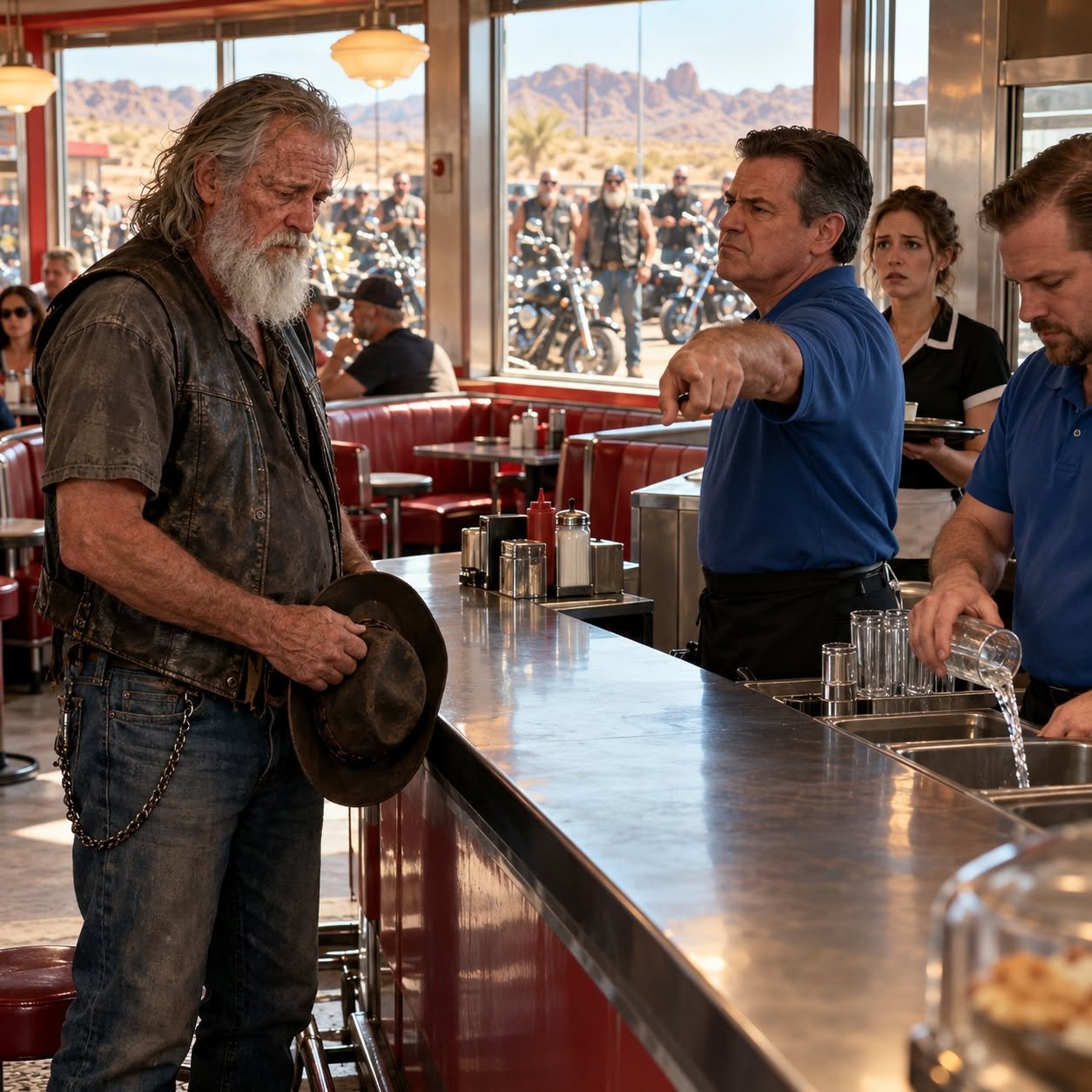
The manager poured the water into the sink while I was still standing there. Not because the glass was dirty — because the waitress had filled it for me. Outside, the thermometer read 106 degrees. I had buried my oldest friend that morning, and I was having trouble keeping my hands steady.
My name is Walter Hayes. Most of my friends call me Ash. I had been riding motorcycles since I was seventeen. The man we buried that morning, Eddie Lawson, had been riding beside me almost as long. We had survived bad jobs, worse marriages, and enough mechanical failures to open a museum. For forty-six years, he had called every Sunday. Sometimes we talked for an hour. Sometimes he only said, “Still breathing?” I would say, “Unfortunately.” Then he would laugh. The previous Sunday, his daughter called instead. She didn’t laugh. She just told me the time of the service.
The service was small and plain, the way Eddie would have wanted it — no fuss, no long speeches. His daughter spoke for five minutes about a father who taught her to change her own oil and never let her win at checkers. The club stood in a row at the back in their vests, forty strong, silent as stone. When it was over, Eddie’s daughter hugged me hard and said, “He talked about you every week, Ash. Every single week.” I carried that with me to the diner like a warm coal.
After the funeral outside Bullhead City, everybody wanted to eat together. I couldn’t manage it. Grief is a strange thing — sometimes you need people, and sometimes you need road. I told them I needed a little road. That was how I ended up pulling into the Juniper Diner outside Kingman, Arizona, with a dry throat and Eddie’s folded funeral program inside my vest. I knew the owner, but I hadn’t visited in years. A diner changes when you stay away. New paint. New booths. New people behind the register. The bell above the door was the same.
A young waitress looked up and smiled. “Just one?” “Just me.” She reached for a menu, but a man in a blue polo stepped in front of her. His name tag read BRENT. “I’ll handle it, Hannah.” She stopped so abruptly that I noticed. Brent looked at my vest, then my boots. “Dining room’s pretty busy.” There were three empty stools at the counter.
I noticed Hannah’s eyes flick to Brent and then away, quick as a blink. She’d been reaching for a menu with a genuine smile, and it died the instant he stepped in. There was history in that flinch — a young waitress who’d been corrected before, in front of customers, and had learned to go still. I knew that stillness. I’d seen it in dogs that had been kicked. It made something in my chest tighten, even before I understood what was happening. “I only need somewhere cool for a minute,” I said. “Could I get some water?” Another man came around the register. SCOTT, according to his name tag. “Restrooms and tables are for customers.” “That’s fine.” I took out my wallet. “I’ll buy a lemonade.” Brent didn’t reach for a menu. “We’re trying to keep this a family place.” I looked past him at a little boy dipping fries into his milkshake. “So am I.” I meant it gently. Scott heard something else. “Don’t get smart.”
The room began to quiet. That was the worst part: feeling everyone listen while pretending they weren’t. I set five dollars on the counter. “Water, lemonade, whatever’s easiest.” Scott pushed the money back with the tip of his finger. “We’re asking you to leave.” Behind them, Hannah filled a glass. Brent turned. “What did I tell you?” “He looks overheated.” “Dump it.” She hesitated. He held out his hand. The ice made a small, bright noise against the stainless-steel sink. I remember staring at it. Such an ordinary sound. I had heard it thousands of times without feeling anything. That day, it sounded like a door closing.
At a nearby booth, an older couple suddenly found their plates fascinating. A truck driver at the counter stared into his coffee. Nobody said a word — and I understood, because I’d been that person too, the one who watches something wrong happen and does the arithmetic of getting involved. Shame burned up my neck, hotter than the grief. Not just at them, but at the whole quiet room, myself included, for letting a girl with a kind heart stand alone.
Scott stepped closer. “You heard him.” Then he touched the faded patch on my vest. “What’s this supposed to be? Some tough-guy club?” I moved back. “Please keep your hands to yourself.” His smile disappeared. Brent put his palm flat on the counter hard enough to rattle a spoon. “Out. Before we have to call someone.” I picked up my money. For a moment, I wanted to tell them who owned the place. I wanted to explain that I had helped that man carry the original grill through the back door twenty years ago, back when the Juniper was a cinder-block box with six stools. But another thought stopped me. What if I hadn’t? What if I really were just an old stranger with five dollars and nowhere cool to sit? Would that make it all right? “All right,” I said. Then I walked outside.
The heat pressed against my face like an open oven. I sat on the low wall beside my motorcycle and called Marcus, our riding club’s road captain. They were gathering less than ten miles away, waiting for me to join the meal I had declined after the funeral. I gave him the name of the diner. “Stay put,” he said.
Marcus didn’t ask what happened. He didn’t need to — twenty years of riding together means you learn to hear things in a man’s voice. “You sitting down?” he asked. “I’m sitting.” “Water?” “Marcus, it’s 106 out here.” “On my way.” I could hear engines starting in the background before he’d even hung up. That’s the thing about a real club: it’s not the patch, it’s not the bikes. It’s forty people who come when you call, no questions asked, because one day it might be them on the low wall. Through the window, I could see Scott imitating the way I walked, and a couple of customers laughing. Hannah stood near the kitchen, holding an empty tray against her chest, not laughing. I looked down at Eddie’s funeral program. “Hell of a day,” I whispered.
Twenty minutes later, the first motorcycle turned into the lot. Then another. Then enough that people inside began getting up from their booths to look. Forty riders parked in orderly rows, leaving the entrance clear — Marcus runs a disciplined club. He reached me first and handed me a cold bottle of water. Behind the diner window, Scott stopped smiling. Then a pickup pulled in, and the diner’s owner climbed out. He hurried toward us, took one look at my face, and said, “Walter?” I stood up slowly. Inside, Brent was already pointing toward the phone. He had no idea the man walking beside me was the person he was about to call.
Frank Delgado had owned the Juniper for twenty-two years, and I had known him for thirty. He walked through that door with me beside him, and the whole diner went silent. He took in the scene — me, sunburned and hollow-eyed; forty riders visible through the windows; Brent with his hand on the phone; Hannah white-faced by the kitchen. “Somebody want to tell me what happened here?” he said quietly. Hannah spoke first, her voice shaking. “They wouldn’t serve him, Frank. I tried to give him water and Brent made me dump it.” Frank looked at Brent. Then at Scott. Then he said, in a voice that carried to every corner, “You threw a man out of my diner for asking for water?”
Brent started to explain about the family atmosphere. Frank held up one hand. “I built this place on the idea that a traveler can get a glass of water and a fair meal. You know who carried the grill through that back door with me?” He put his hand on my shoulder. “This man. Twenty years ago.” He looked at Scott. “And you put your hands on a customer.” Scott opened his mouth and closed it. Frank took a breath, and I could see the decision land. “Both of you — you’re done. Collect your things.” Just like that. No shouting. It was the quiet that made it final. Brent’s face went red, then white. Scott stared at the floor. They left through the kitchen, and nobody watched them go.
At the door, Scott paused and looked back at me, and for a second I thought he might apologize. What came out was smaller: “I was just doing what Brent said.” I looked at him steadily. “Son, that’s what everybody says.” He flushed and pushed through the kitchen door. I didn’t feel triumphant. I felt tired, and sad, and oddly sorry for him — because Brent would find another job, but Scott would carry that moment with him, and I hoped it taught him something. Hannah told me later he never came back to the Juniper. Maybe that was for the best.
Then Frank turned to Hannah. “You,” he said, and she flinched. “You did the right thing, and it cost you nothing to do it, but you did it anyway when your bosses told you not to.” He smiled for the first time. “You’re the shift lead starting tomorrow, with the raise that goes with it.” Hannah burst into tears — the good kind — and the whole diner applauded, including, I noticed, the little boy with the milkshake fries. Frank turned to the room. “Folks, I apologize for what you witnessed. This isn’t who we are.” Then he looked at my forty riders. “And I hope you’re all hungry, because the grill’s hot and lunch is on the house.”
What followed was the biggest lunch rush the Juniper had seen in years. Forty riders filled every booth and stool, ordering burgers and pie and telling stories, and the kitchen — with Hannah suddenly in charge — ran like a machine. Frank sat with me at the counter and ordered two lemonades, and we talked about Eddie. I told him about the Sunday calls. He told me about the time Eddie fixed the diner’s walk-in freezer at midnight on a Saturday and refused payment. We raised our glasses. “To Eddie,” Frank said. “Still breathing?” I said, and we both laughed, and it hurt, and it helped.
Before I left, Frank did one more thing. He took a piece of card stock and a marker, wrote something in his careful block letters, and taped it to the wall beside the register where every customer and every employee would see it. It read: “Nobody gets turned away for a glass of water. — Frank.” He stepped back and looked at it. “Twenty-two years I owned this place, and I never thought I needed to write that down.” He clapped my shoulder. “Thank you for teaching my staff a lesson I should have taught them myself.”
I rode home that evening lighter than I’d arrived, though the grief was still there — grief doesn’t leave, it just learns to ride pillion. At the club’s next meeting, Marcus proposed naming our autumn charity ride for Eddie Lawson, and forty hands went up at once. The first annual Eddie Lawson Memorial Ride raised enough to put a new roof on the veterans’ hall. I led the pack, with Eddie’s funeral program — now laminated — tucked in my vest, right over my heart.
Months later, I stopped at the Juniper again. Hannah — Shift Lead Hannah now, according to her new name tag — saw me through the window and had a glass of ice water on the counter before I’d even sat down. “On the house, Ash,” she said, grinning. “House rules.” The card was still on the wall beside the register, a little sun-faded now: “Nobody gets turned away for a glass of water.” I drank it slow and thought about that afternoon — the sink, the ice, the laughter — and about what I’d almost said and the better thing I’d realized instead. It shouldn’t matter who you know, or what your vest says, or whether the owner is your old friend. A glass of water is a small thing. Denying it is a big one. Frank understood that now. Forty riders understood it. And somewhere, I like to think, Eddie was laughing — because his oldest friend had finally learned the answer to his Sunday question. Still breathing? Unfortunately. And gratefully. And, thanks to a glass of water, a little more kindly than before.


