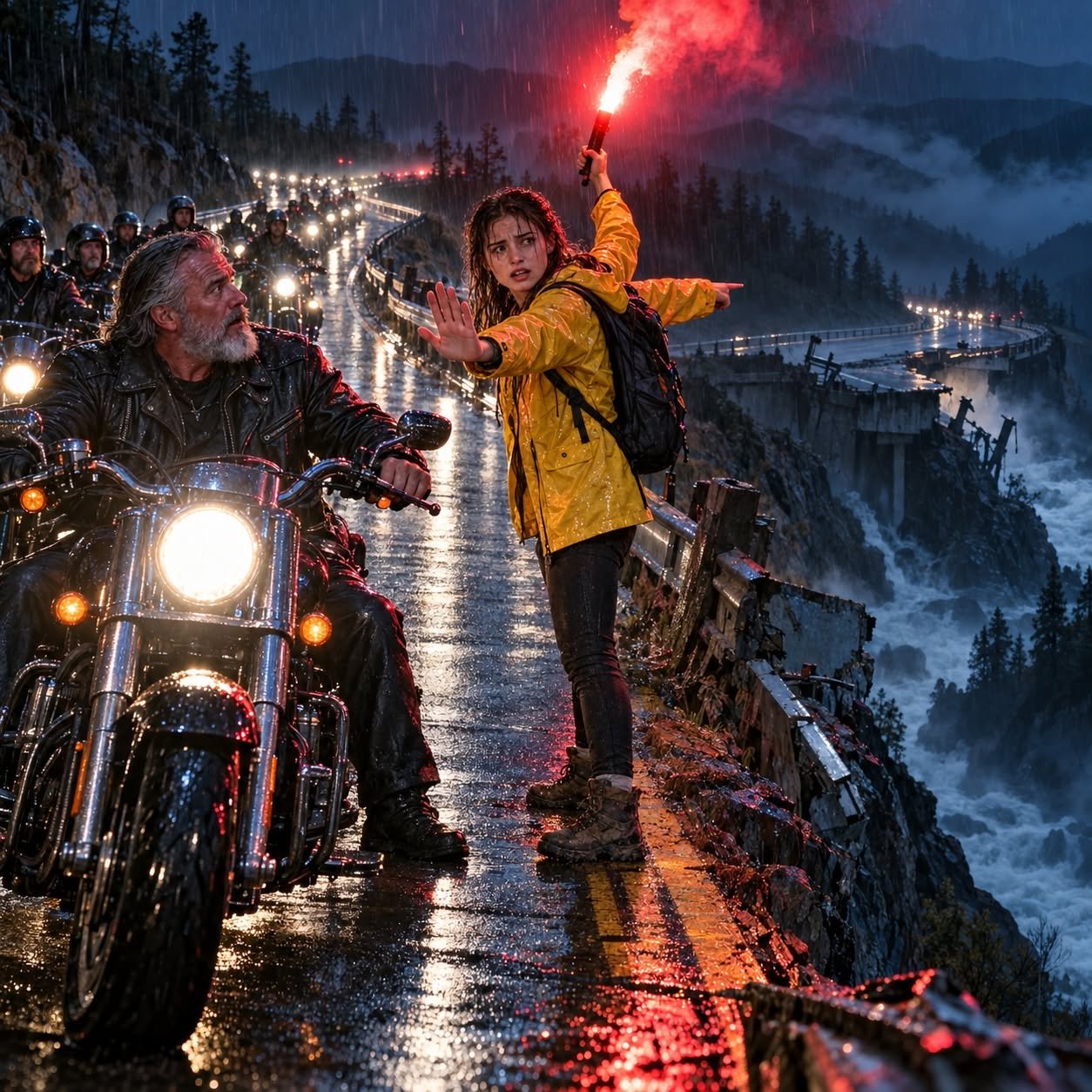
The motorcycle stopped so close that its headlight turned the rain on my coat into silver needles. The rider jumped off, furious — I could see his mouth moving, but I couldn’t understand him. Behind him, headlights filled the mountain road, stretching around the bend. Five hundred people had every reason to think I was the danger. None of them knew what waited beyond the next curve.
My name is Claire Bennett. I was nineteen, born profoundly deaf, and living in my grandfather’s old cabin in the San Bernardino Mountains. My uncle, Martin, operated a gas station down the mountain and checked on me often, though I insisted I could manage the cabin myself. That Friday, he had warned me about a large memorial ride scheduled to pass near midnight. Stay clear of the highway, he signed. Lots of motorcycles. Bad weather. I promised.
At eleven fifteen, my reading lamp flickered, and the cabin shook, and a mug slid off the table and broke near the stove. I knew the movement of storms against that house — wind pressed at the windows, heavy rain rattled the roof. But this had come through the floor, a deep shudder in the bones of the mountain itself.
My grandfather built that cabin with his own hands in 1962, and he raised me in it after my parents died. He taught me to read the mountain the way other children learn to read books — the way the floorboards tremble before a rockfall, the way the windows rattle differently for wind and for rain, the way the ground itself speaks if you know how to listen. “Your ears don’t work, sweetheart,” he used to sign, “so the mountain talks to your feet instead.” That night, my feet heard it first. I pulled on boots and my yellow raincoat, grabbed a flashlight, and went outside. The trail toward the gorge was familiar; my grandfather had walked it with me since I was small. That night, rain turned every root slick. I kept my light low and moved carefully until the trees opened above the highway. Then I stopped. The bridge was gone.
Beyond the guardrail, the road ended in darkness. Lightning briefly showed twisted steel far below, in the gorge. I backed away from the edge, my heart hammering against my ribs. Across the gorge, two flashlights moved among the concrete supports. One beam settled on a man standing beside the barrier, and another man joined him. I couldn’t hear what they said. I saw one point toward the highway approach, then check his watch. There were dark marks on the concrete, damaged equipment near the supports. I didn’t know enough to identify sabotage. But I knew enough not to announce myself. I switched off my light and crouched behind a tree.
Then I remembered the motorcycles. The bridge sat immediately beyond a blind curve. In daylight, a careful driver might notice something wrong. In that rain, the first riders might not see the gap until they reached it — and five hundred motorcycles were coming. I ran home. My phone showed no service, and an emergency message wouldn’t send. The cabin’s internet was down. I went to the truck. Nothing happened when I turned the key. Under the hood, my flashlight revealed wiring hanging loose where it shouldn’t have been. My stomach tightened. Someone had been beside my house.
I looked toward the dark trees, then back at my phone. Still nothing. The road wound around the mountain in a long horseshoe — walking along it to reach the straightaway would take too long. But there was another route, through the ravine: steep, muddy, familiar only in daylight. I took the roadside emergency kit from the truck and started down. Halfway through the trees, my boot slipped, and I slid hard into a fallen trunk. Pain shot through my shoulder, and my flashlight rolled away. I found it beneath a branch. Then another light swept across the trees above me, and I went still. A man moved along the ridge with something long in his hands. I couldn’t tell whether he had heard me. That uncertainty frightened me more than knowing would have.
I crawled behind the fallen trunk and covered my flashlight. His beam passed over the ground beside my boot — so close I stopped breathing. I waited until it moved away, then continued, slower now, using both hands on the climb, my palms scraped raw and my left shoulder throbbing. By the time I reached the straightaway, my watch read eleven fifty-eight. I activated a red warning flare from the emergency kit and held it above my head. The first headlight appeared through the rain. Then three. Then so many that the darkness behind them seemed to retreat. I waved from the edge of the lane, stepping farther into view when I saw the lead rider begin slowing. Brake lights spread backward through the procession like a red wave.
The first motorcycle stopped. The rider dismounted and came toward me, pointing at the flare, his mouth moving fast. I signed: Bridge down. Stop. People ahead. He didn’t understand. I pointed to my ears and shook my head. His expression changed — the anger drained out of it, replaced by something focused and serious. He took out his phone and opened a blank screen. I typed with wet, clumsy fingers: BRIDGE GONE. PEOPLE THERE. DO NOT GO. He read it twice. Then he turned and signaled to the riders behind him, and within moments the whole mountainside was still except for the rain and five hundred idling engines.
Behind him, the line of riders stretched back around the bend, and I saw a woman dismount and hurry forward with a dry jacket, which she draped over my shaking shoulders without a word. Another rider pressed a thermos of coffee into my hands. Nobody pushed, nobody shouted. Five hundred bikers, and the only sound was the rain. Later, Cole told me through his phone that the moment they understood — a deaf nineteen-year-old girl, alone, in a storm, trying to save them — the whole road went quiet out of respect. I hadn’t noticed. I was too busy being terrified. A few minutes later, two men returned from checking the road on foot. Even before the leader turned his phone toward me, their faces told me they had seen it. SHE’S RIGHT. THE ROAD ENDS. My knees weakened with relief.
Then the headlight beside us exploded.
The leader seized my coat and pulled me down behind the motorcycles as glass scattered across the wet asphalt. The bridge hadn’t been the whole trap. From the ridge above came the flat crack of a rifle, and I understood — in the way you understand things when your life depends on it — that the two men at the gorge had seen us stop the ride, and they were not going to let witnesses leave this mountain. The leader — I learned later his name was Cole, a road captain with twenty years of riding — kept one arm across my back and used his free hand to type on his phone, holding it up for the men around us. TAKE COVER. ENGINES OFF. LIGHTS OUT. Five hundred motorcycles went dark and silent, and the mountain held its breath.
What happened next, I watched through the rain with my heart in my throat. Two riders — later I learned they were former Marines — slipped into the trees with the quiet competence of men who had done this before, moving uphill toward the ridge.
I grabbed Cole’s sleeve and typed with shaking hands: THEY HAVE A GUN. PLEASE BE CAREFUL. He read it, nodded once, and typed back: THEY’RE TRAINED. STAY DOWN. I stayed down, but I watched the treeline with my whole body tense, counting heartbeats the way my grandfather taught me to count seconds in the dark. Every vibration through the wet asphalt told me something — engines cooling, boots moving, men breathing hard. When the two Marines came back down the hill with the rifleman between them, I felt it through the ground before I saw it, and I started crying with relief. Cole stayed with me, his hand on my shoulder, and I realized he was humming — I could feel it through his palm, a low vibration meant to calm me. It worked. Below us on the road, a young rider with a shaking hand managed to get one bar of signal and called 911, and another rode hell-for-leather back down the mountain to Martin’s gas station. My uncle, who had been watching the clock and worrying, called the sheriff before the rider even finished talking.
It was over faster than it had begun. The two men on the ridge, realizing the mountain was now full of witnesses and that sirens were winding up from below, tried to run — straight into the path of the two Marines. Deputies arrived within the half hour, soaked and grim, and took them into custody. And then the truth came out, piece by piece: the men were fleeing an armed robbery two counties over. They had blown the bridge to slow any pursuit, cut the wiring in my truck so I couldn’t drive for help, and smashed the junction box that fed my cabin’s internet. The man with the long object on the ridge had been their lookout. If five hundred motorcycles had ridden around that blind curve at midnight, in that rain — I don’t let myself finish that thought. The sheriff finished it for me, quietly: “Young lady, you saved a great many lives tonight.”
Dawn came gray and exhausted. The wreckage in the gorge steamed in the rain. Martin arrived and hugged me so hard my injured shoulder protested, and I didn’t care. Cole stood awkwardly to one side until I walked over to him, and then — in front of five hundred bikers — this tough road captain wrapped me in a hug as gentle as my grandfather’s. One of the scouts pressed a folded bandana into my hand. “For the shoulder,” his phone said. I cried then, for the first time all night, and nobody pretended not to notice.
The memorial ride was postponed one week, and when it finally rolled, I was the guest of honor. I rode behind Cole on his big touring bike, my arms around his jacket, my yellow raincoat replaced by a vest the club had made for me — with my name stitched on the back and, beneath it, the words “SHE STOPPED FIVE HUNDRED.” Five hundred motorcycles rode in perfect formation through the mountains that day, and when we crossed the temporary bridge the county had rushed into place, every rider slowed, and five hundred headlights dipped once in salute. I felt the rumble of it through the whole bike, and I laughed out loud.
The club wouldn’t let the story end there. They repaired my truck — properly, with a full tune-up — and installed a satellite emergency beacon on the cabin, the kind that works when nothing else does. They put a new roof on my grandfather’s cabin, refusing to take no for an answer. “You saved our lives,” Cole typed, when I protested. “Let us fix your roof.” And then I did something for them: I started teaching the club basic sign language. Every month, a dozen leather-clad bikers sit in a circle and carefully shape their big hands into “thank you,” “are you okay,” and “slow down.” They are terrible at it and they love it.
People ask me if I was scared that night. I tell them the truth: I was terrified. But I also tell them something I’ve come to understand since — that being deaf saved those riders as much as I did. A hearing person might have slept through the tremor, or mistaken it for thunder. I felt the mountain shudder through the floorboards because feeling vibrations is how I’ve listened to the world my entire life. What some people call a disability was, that night, the exact ability five hundred people needed.
This spring, on the anniversary, the club rode the mountain road again — all five hundred, plus some new faces. At the new bridge, Cole stopped the procession, and every motorcycle’s headlight blinked twice: on-off, on-off. He turned to me and signed, slowly and carefully, the first phrase I’d taught him: THANK YOU. Five hundred headlights blinked it back at me in the dusk. I stood on the shoulder of that road in my stitched vest, and I signed back the only answer there was: YOU’RE WELCOME. Then we rode on into the mountains, five hundred strong, and the road ahead was whole.


