Wyatt Mercer married me for my father’s land. Not for my smile, not for my heart, and certainly not for the heavy, full-figured woman standing beside him at the altar in a dress that had taken my mother’s best friend three weeks to fit. He wanted Willow Creek Valley, the only dependable water source for miles across the unforgiving Texas Panhandle, and I was simply the price he had to pay.
I heard what he told his ranch hands after our wedding, because the kitchen door was thin and their laughter was not. “She won’t last one Texas summer,” he said. “Look at her. She can barely cross the yard without stopping.” The men laughed. I stood behind that door with my hands trembling around a cold tin plate, and I made myself a promise: one day, Wyatt Mercer would regret every word. I just never imagined that day would begin with an abandoned stove, twelve hungry cowboys, and a terrible accident that would leave my husband fighting for his life.
Texas Panhandle, 1882. Dust settled over everything. It crept beneath doors, coated the windowsills, and turned freshly scrubbed floors brown before the water dried. On my fourth morning at the Mercer ranch, I stood in the neglected kitchen leaning against a broom, my pale-blue cotton dress clinging to my broad shoulders and generous curves. At thirty-one, I was a large, full-figured woman with rounded cheeks, a soft waist, and wide hips — a body that had never fit anyone’s idea of a delicate frontier bride. My arms ached from hauling water and my back protested every movement. But I was still standing, and that was more than most people expected.
Eight days after my father’s funeral, Wyatt Mercer had married me in a ceremony lasting barely twelve minutes. Father had left me Willow Creek Valley, and Wyatt needed its water for his cattle, and the county men insisted a woman couldn’t protect such valuable property alone. So I accepted the marriage — not because I was foolish enough to believe Wyatt loved me, but because I had spent fifteen years caring for my sick father, and I refused to lose the one thing he had trusted me to keep. Wyatt brought me to his ranch, showed me my bedroom, and disappeared into the cattle country. He never asked what I could do. He only looked at my size and decided what I couldn’t.
At supper, an elderly ranch hand named Hollis delivered a plate of gray salt pork and a biscuit so hard I suspected it had once been used as a horseshoe. I stared at it, then carried it outside, where the hog devoured it happily. “At least somebody appreciates the cook,” I murmured. The next morning I discovered the kitchen: a magnificent cast-iron stove standing beneath years of grime, a pantry smelling of spoiled grain, cobwebs on the ceiling, cupboards thick with dust. But beneath that neglect I found treasure — good flour, dried apples, cured bacon, beans, onions, garlic, sorghum, and crocks of lard. Enough food to nourish twelve hardworking men, yet every evening they ate like prisoners. I placed my palm against the cold stove. “Well, old girl,” I whispered, “looks like we’ve both been underestimated.”
For three days I worked. I scrubbed the stove until its iron shone, washed the shelves, cleared the pantry, and brought my father’s sourdough starter back to life. By Friday afternoon the kitchen smelled of lemon oil, clean wood, and fresh possibilities. That was when Wyatt came home. He filled the doorway, tall and broad-shouldered, his dark hair damp beneath his hat, and his eyes moved slowly around the room. “What happened in here?” “I cleaned.” “I can see that.” He noticed the green beans in my lap. “Hollis left your supper.” “I gave it to the hog.” Wyatt stared. “You didn’t like it?” “Hollis doesn’t cook, Mr. Mercer. He frightens ingredients until they surrender.” Something unexpected happened — Wyatt nearly laughed. Then his expression hardened. “We don’t have time for fancy meals. Men work. Food is fuel.” “Then perhaps you should stop poisoning the engine.”
His jaw tightened while I continued snapping beans. “Tomorrow, I’m cooking supper.” “For twelve men?” “Unless you’ve misplaced a few.” “You’ll exhaust yourself before noon.” There it was again, that familiar judgment. I slowly placed the beans on the table. “Mr. Mercer, this body has carried flour sacks, water buckets, grief, and your family name. Don’t mistake a woman’s size for weakness.”
That night I lay awake listening to Wyatt breathe on his side of the bed, and I thought about my father’s sourdough starter bubbling beside the window — fifteen years old, carried across three counties, kept alive through my father’s long illness because I fed it every single day without fail. Some things survive on stubborn care. I had kept my father alive for fifteen years. I had kept myself alive for thirty-one. I wondered, in the dark, whether Wyatt Mercer had any idea what kind of woman he had married. I decided he was about to find out. For several seconds Wyatt said nothing. Then he turned and walked away — but not before glancing toward the bubbling sourdough starter beside the window. That night we slept on opposite sides of the bed. Wyatt had never touched me with affection, had never even asked whether I was comfortable. Our marriage was a business arrangement, and I knew it. Still, I believed a wife deserved respect, even one he hadn’t wanted.
Before sunrise, Wyatt prepared to ride toward the northern ravines. Several calves had wandered into dangerous ground, and the ranch hands needed to retrieve them before a storm arrived. “We’ll be late,” he told me. “Hollis will handle supper.” I looked at him steadily. “If you can still stomach Hollis’s cooking after smelling mine, I’ll serve it myself.” He shook his head and left. I waited until the riders disappeared beyond the ridge, then tied on my apron and went to work.
I built a roaring fire beneath the cast-iron stove, soaked beans with dried peppers, browned bacon in a heavy skillet, and set beef bones simmering in a deep iron pot. I brought out the last good shoulder of venison, mixed flour with cold lard, buttermilk, and a pinch of salt, and soon rows of tender biscuits waited beneath clean linen. Apples simmered with sorghum until the entire house smelled of cinnamon and sweetness. The kitchen came alive, and for the first time since arriving, I felt like myself again — not Wyatt Mercer’s unwanted wife, not the large woman strangers whispered about, just a capable woman doing something she knew how to do. By noon, smoke curled from the chimney, the beans were softening, the venison was roasting, and twelve hungry cowboys were about to discover what a real supper tasted like.
Then I heard hoofbeats. Fast. Too fast. A young ranch hand thundered into the yard, nearly falling from his saddle. “Mrs. Mercer!” I hurried onto the porch, and his face was pale beneath the dust. “Something happened at the ravine!” My heart lurched. “What happened?” “The ground gave way. Three men are hurt.” He swallowed. “And Mr. Mercer — he’s trapped beneath a steer. We can’t move it. And the storm’s coming straight toward us.” I looked north. The sky had turned black as iron, and thunder rolled across the plains. For one terrible moment I could almost hear Wyatt’s voice: You’ll exhaust yourself before noon. You won’t last one Texas summer. I looked at the wagon, the medicine chest, the horses. Then I removed my apron. “Help me hitch the team.”
The young cowboy blinked. “Ma’am, Mr. Mercer said you weren’t supposed to—” “I know exactly what my husband said.” I stepped down from the porch. “But he’s about to learn something he should’ve known before he married me.” Within minutes I had blankets, water, clean bandages, and the medicine chest loaded into the wagon, along with the pots of beans and the basket of biscuits — because hurt men need feeding as well as bandaging. The young hand stared as I gathered the reins. “You can drive this thing?” I looked him straight in the eye. “Son, I was driving wagons before you learned to saddle a horse.” Lightning flashed beyond the ridge. I snapped the reins, and as the wagon lurched toward the ravine, I had no idea that what awaited me there would change my marriage forever.
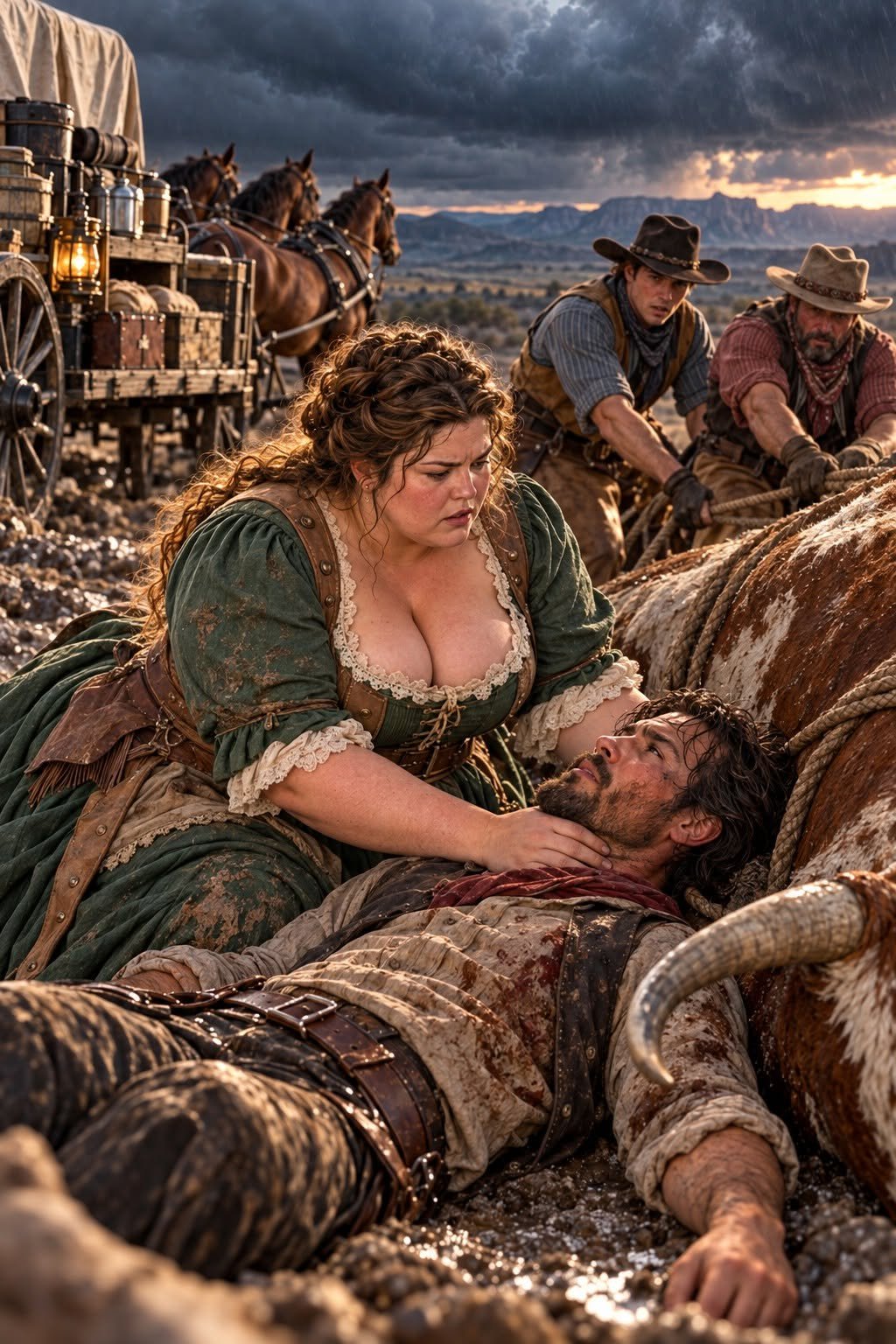
The scene at the ravine was worse than the boy had described. The steer lay on its side across Wyatt’s legs, easily a thousand pounds of dead weight, and Wyatt was white-faced and grim, his hat gone, one hand gripping a rock. Three other men sat or lay nearby, one with a gashed forehead, one cradling an arm, one dazed. The remaining hands had ropes on the steer but no leverage, and the first cold drops of rain were beginning to fall. Wyatt saw me and his eyes widened. “Ellen — go back. Get the doctor.” “The doctor is forty miles away and there’s a storm coming,” I said, climbing down. “Tell me what you need.” He stared at me for a long moment, and I saw the pride in him war with the pain. Finally he said, very quietly, “I need you to pull that steer off me. The men are hurt. You’re the only one here who can drive a team straight.”
It was the one thing no one believed a woman like me could accomplish — take a frightened four-horse team in a rising storm and drag a thousand-pound steer off a trapped man without dragging the man with it. I didn’t hesitate. I unhitched the team from the wagon, ran a long line from the doubletree to the steer’s hind legs, and positioned the horses on the firm ground above the wash. “When I say pull, you walk them forward slow and steady,” I told the young hand. “Not a run. A walk. You hear me?” Then I knelt in the mud beside my husband, took his hand, and said, “On my word.” I watched the rope, felt the tension, judged the angle the way my father had taught me when I was twelve and driving his freight wagon. “Now,” I said. The team leaned into the harness, the rope sang, and the steer shifted — an inch, then a foot, then clear. The men shouted.
The young hand who had ridden for help stared at me like I’d performed a miracle. “Ma’am,” he breathed, “you drove that team like—” “Like my father taught me,” I finished. One of the hurt men, the one with the gashed forehead, started laughing through his pain. “Boys,” he said, “I believe we’ve been wrong about Mrs. Mercer.” I knelt back down beside Wyatt, who was gripping my hand hard enough to hurt. “Told you,” I said softly. “Don’t mistake it.” He managed a pained grin. “Never again.” Wyatt cried out once as his legs came free, and then he was laughing, a wild, disbelieving laugh, and I was crying and didn’t care who saw.
I worked then the way I’d worked in my father’s sickroom for fifteen years — calm, quick, certain. I splinted Wyatt’s broken leg with a wagon slat and strips torn from my own petticoat, bound the gashed forehead, set the wrist as best I could, and got all four men under the wagon canvas as the storm broke. And then, in the rain, with thunder rolling over the ravine, I built a small fire under the canvas and served hot beans, venison, and biscuits to twelve soaked, shivering, grateful cowboys. Nobody spoke much. They were too busy eating. But I saw the way they looked at me, and it was not the way they had looked at me that morning.
The ride home took two hours through the mud, with Wyatt lying in the wagon bed under blankets, his head in my lap. He was feverish and half-conscious, but once, clearly, he said, “I’m sorry, Ellen.” I smoothed his wet hair back. “Hush. Save your strength.” “No,” he whispered. “I married the valley. I should have married the woman.” I didn’t answer, because my throat had closed up, but I held his hand all the way home.
Wyatt’s leg took six weeks to mend, and in those six weeks everything changed. He ate my cooking and asked for the stories behind the recipes. He watched me run his ranch — because someone had to, and I did — and he saw the hands come to me for decisions and the decisions turn out right. One evening, when he could finally stand with a crutch, he asked Hollis to bring him to the kitchen, and in front of the whole crew he said, “This woman pulled a steer off me in a storm and then fed twelve men under a wagon sheet. Any man here who ever laughed at my wife can take it up with me.” Nobody laughed. Old Hollis, to everyone’s astonishment, asked if he could learn to cook properly, and became my devoted assistant, and his biscuits — eventually — became almost edible.
When Wyatt could ride again, he did something I never expected: he had the county clerk draw up new papers putting Willow Creek Valley in both our names, equal partners. “It was never mine to take,” he said. “It was yours to share, if you chose to.” And then, awkward as a schoolboy, he began courting me — wildflowers on the kitchen table, asking about my day and actually listening, walking with me in the evenings while the valley turned gold. I made him wait a proper while. A woman should be courted, even by her own husband. Especially by her own husband.
A year later, on a quiet evening, Wyatt found me in the kitchen rolling out pie crust, and he wrapped his arms around me from behind — all of me, the way a man holds something precious — and said, “Best bargain I ever made.” I elbowed him. “You didn’t bargain, Mr. Mercer. You got lucky.” He laughed, and the sound filled the warm kitchen, and outside the window Willow Creek ran silver through the valley that was ours. Some marriages begin at the altar, I thought, flour on my hands and my husband’s arms around me. Mine began in a ravine, in the mud, in a storm — the day the proudest cowboy in the Texas Panhandle looked up at the wife he’d underestimated and finally saw her.


