The magistrate’s voice carried across the little frontier church, warm and certain, as he told the bridegroom he might now kiss his bride. Every head turned toward the couple. And Calvin Brooks took one step backward, away from the woman in the ivory gown standing beside him.
Henrietta felt the silence press down on her like a hand. She was a big woman, and she stood very still, and one tear traced a slow path down her cheek where everyone could see it.
Calvin did not look at her. He looked past her, toward the pew where her wealthy father sat stiff and satisfied, and said, “The paperwork is signed. The money had better be wired by noon.”
That was the beginning of their marriage.
Calvin Brooks had not married for love. He had married because the Broken Spur Ranch was bleeding out from under him, the bank circling, and a Chicago railroad man had offered a bargain plain as a fence line: marry my daughter, and the money that saves your ranch will be yours. Calvin had told himself he was buying time, nothing more. He had braced himself for a spoiled city girl who would weep at dust and demand to go home before the week was out.
What stepped down from the train was nothing he had prepared for. Henrietta wore a fine green traveling dress, and she leaned heavily on a cane, and her joints pained her with every step she took on the platform. She was a large woman, unhurried and dignified, and Calvin watched her come toward him and felt his disappointment show on his face before he could stop it.
He said nothing kind on the ride to the ranch. When the cabin came into view at last, he reined in and spoke the words she had already read in his eyes a dozen times over. “You have my name on paper. I’ll give you a roof over your head and keep you safe from harm. But don’t expect me to call you my bride.”
Henrietta lifted her chin. Her voice did not tremble. “As you wish, Mr. Brooks.”
For two months she lived beside a husband who barely looked at her. He ate the food she put on the table and slept under the roof she kept, and he spoke to her only when necessity forced him. It would have been easy to grow bitter. It would have been easy to grow useless. Henrietta refused to be either.
She set to work the way a river sets to wearing down stone. She scrubbed years of smoke and grime from the cabin walls until the wood showed clean. She learned the moods of the stubborn wood stove and coaxed it into baking bread whose smell filled the kitchen on cold mornings. She patched the cracks where the wind came through, boiled laundry until the gray left it, sorted the jumbled supply shelves, and one quiet afternoon sat down with the ranch ledgers Calvin had neglected for years.
She found mistakes. Small ones, and then not-so-small ones. Money leaking away in double-counted feed, in fees he had never questioned, in entries that simply did not add up. She corrected them in her neat hand, and Calvin ate the bread, and his accounts stopped bleeding, and he never once said thank you.
Then the banker came. He arrived one afternoon in a fine coat with two of his men behind him, just as Henrietta was hanging wet blankets on the line, her arms aching, her cane hooked over her elbow. He looked her up and down and laughed out loud. “I heard Brooks sold himself to a Chicago railroad man,” he said. “Didn’t realize they shipped the livestock with him.” His men snickered. He went on, louder, so the whole yard would hear: “For five thousand dollars, I’d have expected a woman who could fit through the front door without greasing the hinges.”
Henrietta went very still. The blanket slipped in her hands. Out of the barn came Calvin, crossing the yard without a word, and his fist caught the banker square on the jaw with a sound like a splitting log. The banker went down into the dirt, and his men scrambled to pick him up.
For one bright, dizzying moment Henrietta thought everything had changed. “Thank you, Calvin,” she whispered.
He stopped, but he would not look at her. “Don’t flatter yourself. I didn’t hit him for you. Nobody comes onto Brooks land and insults what belongs to a Brooks.”
That night Henrietta cried into her pillow so quietly that the cabin gave her away to no one.
The weeks that followed were cold and quiet. Then came a morning in November, strangely warm, the sky bruised purple at the edges while Calvin saddled his horse. Henrietta stood on the porch and studied that sky the way she had learned to study everything on the frontier, carefully. “Please stay close today,” she said.
He rode out without answering, and by noon the temperature had dropped forty degrees, and the horizon simply disappeared. A Wyoming blizzard came down like a curtain, and the world turned white and roaring.
Four miles from home, on a slope above a ravine, Calvin’s horse lost its footing on ice. Man and horse went down. The horse scrambled up and bolted. Calvin hit the frozen ground with a pain like lightning through his leg, and when he tried to stand, the leg folded under him and would not hold him.
He dragged himself against a rock out of the worst of the wind and pulled his coat tight, and the snow began to cover him, first his boots, then his shoulders. No hand knew where he had gone. No one would come looking until it was far too late. For the first time in his proud, hard life, Calvin Brooks understood with terrible clarity that he was going to die alone on that slope, and the thought that followed it, sharp as the cold, was of the woman waiting in his cabin, the woman he had never once called his bride.
Back at the Broken Spur, Henrietta stood at the window and stared into a wall of white. Calvin had ordered her to stay inside. And every cruel voice she had ever heard came back to her at once, the banker’s laughter and the whisperers in Chicago and her own tired doubts. Too heavy. Too slow. Too weak. Too useless.
She looked at the empty chair by the stove, the chair where Calvin should have been sitting. And then she made her decision.
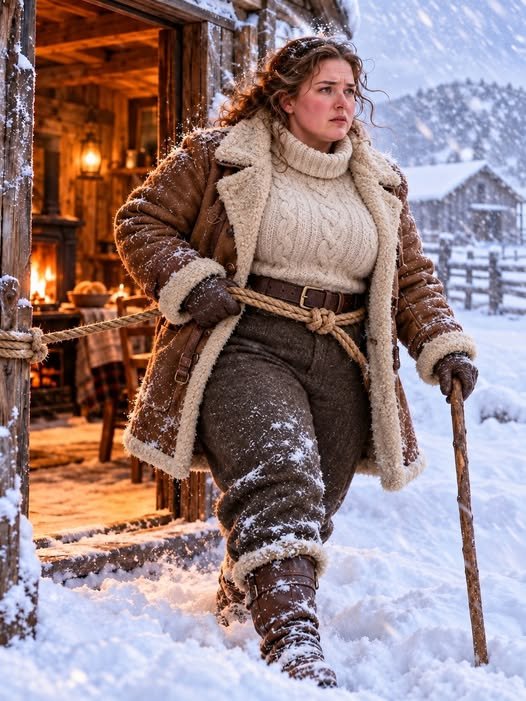
She took off the corset that restricted her movement and her breathing. She pulled on Calvin’s heavy wool trousers and his greatcoat. She wrapped scarves around her face until only her eyes showed. She tied a long ranch rope firmly around her waist and made the other end fast to the porch post, paying it out as she went, the way a sailor pays out line. Outside, the wind screamed across the plains like something alive.
Henrietta tightened her gloves. Then the woman Calvin Brooks had refused to call his bride opened the door and walked directly into the blizzard to bring her husband home.
The cold struck her like a blow. Within twenty steps she could not see the cabin behind her, only the rope stretching back into the white, her one thread connecting her to the world. She moved the way she had learned to move through pain all her life, one deliberate step at a time, her cane probing the drifts ahead. The wind tore at her coat and filled her mouth with ice. Twice she fell and hauled herself up by the rope. She called his name until her throat was raw, and the storm swallowed every sound.
She found him by the rope. The line caught on something solid beneath the snow near the ravine’s edge, and she followed it down with her hands and uncovered first a boot, then a coat, then Calvin’s face, pale and still beneath a mask of frost. For one terrible moment she thought she was too late. Then his eyelids fluttered, and he whispered her name. Not “woman.” Not “you.” Henrietta.
“I told you to stay inside,” he said, and she almost laughed, and almost wept, and did neither.
“As you wish, Mr. Brooks,” she said, and began to dig.
She bound his leg with strips torn from her own scarf and a straight branch, the way she had once bound a foal’s leg on her father’s estate, long ago, when she was a girl who believed kindness was a kind of strength. She got him sitting. She got him, somehow, standing on his good leg with his arm across her shoulders, and she took his weight, all of him, and began the long walk back along the rope, step by agonizing step, while the storm raged and her joints screamed and she did not stop.
It took hours. When the porch post finally loomed out of the white, she nearly fell to her knees with relief, but there was no time. She got him inside, stripped his frozen clothes, wrapped him in every blanket she owned, and built the stove up until the little cabin roared with heat. She rode out the next morning, in snow still falling, to fetch the doctor from town, and she sat by Calvin’s bed through the fever that followed, spooning broth between his lips, until his eyes opened clear and stayed clear.
The first thing he said, his voice rough and small, was, “You came for me.”
“You are my husband,” she said simply.
He was quiet for a long time. Then, haltingly, like a man learning to walk again, he told her the truth he had carried since the magistrate’s church. That he had been ashamed, not of her, but of himself, of the bargain he had struck, and he had punished her for his own shame because it was easier than facing it. That every meal she had cooked and every figure she had corrected had shamed him further, because she had given and he had only taken. “I don’t deserve you,” he said.
“Probably not,” Henrietta said, and for the first time in months, Calvin Brooks laughed, and then he wept, and she held his hand and let him.
The money came, wired by noon as promised, and the bank was paid, and the ranch was saved. But the greater saving had been done with a pencil in a quiet kitchen, and Calvin knew it, and the whole county came to know it, because Henrietta’s corrected ledgers turned up the banker’s own quiet cheating, and the man who had laughed at her on her own clothesline left Wyoming with his reputation in tatters.
Spring came to the Broken Spur. The snow melted off the high pastures, and the calves came, and Henrietta walked the yard with her cane and her head high, and the hands tipped their hats to her, every one. One evening Calvin found her on the porch, watching the sun go down behind the hills, and he sat beside her, and he took her hand, and he said the words he should have said in that little church a lifetime ago.
“Henrietta Brooks,” he said. “My bride.”
She turned to him, and her eyes were bright, and he leaned in and kissed her, gently, truly, in front of God and the ranch and nobody else at all. It was not the kiss the magistrate had asked for. It was better. It was earned.
And from that day on, whenever anyone asked Calvin Brooks how the Broken Spur had been saved, he told them the truth: it was saved by the strongest woman he had ever known, who walked into a blizzard for a man who did not deserve her, and walked out of it with his heart.