The desert had never felt so empty, or so full of a man’s regrets. Daniel Reeves drove with both hands on the wheel of his old pickup, the late-afternoon sun bleeding orange across the New Mexico sky, and he watched the numbers on the fuel gauge the way a man watches the days left in his life — counting down to nothing. Forty-one years old, five months without work, and another job interview in Albuquerque had ended with a smile and a promise to call that he knew by now would never come.
Pete had been dead five months. The little repair shop where Daniel had learned everything he knew — the shop where the smell of motor oil had smelled like home — was padlocked and dark. Pete had been more than a boss; he’d been the father Daniel’s own had never been, teaching him to listen to an engine the way a doctor listens to a heart. When Pete’s heart gave out on a Tuesday morning, the business folded with him, and Daniel folded a little, too.
He was driving the long way home that evening, down an old two-lane desert road he hadn’t taken in years, mostly because he couldn’t stand the thought of arriving anywhere with nothing to report. His wife, Karen, would be waiting with that patient, tired hope in her eyes that hurt him more than any rejection letter. His boy, Tyler, twelve years old, still believed his dad could fix anything.
That was when Daniel saw the smoke.
It rose thin and dark from below the highway shoulder, off past the guardrail where the land fell away toward a dry wash. He slowed, squinted, and then he saw it — an SUV nose-down against a boulder the size of a small house, its hood crumpled and steaming. Daniel’s hands moved before his mind caught up. He pulled onto the shoulder, threw the truck into park, and was down the embankment before the dust from his own tires had settled.
The driver’s window was shattered. Inside, a young woman — maybe twenty-five — was twisted in her seat, her face pale and streaked, one leg pinned hard beneath the collapsed dashboard. Smoke was seeping from under the hood, curling toward the cab. “Hey,” Daniel said, his voice coming out steady even though his heart was hammering. “I’m Daniel. I’m going to get you out of here.”
“I can’t feel my foot,” she whispered. Her name was Claire, she managed to say. Her phone had no signal. No one else had stopped. She’d been there nearly twenty minutes.
Daniel ran back up to his truck and grabbed the pry bar he kept behind the seat — Pete’s old pry bar, the one Pete had pressed into his hands the day he finished his apprenticeship and said, “A good man carries his tools.” He wedged it against the crushed metal, set his shoulder, and pulled until the veins stood out in his neck. The dashboard gave with a shriek of torn steel, and Claire gasped — half sob, half relief.
He half-carried, half-dragged her up the embankment to his truck, her arm around his neck, her breathing ragged against his ear. The smoke behind them was thickening. He laid her across the bench seat, drove like his own life depended on it to the gas station six miles up the road, and burst through the door shouting for someone to call 911.
The paramedics came. Claire was loaded into the ambulance, stable, conscious, and bound for the county hospital, where they would keep her overnight for observation. Daniel stood in the parking lot with the heat shimmering off the asphalt and realized he was shaking. He followed the ambulance in his truck anyway, because Pete had once told him, “You don’t leave a job half done, son,” and Daniel wasn’t sure this job was done.
So he sat in the waiting room with dried blood on his sleeve — not his blood — and stared at the clock and tried not to think about what could have happened if he hadn’t taken the long way home.
That was when the doors opened and the whole room seemed to shift.
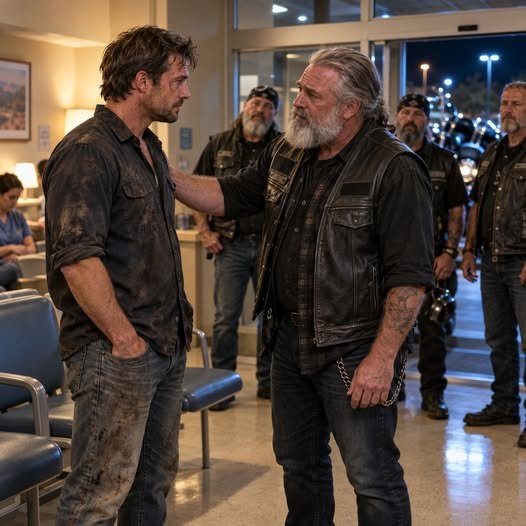
A broad man in a black leather vest walked in first, his boots heavy on the tile floor. Behind him came more leather, more boots — a river of motorcycle riders, forty of them, filling the doorway and spilling into the corridor. The waiting room went silent. Daniel stood up slowly, unsure whether to speak or step aside.
“I’m Claire’s father,” the big man said. His name, Daniel would learn, was Marcus Hale. “Tell me exactly what happened to my daughter.”
And Daniel told him. He told him about the smoke below the highway, and the boulder, and the pry bar, and Claire’s leg, and the drive to the gas station. He left nothing out, the way Pete had taught him to give an honest account of a repair — every step, every decision, plain and true.
Marcus listened without moving, his heavy arms crossed, his eyes never leaving Daniel’s face. When Daniel finished, there was a long silence. Then Marcus Hale — president of a riding club called the Desert Sons, a man whose vest carried patches earned over thirty years of highway miles — did something nobody in that waiting room expected. He reached out, took Daniel’s hand in both of his own, and held it.
“Son,” he said quietly, “you saved my little girl’s life. I will never forget it.”
What happened next nearly brought Daniel to his knees. The riders wanted to pay. Not just a thank-you, not a handshake — they insisted on covering Claire’s medical costs, every bill, down to the last penny. “She’s ours,” Marcus said. “And you’re the reason she’s still ours.” Daniel tried to refuse. They would not hear it.
Claire’s leg, it turned out, was bruised and sprained but not broken — the dashboard had caught it, not crushed it. She would walk with a limp for a few weeks, the doctors said, but she would be whole. That night, Daniel was allowed to see her. She was awake, pale against the white pillow, and when he walked in, she started to cry.
“I heard you didn’t leave,” she said. “I heard you sat out there the whole time.”
“My mentor taught me you don’t leave a job half done,” Daniel said, and smiled for the first time in what felt like months.
They talked for an hour — about the desert, about engines, about her father, about everything and nothing. Claire was a schoolteacher in a small town east of the city, and she loved her students the way Daniel loved a well-tuned engine. When he finally said goodnight, she held his hand and said, “Thank you for stopping. Nobody else did.”
The next afternoon, Marcus Hale called him. Not a text — a call, the way men of his generation still did things. “Daniel,” he said, “come see me. I have something to ask you, and I’d rather ask it face to face.”
The Desert Sons had a clubhouse outside town — a converted warehouse with a workshop in the back that serviced the club’s bikes. Marcus met Daniel at the door, offered him coffee in a chipped mug, and walked him through the workshop, where three motorcycles sat in various states of repair. “Our mechanic left last spring,” Marcus said. “Moved to Arizona. We’ve been patching things together since, and I won’t lie to you — we’re not mechanics. We’re riders. There’s a difference.”
Daniel looked at the bikes. A carburetor that needed rebuilding. A transmission that sang a half-step off. A wiring harness some amateur had butchered. His fingers itched the way they hadn’t in five months. He could see every problem and every fix, clear as daylight.
“Marcus,” he said slowly, “are you offering me a job?”
“I’m offering you more than that, if you want it.” Marcus leaned against a workbench and crossed his arms. “We’d pay you a fair wage to run this shop — real money, not charity. But I’ll tell you what I’d really like. I’d like to help you open your own place. Your name on the sign. The club’s bikes, the town’s bikes, whatever comes through the door. We’ll put up the seed money. You pay it back when you can, how you can. No contract that would choke a man — just my word, and yours.”
Daniel had to sit down. He thought of the padlocked shop, of Pete’s tools gathering dust in his garage, of Karen’s tired hope and Tyler’s twelve-year-old faith. He thought of the pry bar behind his truck seat.
“Why would you do that for me?” he asked, and his voice cracked on the last word.
Marcus was quiet for a moment. Then he said, “Because five months ago you were the kind of man who stops on a desert road. That kind of man doesn’t come around often. And because my daughter gets to teach her classroom tomorrow, and the day after that, and the day after that. That’s why.”
They shook on it, and then Marcus did what big men do — he pulled Daniel into a hug that nearly cracked his ribs, and Daniel laughed for the first time in months, right there in the middle of that workshop, with the smell of motor oil rising up around him like a blessing.
It took six weeks. The Desert Sons didn’t just write a check — they showed up. Riders who’d never held a wrench swept floors, painted walls, hung the sign. Claire came on a Saturday, still limping a little, carrying a potted plant for the front window and a handmade sign that said “Grand Opening — Free Coffee for Heroes.” She hugged Daniel so hard he thought she might never let go.
They named the shop Reeves & Son Auto Repair. “Son’s a little premature,” Marcus said with a grin, nodding toward Tyler, who was already sweeping the bay with enormous seriousness. “But a boy who sweeps a shop floor like that is going to earn it.”
On opening day, the parking lot filled with motorcycles — forty of them, chrome glinting in the morning sun. Marcus presented Daniel with a leather vest of his own. On the back, the Desert Sons patch. Under it, stitched in careful thread, a new patch that read: “Family.”
Karen cried when she saw it. She told Daniel later she’d been scared — scared that the man she married was disappearing a little more each day he went without work. “You’re back,” she said simply. And he was.
Claire kept coming by the shop, at first with thank-you casseroles, then just to talk. She and Karen became friends. She tutored Tyler in math at the little desk in the shop’s office while Daniel worked, and Tyler — who had worshipped his father quietly for years — started telling his friends at school that his dad was the bravest man in New Mexico.
A year later, Daniel stood in his own shop — his name on the sign, his tools on the benches, Pete’s old pry bar mounted in a place of honor above the door — and watched Marcus roll in with Claire riding behind him. They’d come for the shop’s anniversary, and Claire brought a gift: a framed photograph of a desert road at sunset.
On the back she’d written: “For the man who stopped. You didn’t just save my life that day. You found yours.”
Daniel keeps that photograph in his office, where he can see it from his workbench. He tells every young mechanic who comes through his door the same thing Pete told him, and the same thing the desert taught him on that empty road: a good man carries his tools, a good man stops when he sees smoke, and sometimes the life you save turns around and saves yours right back.
He was out of work five months. He was a stranger on a desert road. And then he was family — to a teacher with a brave heart, to forty riders with engines like thunder, and to a broad man in a leather vest who asked him what happened and then changed everything with six words:
“Son, you saved my little girl.”


