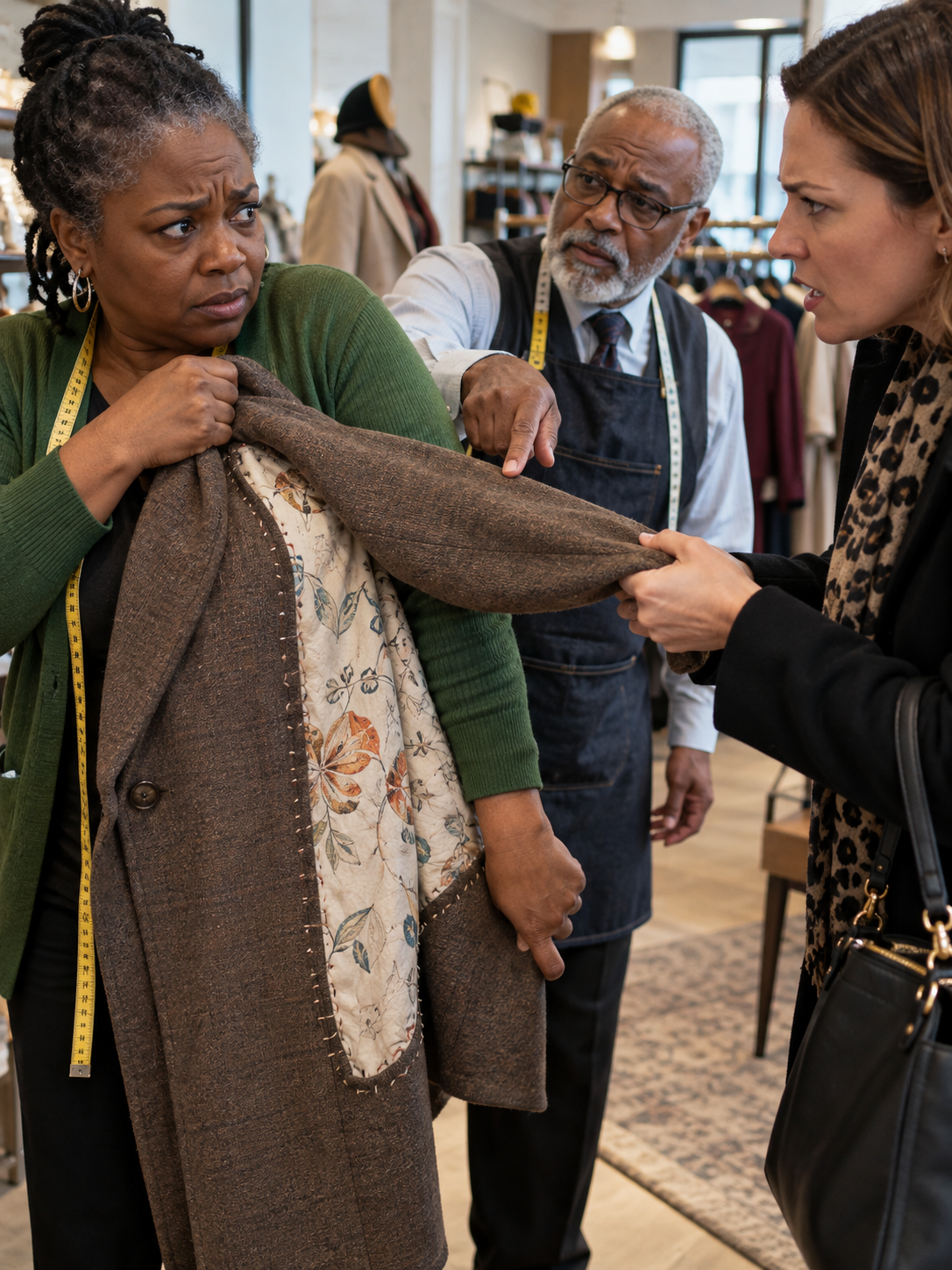
The shopper caught the coat by its sleeve before Vivian reached the counter. “That came off the display,” she said loudly. Vivian turned, holding the wool close so the pull would not tear it. Behind them, a sales assistant looked from the shopper’s expensive handbag to Vivian’s green cardigan. The store tailor came out of the fitting area when he heard the word thief.
Vivian was forty-eight and had brought the coat to have its lining finished. She could sew, but her own machine had broken halfway through a project she wanted completed before the weekend. She had called ahead and spoken to Mr. Harris, the tailor. He told her to bring it in. The coat had never belonged to the store or hung on any display inside it.
The shopper insisted she recognized the fabric. A similar coat was advertised in the window, and Vivian had been standing nearby. That was enough for her to decide she should prevent someone leaving. Vivian asked her to release the sleeve. The woman tightened her grip and told the assistant to call security. People by the scarves began watching, some holding garments frozen halfway between rail and basket.
“Please take your hand off my coat,” Vivian repeated. Her voice sounded calmer than she felt. She knew how quickly a public accusation could settle into the room, especially when the accused person was expected to prove innocence while everyone else watched. She was a Black woman carrying work she had made herself. A stranger was treating both facts as something suspicious.
The assistant finally stepped between them and asked the shopper to let go. Mr. Harris approached with the appointment book still open. He recognized Vivian’s name from the call and asked to see the coat. The shopper said he should check the store inventory first. He answered that he would speak to the person who brought the garment before accepting anyone else’s account of it.
Vivian laid the coat across the counter. The outer wool looked ordinary enough: brown, warm, carefully brushed. Then Mr. Harris opened the unfinished lining, and a bright pattern of birds and climbing leaves appeared inside. Vivian touched a tiny stitched initial near the hem. Her sister had drawn those birds before she died. It was the reason Vivian wanted the coat finished by Saturday.
Her sister, Renee, had illustrated fabric for small shops and community sewing groups. The lining came from the last piece Vivian kept after clearing Renee’s studio. Saturday would have been her birthday. Vivian wanted to wear the coat when the family met for lunch. The outside could be practical. The inside could hold something lively Renee would have chosen for herself without asking whether it matched.
Mr. Harris inspected the seam allowance and the hand-basted edges. He did not need a sentimental explanation to know the garment was a customer’s unfinished work. He asked the manager to check the display coat anyway, so the accusation could be closed clearly. Its fabric was a different weight, its buttons a different shape, and its lining plain gray. Similar from a distance did not mean identical. He placed the two coats near each other only long enough to document the differences, then returned the store garment to its hanger. Vivian did not want her work handled by the shopper again. Mr. Harris honored that without making a fuss. The manager took notes while Vivian described the appointment, the grab, and the words spoken before anyone asked her name.
The manager asked the shopper to apologize. She said she was trying to help the store and that anyone could have made the mistake. Vivian pointed to the sleeve, where the fabric had stretched beneath the woman’s fingers. “Anyone could have asked,” she said. The shopper looked toward the other customers, as though the audience she had created might now protect her from answering.
Vivian asked for the incident to be recorded and the security footage preserved if available. She wanted an accurate account, not another round of public speculation. The manager agreed. The assistant apologized for hesitating before asking the woman to release her. Vivian thanked her for doing it eventually, but she did not assure her the delay had felt small. Her sleeve had been held the whole time.
Mr. Harris examined the stretched section. The wool could be eased back carefully, and he showed Vivian where it needed attention. They discussed the lining as two people who understood sewing: the curved hem, the loose corner, and how to keep the birds upright when the coat moved. Vivian’s shoulders settled as the conversation returned to the work she had come to do.
The shopper left before the appointment ended. Vivian was glad. She did not want to perform forgiveness while still upset. The manager offered to waive the finishing charge, but Vivian asked to keep the repair bill separate from the incident. Mr. Harris’s time was worth paying for. The store could address the torn confidence of its welcome without turning a craftsman’s skilled labor into a coupon.
They eventually agreed the store would cover the damage caused by the grab while Vivian paid for the lining work she originally requested. The written receipt described both clearly. It was a practical arrangement, which Vivian preferred to vague assurances. Mr. Harris promised to call if any hidden problem appeared. She left the coat with him and walked out carrying an ordinary claim ticket instead of a burden of proof. Vivian checked the time before leaving. She had taken an hour away from work for the appointment and now needed longer. The manager offered a quiet place to call her office. She accepted. An accusation had already cost time as well as composure, and she appreciated a practical response that acknowledged the interruption rather than only promising better feelings afterward.
At home, Vivian told her husband what happened. He wanted to return to the store immediately. She asked him to sit with her first. She was tired of the scene and did not want to spend the evening creating another one. They made dinner, and she showed him a sketch of the birds Renee had drawn. He remembered the day she chose the lining fabric.
Mr. Harris called Friday morning. The coat was ready, with the stretched sleeve restored and the hem lying flat. He had left the little stitched initial visible inside because Vivian asked him to. She tried it on in front of the fitting-room mirror. When she opened it, the birds spread along both sides as if they had been waiting for someone to stop looking only at the outside.
The sales assistant recognized her and brought the receipt without announcing her return to the room. Vivian appreciated that. They spoke briefly about what happened, and the assistant said the manager had reviewed how to respond when a customer accused another customer. Vivian hoped the conversation included asking for evidence before accepting the loudest voice. The assistant said that was the first point they discussed.
At Saturday lunch, Vivian draped the coat over the back of a chair. Her niece noticed the lining and put down her fork. Renee used to draw birds in the margins of school notes. The family passed the coat around gently, remembering other illustrations that had appeared on shopping lists and birthday cards. Vivian told the store story later, after the lining had been allowed to mean Renee first. One of Renee’s friends remembered seeing an early version of the pattern pinned above her desk. The birds began as a drawing on a train ticket. Vivian had not known that. She wrote the detail down after lunch, happy to add a new memory to the fabric. The coat was becoming a place where family stories could meet without needing to be identical.
Her niece asked to learn how to sew. Vivian said they could begin with a straight seam and an old pillowcase rather than the coat. They met the following Sunday, laughing when the thread knotted. Vivian told her what Mr. Harris had said about leaving enough fabric inside a seam for the future. An object could be made with room for repair, even when the person making it hoped repair would never be needed.
The brown coat became an everyday favorite. Vivian wore it to work, the grocery store, and the bus stop. She did not save it only for occasions worthy of her sister’s memory. Renee had believed beautiful patterns belonged in ordinary life. Every time Vivian reached into a pocket, her hand brushed the bright lining she had almost been prevented from carrying across a shop floor. She kept the repair receipt with her sewing notes, not in the pocket as a permanent defense. Carrying proof everywhere would have given the shopper too much space in her life. If another question arose, she could answer it. For the ordinary walk to work, she preferred the coat to carry gloves, keys, and the bright lining she had chosen.
Mr. Harris had opened the coat to inspect the sewing. What appeared was a piece of a family’s life no stranger could have guessed from the window display. Vivian should never have needed that revelation to be treated fairly. Still, she was glad the story ended with the coat on her shoulders, the sleeve repaired, and her sister’s birds moving wherever she chose to go.