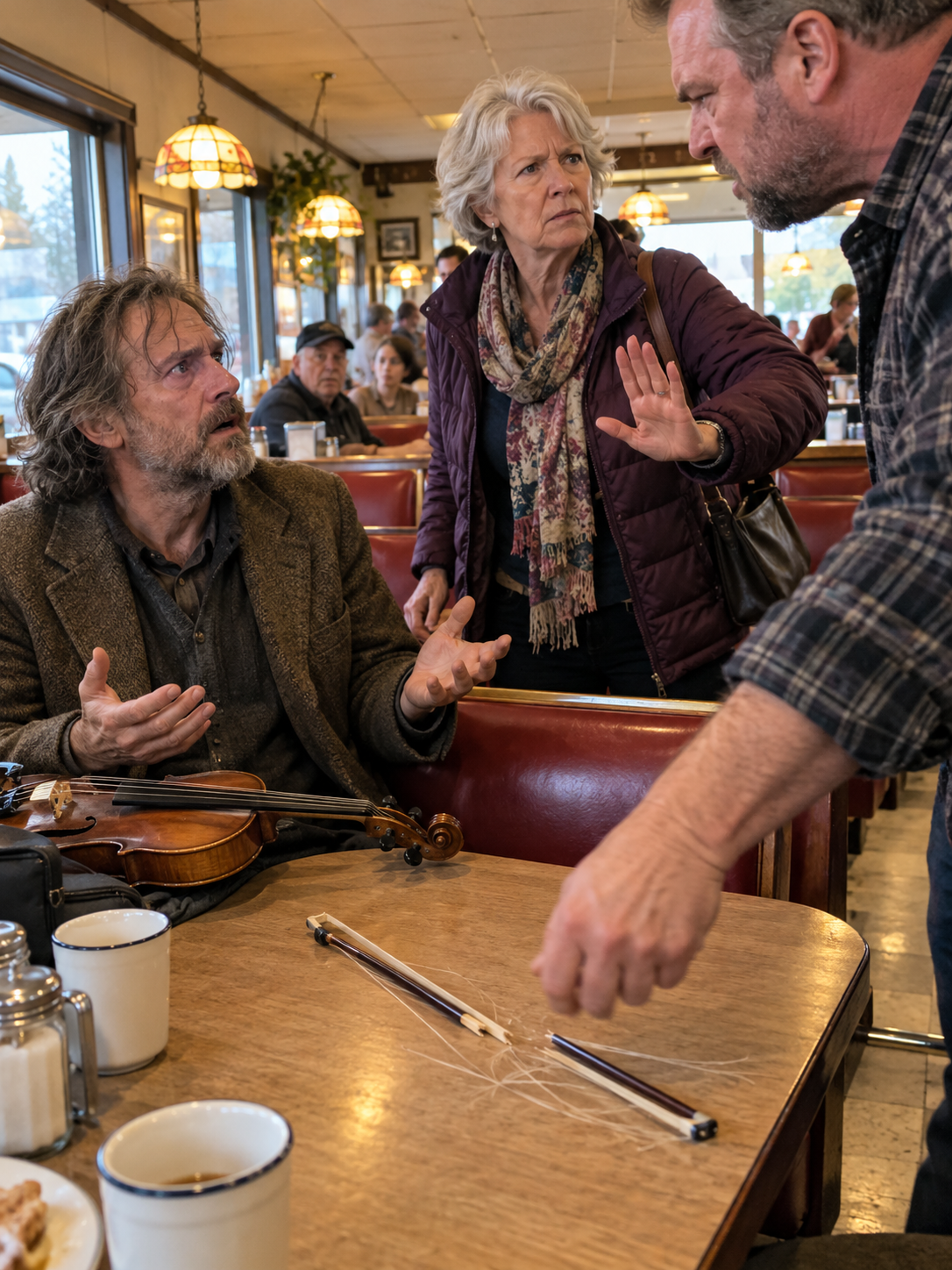
The bow broke with a dry crack loud enough to stop conversation in the diner. Thomas Vale stared at the two pieces on the table. He had not played a note inside. His violin case sat open only because he was checking a loose latch. The man standing over him said he had warned the owner about people coming in to beg.
Thomas was fifty and played outside the train station on afternoons when the weather allowed. He also repaired furniture in a neighbor’s workshop. That morning, he had earned enough for lunch and stepped into the diner he once visited with his wife. He ordered soup, placed his money by the menu, and opened the case so the broken latch would not catch the instrument.
The customer had complained before Thomas reached the counter. When Thomas said he was there to eat, the man took the bow from the case and bent it. Thomas rose too late to stop him. Now the horsehair hung loose between the broken ends. At table six, a woman in a plum-colored coat put down her tea and stood.
“Give him room,” she said. The customer told her to mind her business. She moved beside Thomas without touching either man. The owner came from the kitchen after hearing the sound. For a moment, everyone seemed to look at Thomas to decide whether this was going to become a fight. He sat down slowly and held out his hands, which were shaking.
The bow had belonged to his father, a school music teacher who bought it secondhand and cared for it for thirty years. It was not famous or exceptionally valuable to a collector. Thomas knew the exact place where his father’s thumb had worn the finish smooth. Seeing that small curve separated from the rest hurt more than he could explain in front of people eating breakfast.
The woman from table six looked inside the violin case. A program lay beneath the strings compartment, folded to protect a handwritten note. “Were you going to play this for someone?” she asked. Thomas nodded. He had practiced a particular piece for months, but the person expecting it did not know. He was supposed to leave for the train station after lunch.
His daughter, Emma, was getting married in a neighboring town that afternoon. She had asked him to come as a guest, promising he did not need to perform. Thomas wanted to surprise her with the tune his wife used to hum while washing dishes. After her death, father and daughter had spent years talking mostly about practical things because memories felt capable of upsetting an entire day.
The woman, Helen, introduced herself as a retired music teacher. She did not recognize Thomas or his violin. She recognized the care with which he laid the broken pieces on a napkin. She asked permission to call a colleague who repaired string instruments. Thomas said a new bow would be beyond what he could pay that morning, especially with a train ticket already in his pocket. Helen knew how quickly embarrassment could make a musician agree to whatever ended a scene. She asked Thomas whether he wanted her help before placing the call. He said yes. It mattered to him that she had not already decided what he needed. He gave her the repairer’s name from an old receipt, and she checked whether that workshop was open.
Helen said she was asking about a loan, not a purchase. Her colleague had a workshop ten minutes away and often lent student bows while repairs were underway. The owner wrote down what he witnessed and asked the destructive customer to leave while the matter was addressed. He kept the receipt showing Thomas had ordered a meal, because even that simple fact had been contradicted in public.
Thomas gave his account and kept the broken bow. He did not chase the man outside or try to win the room back with a performance. Helen sat across from him while the owner brought the soup he had paid for. His hands were steadier around the warm bowl. She asked what time his train left, then checked the route to the workshop on her phone.
At the workshop, the repairer examined the pieces and said the damage needed proper assessment. He would not promise an invisible repair. He did have a suitable bow to lend, along with a simple written agreement. Thomas played a few quiet notes to check the weight. The unfamiliar balance made him pause, then adjust. His father had always said an instrument required listening before insisting.
Helen waited while Thomas signed the form. She did not ask for a photograph or make him promise to repay kindness with a song. When he offered to help carry a cabinet in the shop another day, the repairer said they could discuss that after the wedding. The immediate task was getting a father onto a train with something he could use. On the station platform, Thomas called Emma’s aunt to say he was still on schedule. He did not ask her to keep the morning secret. She listened, then said there would be food waiting and a quiet room if he needed one. Those details helped him picture the rest of the day as a place he could arrive, rather than another performance he had to survive.
Thomas arrived with minutes to spare. On the journey, he kept the violin closed and reread the program. Emma had written him a note on its inside page: she knew weddings would be difficult without her mother and did not expect him to make the day easier for everyone. He had carried those words for weeks. Now he realized he could tell her what had happened rather than hide it.
He found her before the ceremony with her aunt nearby. He explained the broken bow and the borrowed one, then admitted he was not certain he could play without getting upset. Emma took his hand and said they could decide later. She was glad he came. The relief in that plain answer made him more emotional than the accident at the diner had allowed him to be.
After dinner, Emma asked whether he still wanted to try. Thomas took out the violin and told the guests where the melody came from. He made one mistake, stopped for a breath, and began the phrase again. Nobody looked disappointed. Emma stood beside her husband, smiling through tears at a tune she had last heard from another room while her mother cleaned the kitchen.
The performance did not repair the bow or erase the public insult. It returned the afternoon to the purpose Thomas chose before a stranger interrupted it. Afterward, he put the borrowed bow in its case and ate a slice of cake with his daughter. They talked about visiting the workshop together. It was the first future plan they had made that grew directly from remembering her mother. His new son-in-law asked about the violin after the plates were cleared. Thomas showed him the case and explained which part his father used to maintain himself. The conversation stayed practical and unhurried. He realized they had rarely spoken alone before. The borrowed bow became an opening into family life that would continue long after the wedding guests went home.
The damaged bow remained with the repairer for several weeks. Thomas followed up about the cost and the incident through the appropriate channels, keeping the witness account and assessment. Helen did not manage that process for him. She called once to ask about the wedding, and he described the borrowed bow, the repeated phrase, and Emma’s face when she recognized the tune.
Thomas returned the loan on time. The repaired bow looked different along the join, and the repairer explained its limitations honestly. Thomas decided to preserve it and use another for regular playing. A visible scar was easier to accept when nobody tried to sell him a promise that nothing had happened. He placed his father’s bow beside the folded wedding program at home.
The diner owner invited him back for lunch. Thomas went with Helen and paid for his meal. They talked about music teaching and old furniture, discovering they both preferred useful objects with signs of care. The owner asked whether he wanted to play sometime. Thomas said he would think about it. He liked having the choice restored without needing to decide immediately. Helen brought a program from a school concert she helped organize. Thomas recognized a piece he once taught Emma when she was small. They talked about beginners squeaking through their first lessons and the patience it took to let them finish. It was pleasant to discuss music without defending its value to someone determined to dismiss the person carrying an instrument.
Whenever Thomas remembered the crack in the diner, he also remembered a chair moving at table six. Helen had not known his father, his daughter, or the melody waiting in the violin. She simply saw someone damage another person’s belongings and refused to let that become an ordinary part of lunch. The rest of the story became possible because she stood up.


