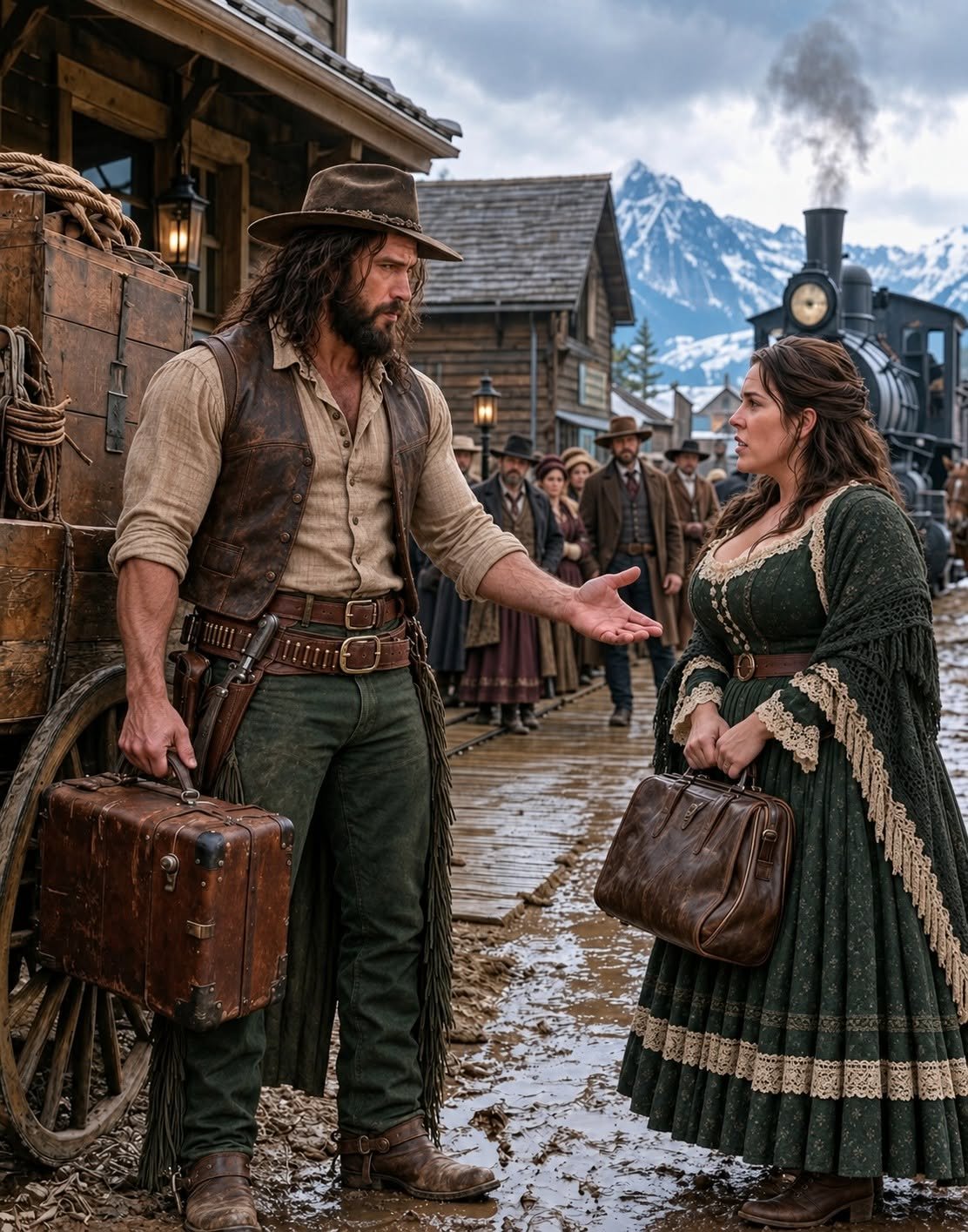
The locomotive let out a final, agonizing hiss, bleeding white steam across the splintered planks of the Oak Haven station. Abigail Mercer sat on her worn leather trunk and watched her future walk away without a backward glance.
Josiah Miller had taken one long, scrutinizing look at her calloused hands, her wind-chapped face, and the mud caked on her boots — and turned his back. No tipped hat. No apology. Just a folded letter slipped back into his vest pocket and the flat words: “The agency made a mistake.”
Abigail was twenty-eight years old, and she had spent everything she had on the ticket west.
Five days on a rattling train from a Chicago tenement, where the coal smoke had clung to her throat and the hunger had gnawed at her ribs, had brought her to this: a dusty Wyoming platform, forty-two cents in her reticule, and a trunk full of iron skillets that suddenly felt like an anchor.
She did not cry. Tears were a luxury for people who had someone to wipe them away.
The stationmaster kicked the side of her trunk with a scuffed boot. “Can’t stay here, lady. Freight’s coming in.”
“I’m waiting on an acquaintance,” Abigail lied smoothly.
“Wait on the street,” he grunted, and walked away.
Abigail gripped the leather handle and tried to drag the trunk toward the platform’s edge. The wood groaned against the planks. It moved two inches. Her hands burned.
“You’re tearing up the floorboards.”
The voice was deep, scraping like gravel under a wagon wheel.
She turned. The man behind her looked as though he had been carved directly out of the mountains looming in the distance — tall, broad-shouldered, a canvas coat stained with grease and wood sap, a thick dark beard, and eyes startlingly blue.
“It’s my trunk,” Abigail said defensively. “I’ll drag it how I please.”
“Suit yourself,” he said, and leaned against a post, pulling a knife and a piece of cedar from his pocket. He started whittling.
Abigail threw her weight backward again. Two more inches. A sharp, frustrated breath escaped her.
“Saw Miller walk away from you,” the man said quietly, not looking up. “He’s a fool. But he’s a vain fool. Wants a porcelain doll. Wyoming breaks porcelain.”
“If you’re here to gloat at a stranger’s misfortune, you can save your breath,” Abigail snapped.
He looked up then, snapped the knife shut, and stepped forward. Without asking permission, he reached down, seized the trunk’s handle in one massive scarred hand, and lifted it as though it weighed nothing more than a sack of flour.
“I ain’t gloating,” he said. “I’m calculating.”
He carried it off the platform and dropped it into the bed of a battered wagon loaded with flour sacks, kegs of nails, and a rusted iron stove.
“Name’s Andrew Cole,” he said. “I live up the ridge, ten miles out, straight up the timberline.”
“Congratulations,” Abigail said dryly. “Now give me my trunk back.”
Andrew studied her — not the way Miller had, searching for flaws, but the way a man assesses a tool to see if it will hold up under pressure. He looked at her broad shoulders, the dirt on her cheek, the fierce glare in her slate-colored eyes.
“You got a place to sleep tonight?” he asked.
“That is my business.”
“Means no.”
He pulled on a pair of heavy leather gloves. “I got a cabin. It keeps the wind out, mostly. I got plenty of food. And I got two kids — twins, six years old.”
Abigail crossed her arms. “I’m not a wet nurse, Mr. Cole.”
“Good. They don’t need a wet nurse. They need a warden.”
Something heavy crossed his face. “My wife passed on two winters ago. Fever took her quick. Since then it’s just been me and the kids. I work the timber. I hunt. I ain’t got the time to civilize them. They’re running feral — they don’t listen, they break things, they’re angry. I don’t know how to fix it.”
He looked at her, dead serious. “Miller wanted a wife. I don’t. I want a partner. Someone to cook the meals, keep the fire burning, and teach my kids to read without them burning the house down.”
“The sheer audacity of it left her speechless for a moment. “You don’t know anything about me. I could be a thief. I could be mad.”
“You hauled a trunk full of iron pans halfway across the country,” Andrew pointed out. “A thief travels light. And you stood up to Josiah Miller. Mad people usually just scream at him. You’re pragmatic. I need pragmatic.”
He climbed onto the wagon bench and picked up the reins. “I ain’t offering romance. I sleep in the loft. You get the back room. You get a roof, three meals a day, and a cut of whatever money I make off the timber at the end of the season. If you hate it, I’ll bring you back down here in the spring with enough cash to buy a ticket anywhere you want to go. You stay on this street today, you’ll be sleeping in the alley by nightfall.”
Abigail looked at the town — the saloon doors spilling laughter and cheap whiskey into the street — then at her trunk, then at her hands. Forty-two cents. She climbed into the wagon.
The twins were exactly as advertised: feral.
Tommy and Tess Cole, six years old, with their mother’s dark hair and their father’s blue eyes, regarded Abigail from the doorway of the ridge cabin like two cornered foxes. Within her first hour, Tommy tried to set her trunk on fire — “to see if the leather burns blue” — and Tess bit Andrew’s hand when he tried to introduce them properly.
Abigail did not flinch. She had survived a Chicago tenement, a five-day train ride, and public rejection by a mercantile owner. Two six-year-olds did not frighten her.
“Right,” she said, rolling up her sleeves. “First rule of this house: nobody sets fire to anybody’s belongings.”
She cooked that first night — salt pork, beans, and the cornbread she made from the flour in Andrew’s stores — and set three plates on the table. The twins ate as though they had never seen food served on a plate before, which, Andrew admitted quietly, they mostly hadn’t.
“They eat standing up,” he said. “Or outside. I never made them sit.”
“They’ll sit now,” Abigail said.
It took three weeks for the twins to stop testing her. Tommy tested her with mischief — frogs in her boots, pine sap on her chair. Tess tested her with silence, watching from corners with those enormous blue eyes, waiting for Abigail to give up and leave the way their mother had left, the way Miller had left.
Abigail did not leave. She taught them to wash before meals. She mended their clothes. She found the books Andrew’s wife had kept in a trunk — a Bible, a primer, a battered copy of poetry — and began reading aloud every evening by the fire.
The first time Tess climbed into her lap during story time, Abigail’s throat closed so tight she could barely finish the page.
Andrew watched from the doorway, his whittling forgotten in his hands.
“You got a way with them I never had,” he said one night after the twins were asleep.
“You had a way,” Abigail said. “You kept them alive for two winters. That’s a way.”
He was quiet for a long moment. “Their mother — Elena — she used to read to them. Same primer. After she died, I couldn’t open it. Couldn’t stand hearing the words in my own voice.”
Abigail understood then what he had really been asking for at the station. Not a housekeeper. Not a warden. Someone brave enough to do the tender things grief had made impossible for him.
Winter came early to the ridge that year, and with it, the timber work slowed. Andrew spent long days mending tools and splitting wood, and in the evenings he began sitting closer to the fire while Abigail read. Sometimes he carved small animals for the twins — a bear for Tommy, a fox for Tess. Sometimes he just listened.
It was Tess who asked the question, in the careful way of a child who has rehearsed it. “Are you our new mama?”
Abigail’s spoon stopped halfway to the pot. “What do you think, Tess?”
“I think,” Tess said, “that mamas don’t leave. You haven’t left.”
Abigail knelt down, flour on her hands, and looked the little girl in the eye. “Then I suppose that’s my answer.”
Spring arrived with a fury of meltwater and mud, and with it, Josiah Miller.
He rode up the ridge on a fine bay mare, wearing a new broadcloth suit, and found Abigail in the yard hanging wash, her hair coming loose in the mountain wind, Tess reading aloud from the primer on the porch steps while Tommy carved beside his father.
Miller stared. The woman he had dismissed as unpresentable was sun-browned and strong, laughing at something Tommy had said, with two children clinging to her skirts like she was the center of their small universe.
“Mrs. — Abigail,” he said, dismounting. “I’ve come to correct a mistake.”
“Have you,” Abigail said evenly.
“The agency — I’ve written them. I was hasty. A man in my position needs a wife, and I’ve realized —” He gestured vaguely at the cabin, the children, the mountain. “This is no life for a woman of your quality. I can offer you the mercantile, a house in town, standing in the community. Come back with me.”
Tommy stopped carving. Tess stopped reading. Andrew stood slowly from the woodpile, his hand tightening on the axe handle.
Abigail looked at Miller — really looked at him — the tailored suit, the soft hands, the mouth that had called her unpresentable. Then she looked at the cabin, the twins, and Andrew, standing there with sawdust in his beard and fear in his blue eyes.
“Mr. Miller,” she said, “you once told me you needed someone presentable to host your dinners. You were right to turn me away. I was never going to be that woman.”
She stepped closer to Andrew, and his hand found hers.
“I am, however, exactly the woman this family needs. And they are exactly what I need. Good day.”
Miller opened his mouth, closed it, mounted his mare, and rode down the ridge. Nobody in Oak Haven ever heard him mention Abigail Mercer again.
That summer, Andrew built a lean-to schoolroom against the cabin, with a real desk and a slate board. Abigail taught the twins to read properly — and then to write, their tongues sticking out with concentration. Tommy’s letters leaned like drunken fence posts. Tess’s were perfect.
On the twins’ seventh birthday, Andrew gave Abigail a ring. It was not gold — it was carved from a piece of cedar, polished smooth, the way he had once whittled on a train platform while a furious woman dragged her trunk across the boards.
“I ain’t offering romance,” he said, echoing his words from that first day, and then he smiled — the first full smile she had ever seen on him. “Turns out I was wrong about that, too.”
Abigail looked at the ring, at the twins shouting with laughter over their birthday flapjacks, at the ridge rising green and endless beyond the window.
She had arrived at Oak Haven station with forty-two cents and a trunk full of iron pans, rejected and stranded.
She had found, instead, the one thing she had never dared to hope for: a family that chose her — not for how she looked, but for how she stood.
“I accept,” she said. “On one condition.”
“Name it.”
“You never again say you were ‘calculating’ when you picked up my trunk.”
He laughed, and the sound rolled down the ridge like spring thunder, and the twins cheered, and Abigail Mercer — who was about to become Abigail Cole — knew she was home.

