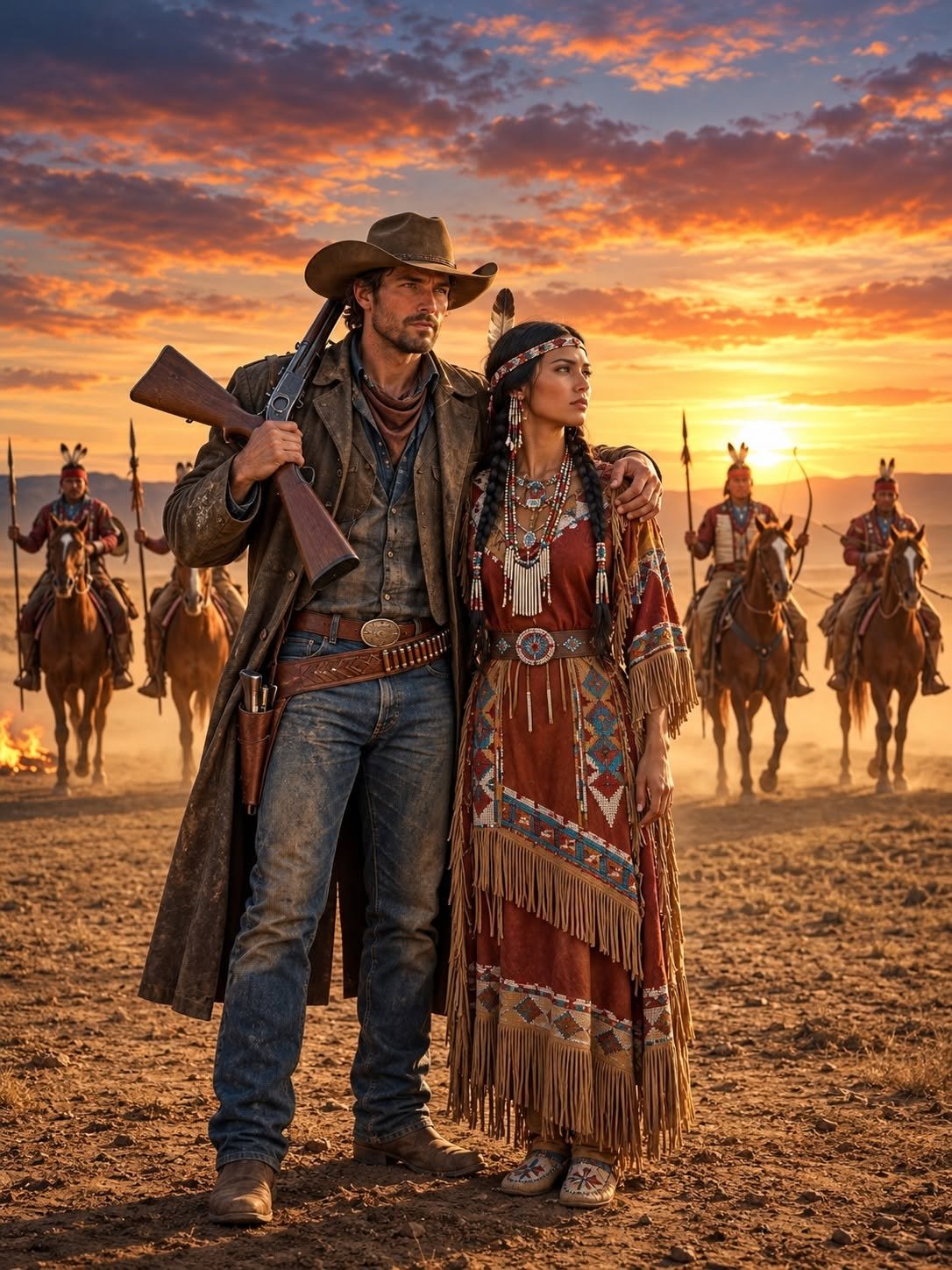
I froze.
Five minutes earlier, I had found a young Native woman tied to a wooden stake in a deserted canyon. I had cut the ropes around her wrists because leaving her there would have been cruel.
Now she was telling me that saving her life might cost me my own.
And somewhere beyond the canyon walls, horses were approaching.
My name is James Calloway. I was a lonely rancher who had spent years living in a small wooden cabin surrounded by dry prairie. I had survived blizzards, droughts, and nights so quiet I could hear the wind moving through the grass.
But nothing had prepared me for the evening a beautiful twenty-two-year-old woman demanded I become her husband.
Especially when she told me that the men coming toward us would shoot me if I refused.
My life wasn’t complicated. Every morning, I fed the cattle. Repaired fences. Checked the water troughs. Worked until the sun disappeared behind the distant hills. My father had taught me that a decent man never walked away from someone who needed help. After he died, those words were about all I had left of him.
That evening, I saddled my horse to inspect the northern pasture. The sky glowed crimson. Coyotes howled somewhere beyond the rocks.
I was riding through a narrow canyon when I noticed something strange beside the trail. A wooden stake. And someone tied to it.
I pulled my horse to a stop. At first, I thought my eyes were playing tricks on me. Then the figure moved.
It was a young woman. Her dark hair hung across her shoulders. Her dress was torn from struggling against the ropes. Her wrists were marked where she had tried desperately to free herself.
I dismounted. “Easy. I’m not going to hurt you.”
She watched me with fierce, frightened eyes. I glanced around the canyon. No horses. No camp. Nobody who could explain why she had been abandoned there.
I pulled my knife. Her shoulders tightened. “Just the ropes,” I promised.
I cut through the bindings. Her hands dropped free. For a moment, she staggered. I reached toward her, but she straightened before I could touch her. She wasn’t going to accept pity. I respected that.
“Are you hurt?” She didn’t answer. Instead, she looked past me toward the canyon entrance. Then she stepped closer — so close I could hear her breathing.
“Marry me now,” she whispered, “or my tribe will kill you.”
I stared at her. “What?”
Her eyes moved nervously toward the distant ridge. “You must say I am your wife.”
“Lady, I just cut you loose.” “I know.” “Then why would anyone kill me?”
She grabbed my arm. “Because you are here with me.”
I shook my head. “I don’t even know your name.”
She looked frightened, but her voice remained steady. “If they find me with a strange man, they may believe he captured me.”
Before I could answer, a faint sound reached us. Hooves. At first barely noticeable. Then louder.
I turned toward the canyon entrance. Dust was rising beyond the rocks. Several riders were approaching.
The woman tightened her grip. “Too late.”
My hand moved toward my rifle. She caught my wrist. “Those men have weapons.” “Then what am I supposed to do?” She swallowed. “Stand beside me.”
I stared at her face. She was afraid — not of me, but of what might happen if those riders misunderstood.
“Why tell them we’re married?” “Because you freed me. Now you are part of this.”
The sound of hooves grew louder. For years, I had imagined finding someone to share my lonely ranch — someone who might sit beside me at supper, someone who would make that quiet cabin feel like a home. But I had never imagined marriage beginning with a warning and twelve armed strangers.
I looked at the woman again. She couldn’t have been more than twenty-two. Yet she stood with her shoulders straight, refusing to let fear defeat her.
And something inside me shifted. Not love. Not yet. Respect.
I slowly lowered my rifle. “All right,” I whispered.
Her eyes searched mine. “You’ll stand with me?” I nodded. “I won’t let them think I hurt you.”
Then the riders appeared. Twelve Comanche warriors entered the canyon, their horses moving through clouds of dust. Some carried bows. Others held rifles. Within moments, they surrounded us.
I kept my hands visible. The woman stepped slightly in front of me.
At the center of the group sat an older chief whose stern expression made my stomach tighten. He looked at the cut ropes. Then at me. Then at the woman.
For several terrible seconds, nobody spoke.
Finally, she lifted her chin and announced in a strong, clear voice: “This is my husband.”
The chief’s eyes narrowed. Every warrior turned toward me.
I suddenly understood how dangerous a single lie could become.
The chief dismounted with a grace that belied his years. He walked to the stake and ran his fingers over the severed ropes. He studied my knife, still in my hand. He looked at the woman’s raw wrists. Then he spoke — not to me, but to her — in a language I did not understand.
She answered, her voice steady but her hands trembling. The chief listened. His face revealed nothing.
Then he turned to me and spoke in broken, careful English. “You. Cut her free?”
“Yes,” I said. “She was tied. I couldn’t leave her.”
“Why you here?”
“I ranch north of here. I was checking my fence line. I found her by chance.”
The chief studied me for a long moment. Then he said something to his warriors, and two of them dismounted and began examining the ground around the stake — the rope fibers, the scuff marks, the direction of the tracks.
“This is my daughter,” the chief said at last. “Ayasha.”
Ayasha. The name settled over me like something I had been waiting to hear.
“She was tied by order of the council,” the chief continued. “She refused the husband chosen for her. She shamed her family. The stake was her punishment — one night alone, to teach obedience.”
I looked at Ayasha. Her jaw was set, her eyes forward. She had endured a night bound to a post in the desert rather than marry a man she did not choose.
“She is brave,” I said quietly.
The chief’s eyebrows rose. “Brave? She disobeys.”
“She disobeys a choice that isn’t hers to make,” I said. “Where I come from, we call that brave.”
A murmur ran through the warriors. The chief raised a hand, and silence fell.
“You claim her as wife,” he said. “Among my people, a husband speaks for his wife. A husband protects. A husband does not cut and run.” He stepped closer. “Prove you are husband, not coward.”
One of the warriors — young, broad, with a scar across his cheek — stepped forward. This, I understood, was the chosen husband. The one Ayasha had refused. His eyes burned with humiliation and fury.
“He will test you,” the chief said. “Not to the death. To the truth.”
What followed was not a fight as I knew fights. The young warrior circled me, and I understood the rules without being told: stand your ground, do not strike first, do not show fear, do not show cruelty. It was a test of spirit, not strength.
He feinted. I held. He shoved my shoulder hard enough to stagger me. I regained my footing and did not retaliate. He came at me again, and this time I caught his wrist — gently, firmly — and held it until he pulled free.
The warriors watched. The chief watched. Ayasha watched, her hands clenched at her sides.
Finally, the young warrior stepped back, breathing hard. He looked at the chief and shook his head once — not in defeat, but in acknowledgment. Then he did something I did not expect: he placed his hand briefly on my shoulder, warrior to warrior, and stepped back into the line.
The chief nodded slowly. “You do not fight like a coward. You fight like a man who protects.”
He turned to Ayasha and spoke in their language. She answered — longer this time, her voice rising with feeling. I caught my own name in the stream of unfamiliar words. The chief listened, and his stern face softened by a fraction.
“She says you cut her ropes expecting nothing,” he told me. “She says you stood with her when you could have ridden away. She says—” He paused. “She says she chooses this.”
He looked between us. “Among my people, a forced marriage is a chain. A chosen bond is a bridge. My daughter refused a chain.” His gaze settled on me. “Do not make her regret the bridge.”
It was not a blessing. It was a warning, a charge, and — I realized — a kind of trust.
The warriors mounted up. The chief was the last to leave. He rode close to me and said, in his careful English: “Take care of my daughter, rancher. The desert remembers everything.”
Then they were gone, dust settling in their wake, and Ayasha and I stood alone in the canyon with the cut ropes at our feet and a future neither of us had planned.
“You didn’t have to do that,” I said.
“Yes,” she said. “I did. They would have killed you.”
“And now?”
She looked at me — really looked at me — and for the first time, the fear was gone from her eyes. “Now we find out if a lie can become a truth.”
We rode to my ranch together, sharing my horse, the sun sinking behind the hills. That night, I gave her my bed and slept in the barn — because a real husband, I figured, earns the name.
In the weeks that followed, Ayasha taught me things no ranching manual ever had: which plants held water in a drought, how to read a storm in the color of the morning sky, the names of the constellations in her people’s language. I taught her to mend a fence, to shoe a horse, to bake bread in a Dutch oven.
We spoke, at first, in the careful sentences of two strangers. Then in longer conversations by the fire. Then in laughter — hers bright and sudden, like rain after a long dry spell.
The chief visited once, in the autumn. He inspected my fences, my cattle, my cabin. He ate Ayasha’s bread and said nothing. As he mounted to leave, he looked at me and said: “The desert remembers. It remembers this, too.”
I never learned exactly what he meant. But Ayasha smiled — the full, unguarded smile I had come to live for — and I decided it was approval.
A year to the day after the canyon, Ayasha and I stood before a traveling preacher — her choice, her insistence — and spoke vows in two languages. She wore a dress she had sewn herself, blue as the desert sky after rain. I wore my father’s boots.
“I chose you twice,” she whispered, as the preacher closed his book. “Once to save your life. Once to share mine.”
My father used to say that a decent man never walks away from someone who needs help. He was right. But what he didn’t say — what I learned from a woman tied to a stake in a deserted canyon — is that sometimes, when you stop to help a stranger, you don’t just save them.
Sometimes, they save you right back.


