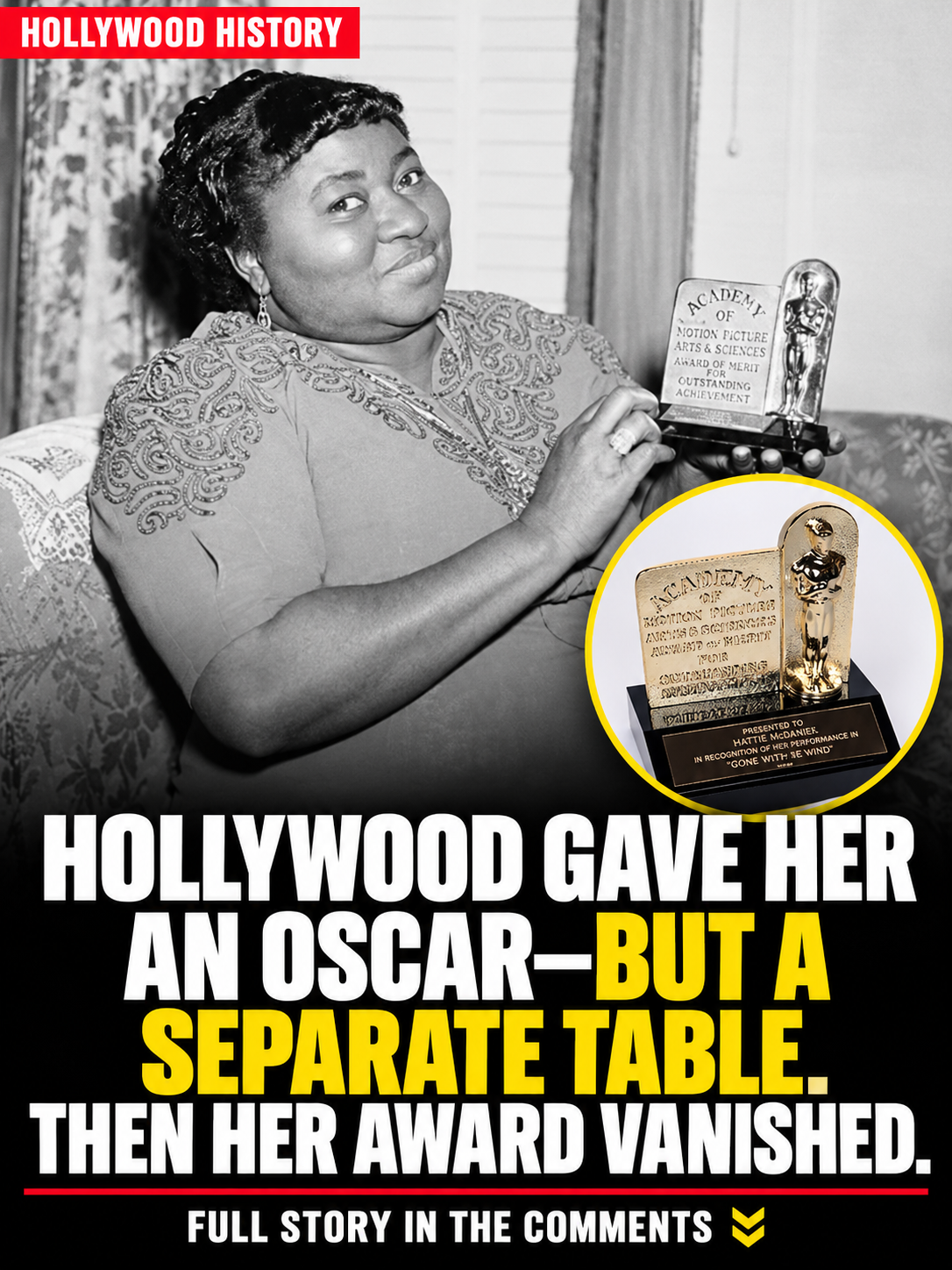
Hollywood Gave Hattie McDaniel an Oscar—but a Separate Table. Then Her Award Vanished.
Hattie McDaniel achieved something no Black performer had achieved before: an Academy Award. But the room celebrating her performance still separated her from her film’s other nominees. The achievement and the humiliation belonged to the same evening, leaving a history that cannot be told honestly by mentioning only the prize. [1] The contradiction gives the story its force. A photograph of McDaniel with the award can look like a straightforward record of success until the circumstances are restored. The same evening demonstrated both the reach of her ability and the limits imposed on her presence. Understanding her achievement requires looking at the recognition and the room together.
Her winning role was Mammy in Gone with the Wind. In 1940, McDaniel became the first Black person nominated for and awarded a competitive Oscar. The victory opened a historic door, even as the circumstances around it showed how much of Hollywood remained organized by racial exclusion. [1] Being first brings visibility, but it does not automatically remove the barriers around a career. Her award showed that a Black performer could receive the industry’s highest competitive recognition. It did not show that Black performers had gained equal access to the industry’s workplaces, public occasions or roles. That difference matters when the victory is remembered decades later.
The ceremony took place at the segregated Cocoanut Grove in Los Angeles’s Ambassador Hotel. McDaniel and her guest were seated separately from the other nominees associated with the film, according to the Academy’s own account. Recognition of her artistry did not produce equal treatment within the room. [1] Seating arrangements can reveal an institution’s values more plainly than a speech. Guests understand who is placed together and who is kept apart. In McDaniel’s case, the arrangement meant that the celebration of her work occurred within a setting that continued to mark her as separate. The physical detail makes the larger history difficult to overlook.
This detail is unsettling because it makes the contradiction visible. An institution could honor a Black woman’s performance while participating in arrangements that kept her apart. The separate table was not a minor inconvenience around an otherwise uncomplicated success. It was part of the conditions under which she had to receive it. [3] The harm lies partly in the demand placed on the person being honored. She was expected to participate in a celebration that recognized her ability while treating her unequally. Readers can admire the achievement and still recognize the unfairness of that demand. Holding those responses together gives the account more honesty than presenting the evening as uncomplicated triumph.
Her broader career deserves attention beyond that one moment. McDaniel worked across stage, radio and screen. Her official legacy biography also records the barriers she faced outside the awards ceremony, including exclusion from the film’s Atlanta premiere under segregation. The obstacles did not begin or end at her table. [4] The premiere exclusion also shows how widely the barriers operated. A major performance could make someone central to a film and still fail to secure her an equal place in events surrounding it. The distinction between appearing on a screen and being welcomed as a person is essential to understanding the conditions Black artists faced.
For older film audiences, familiar movies can carry unfamiliar histories. A performance may be remembered from repeated broadcasts while the conditions surrounding the performer fade. McDaniel’s experience brings the person behind the screen role back into view, with the recognition and restrictions that shaped her working life. [4] Revisiting an older film with this knowledge can change what a family discusses afterward. Alongside questions about a character or a favorite scene, viewers can ask what opportunities the performer had and how she was treated. That conversation returns the artist’s real life to a familiar piece of entertainment and helps younger viewers understand its historical setting.
There is another important detail about her Oscar. The supporting-performance award she received was a plaque, not the familiar freestanding statuette many readers picture. The Academy used plaques for that category during that period. Calling it an Oscar is correct, but imagining the wrong object changes the story of what later disappeared. [1] The plaque matters because an object has a history of its own. Its size, form and display connect the award to the practices of the period. A photograph can therefore be evidence as well as illustration. Looking carefully at what McDaniel actually held prevents the missing-award story from drifting into a more familiar but inaccurate image.
McDaniel wanted that award to benefit students. She left it to Howard University, and it arrived after her death in 1952. A personal honor could become a public example for young artists: evidence that a Black performer had made history in an industry where the opportunities remained limited. [2] Leaving the award to a university gave it a purpose beyond private remembrance. Students preparing for artistic careers could encounter a concrete sign of an earlier performer’s accomplishment. Her decision also placed responsibility on an institution to preserve that connection. The plaque’s meaning was tied to what future students might learn from seeing it.
At Howard, the award was displayed in the drama department. Students could see the object rather than only read a sentence about the first Black Oscar winner. That kind of encounter can make a distant achievement feel tangible, especially for someone preparing to enter the same profession. [5] There is a difference between knowing that someone won an Oscar and standing before the award associated with her. The object can prompt questions about the career, the ceremony and the person who chose to leave it there. That educational value explains why the disappearance mattered even though the historical fact of her victory was never in doubt.
Then the original plaque disappeared. Howard’s account places the disappearance in the 1960s and states that its whereabouts and the reasons for its loss were never established. This is a genuine mystery, but it is not a license to invent a thief, a secret sale or a solved investigation. [2] An unresolved disappearance can attract dramatic explanations, but the uncertainty is itself part of the record. The absence of an established answer does not make every theory equally likely or turn rumor into evidence. The meaningful question is how the university and the Academy could restore the educational connection despite being unable to account for the original plaque.
The missing award left a gap with more than material significance. McDaniel’s achievement remained documented, but the object she had intended for students was no longer available to them. The history survived; a particular way of encountering that history had been lost. The distinction helps explain the push for a replacement. [3] The gap also illustrates how cultural memory depends on care. Records can establish an achievement, while museums and universities preserve objects that help people engage with it. Losing one form of evidence does not erase the others. It can still weaken the experience available to future visitors, which makes an effort to restore that experience worthwhile.
Howard Magazine reported that the family sought a replacement over the years. The eventual decision to provide one belonged to a long effort to restore that visible connection. An institution’s acknowledgment could not locate the missing original, but it could change what students would be able to see going forward. [2] For relatives, seeking a replacement offered a practical response to a loss they could not reverse by searching alone. The new award would not have the original object’s complete history, but it could carry its intended message to students. That is a different kind of recovery: restoring a purpose even when the physical original remains unavailable.
In 2023, the Academy and Academy Museum announced that Howard would receive a replacement of the historic award. The presentation placed the plaque in the Chadwick A. Boseman College of Fine Arts. It was a way to carry out McDaniel’s educational intention despite the original object’s unresolved disappearance. [5] The ceremony gave the restoration a public setting. It acknowledged McDaniel as an artist whose legacy deserved active attention and returned an award bearing her achievement to the institution she had selected. The event’s educational meaning followed directly from that choice, connecting a historic performer with people still preparing to enter the arts.
The distinction between replacement and recovery matters. The new plaque was not the missing original unexpectedly found in a drawer. No discovery resolved its whereabouts. The meaningful development was a deliberate act of restoration: providing a new version of an object that had become part of a university’s cultural memory. [3] That difference can be explained without reducing the emotional value of the replacement. People regularly preserve memory through replicas, reproductions or new memorials when an original is lost. Their usefulness depends on truthful presentation. Howard’s new plaque could serve as a visible tribute precisely because the account remained clear about what it was and what remained missing.
The return also connected generations of Black performers. McDaniel’s award would reside in a college bearing Boseman’s name. Those careers were separated by decades, yet both belong to a story about artistic achievement, representation and the opportunities available to students preparing to tell stories of their own. [5] The college’s name adds another layer of continuity. Students encounter the legacies of artists from different periods within the same educational setting. The connection does not suggest their careers or circumstances were identical. It makes the institution a place where achievements and obstacles across generations can be studied together rather than kept in separate cultural memories.
Her life also included resistance beyond acting. The official legacy biography describes her involvement in challenging segregated housing in Los Angeles. Remembering that work helps keep her from being reduced to a single movie role or to the image of an honored guest enduring an unequal table assignment. [4] Remembering her housing advocacy broadens the picture of McDaniel’s response to exclusion. A performer can be both constrained by an industry and active in other areas of civic life. Her legacy should leave room for that agency. Otherwise, accounts of discrimination risk describing only what was done to her and overlooking what she chose to challenge.
The discomfort around the role that won her the Oscar should not be ignored. Honoring McDaniel’s craft does not require treating every image of Black life in the film as unproblematic. The Smithsonian’s discussion of the replacement places the achievement within the longer, complicated history of Black performers in Hollywood. [3] The distinction between an actor and a role is especially important here. Assessing the film’s racial imagery and recognizing the skill required for a performance are related but separate tasks. Neither requires forgetting the other. A fuller discussion can acknowledge the limits of the role while still considering the career and historic achievement of the woman who played it.
For a family looking at the photograph of McDaniel with her plaque, the question becomes larger than what happened to an award. What was she able to accomplish, what was she made to endure, and what did she hope the next generation would receive from her success? Her life contains all three questions. [4] Her decision about the award provides a clue to the kind of legacy she wanted to leave. She chose an educational home where young artists could encounter it. That documented act gives the story a future beyond the ceremony’s segregation and the plaque’s disappearance. The object was meant to help people looking toward careers of their own.
Howard’s account shows why the replacement was welcomed as a homecoming. The award belonged there because McDaniel had chosen the university as its future home. Restoring its presence respected her decision and gave students a visible reminder of an artist whose historic achievement had survived the loss of its original object. [2] The sense of homecoming therefore came from intention rather than ownership alone. The award’s presence at Howard fulfilled a wish associated with McDaniel’s life. Its return to public view gave students another way to approach her history, making the restoration about access to a legacy as much as possession of a valuable object.
Hollywood gave Hattie McDaniel an Oscar while keeping her apart. The plaque later vanished, but her place in film history did not. The replacement at Howard does not erase the segregation or solve the disappearance. It ensures that a new generation can encounter the recognition she wanted to leave behind. [5] The ending remains complicated, which is why it is memorable. The replacement creates something useful in the present without repairing every part of the past. McDaniel’s achievement, the unequal treatment at the ceremony and the missing original all remain in the story. Together, they explain why the new plaque carries significance beyond a routine university gift.