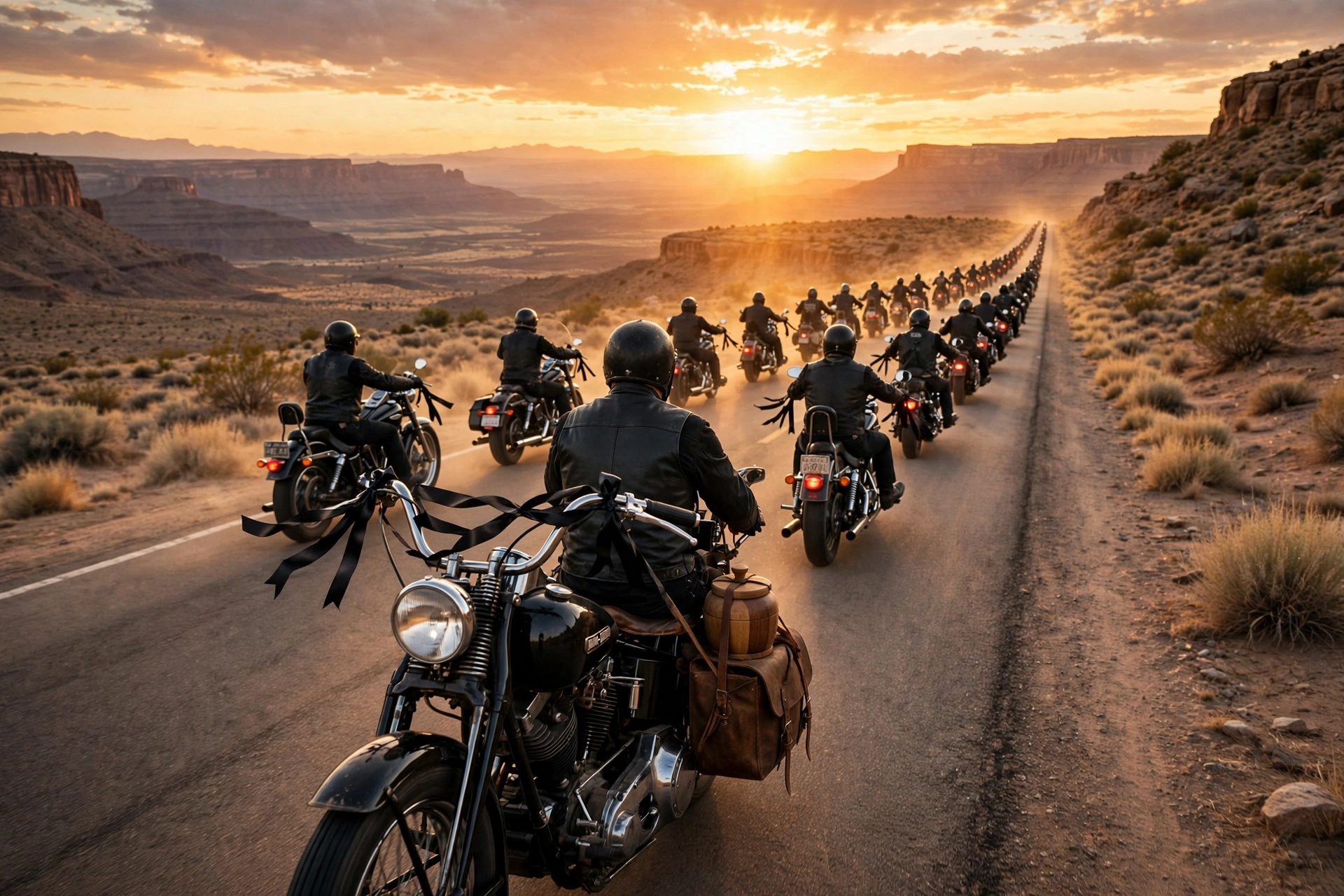
Ray “Preacher” Dolan got his road name because he could quote scripture and curse in the same sentence, and because in thirty-eight years with the Iron Horses Motorcycle Club, he had married half the members, buried a few, and prayed over every bike blessing the club ever held. He was seventy-four years old, rode a battered 1987 Harley Electra Glide he called Mercy, and he was dying.
The cancer had started in his lungs and finished everywhere else. The doctors at the VA gave him weeks, not months. So the club did what clubs do: they circled the wagons. Every evening, brothers rolled up to his little house outside Barstow, California, sat on his porch, and told stories while the desert sun went down behind the Calico Mountains.
One Tuesday evening, Ray called his president — a broad-shouldered man named Marcus “Tank” Reyes — into the kitchen, away from the others. His voice was thin, but his eyes were clear. “Tank,” he said, “I got one last request. When I go, I don’t want a funeral home. I want cremated. And I want my ashes scattered at Sunset Ridge overlook, up on Route 66 past Oatman. There’s a pullout there where the whole desert opens up. I want to ride out with the club one last time.” Tank swallowed hard and nodded. “We’ll take you, brother. Whole club. Full escort.”
Ray smiled. “And Tank — there’s a tin box in my closet. Top shelf. When the time comes, bring it with us. You’ll know what to do with it.”
Three weeks later, on a Saturday morning in late October, forty-two bikes rolled out of Barstow in formation, led by Tank on his Road King, with a small wooden urn strapped carefully into a leather saddlebag on Ray’s own Mercy — ridden that day by Ray’s best friend, seventy-one-year-old Dale “Wrench” Kowalski, who had tears running into his beard the whole way. The tin box rode in Tank’s saddlebag. He hadn’t opened it. A promise was a promise.
The ride to Oatman was the kind of ride old bikers dream about — cool desert air, the road unwinding through black volcanic rock and golden hills, the pack moving as one living thing. At every stop, strangers came up to pay respects when they saw the black ribbons tied to the handlebars. A waitress in Kingman refused to let them pay for coffee. A Highway Patrol officer pulled alongside, read the ribbons, and simply saluted and rode on.
But somewhere past Kingman, the road threw them a curve — literally. A rockslide had closed Route 66 just east of Oatman, barricades across both lanes, a detour sign pointing to a narrow county road winding up through the mountains. Tank pulled the pack over and studied the map. The detour would take them right past a tiny settlement called Cedar Flats — population maybe two hundred — and add an hour to the ride. Nobody complained. Ray would have laughed and called it “the scenic route the Lord intended.”
What none of them knew was that Cedar Flats held the secret Ray had carried for forty years.
The pack rolled into Cedar Flats around noon, planning to gas up and stretch their legs. It was the kind of town you could miss if you blinked: one gas station, one diner, a white clapboard church, and a scattering of houses baking in the sun. The bikers pulled into the diner lot, forty-two engines rumbling, and the few locals on the sidewalk stopped and stared. That’s when an old woman came out of the diner, wiping her hands on her apron. She was maybe seventy, with silver hair pulled back in a braid and kind, tired eyes. She looked at the black ribbons on the handlebars. She looked at the urn strapped to Mercy’s saddlebag. And she went pale as a sheet.
“Whose ashes are those?” she asked quietly. Dale “Wrench” Kowalski, still sitting on Mercy, answered gently. “Our brother. Ray Dolan. Called him Preacher. We’re taking him to Sunset Ridge, like he asked.” The woman’s hand flew to her mouth. “Ray Dolan,” she whispered. “Mercy — that’s Mercy’s name. Oh, Lord. Oh, Lord, after all these years.”
Tank stepped forward. “Ma’am? Did you know Ray?” The woman nodded slowly, tears starting down her cheeks. “My name is Ellen Marsh. And forty-one years ago, Ray Dolan saved my life — and my daughter’s life — on this very road. I never thought I’d see his name again.”
The bikers gathered around as Ellen told her story. In 1985, she said, she was twenty-nine years old, driving a broken-down station wagon with her six-year-old daughter, trying to get from Flagstaff to her sister’s house in California. The car died on a lonely stretch of desert highway at dusk. No phone, no water, temperature dropping. She had walked a mile down the road with her little girl, terrified, when a lone biker pulled over — a young man with long hair and a kind face, riding a Harley he called Mercy.
“He gave us his water, then his jacket for my daughter,” Ellen said, her voice breaking. “He tried to fix the car, couldn’t, so he flagged down a trucker with his flashlight and wouldn’t leave until that trucker promised to take us all the way to Barstow. He rode behind that truck for sixty miles — sixty miles — just to make sure we got there safe.” She paused and looked at the urn. “Before he left, he gave my daughter his Saint Christopher medal — said it had protected him and now it was her turn. And he told me, ‘If you ever need anything, you find the Iron Horses in Barstow and ask for Preacher.’ I never needed anything. I just… I never forgot.”
Tank felt the tin box heavy in his saddlebag. He pulled it out slowly and opened it in front of everyone. Inside was a Saint Christopher medal on a worn leather cord — the match to the one Ray had given away, the pair he’d bought together decades ago. Underneath it was a folded letter in Ray’s shaky handwriting, dated the week before he died. Tank read it aloud, his voice cracking: “To whoever opens this at the overlook — If you’re reading this, the detour took you through Cedar Flats, just like I hoped. That rockslide closes 66 every few years, and I prayed it’d be closed for you. Forty-one years ago I met a woman and a little girl on that road, and I never stopped wondering if they made it okay. If Ellen is still there, give her this medal — tell her the pair is together again, the way it should be. And tell her Preacher kept his promise to watch over them. He just did it from a distance. — Ray”
There wasn’t a dry eye in that parking lot. Ellen took the medal with shaking hands and pressed it to her heart. “He remembered,” she sobbed. “All these years, he remembered us.”
Then Dale “Wrench” Kowalski did something that broke everyone wide open. He walked to Mercy, opened the urn, and asked Ellen: “Would you like to ride with us to the overlook? Ray would want you there.” Ellen nodded, unable to speak. They found her a helmet, and she climbed on behind Wrench — a seventy-year-old grandmother on the back of a Harley, holding tight, riding with forty-two bikers up the mountain road to Sunset Ridge.
The overlook was everything Ray had promised: the whole Mojave spread out below like a golden sea, the sun beginning its slow drop toward the horizon. The club formed a circle. Tank opened the urn. And as Ray’s ashes caught the desert wind and scattered over the valley he loved, Ellen stepped forward and placed the Saint Christopher medal on the stone cairn the brothers had built — the pair together again, just as Ray had written.
Then, from the back of the circle, a younger woman stepped forward — Ellen’s daughter, now forty-seven, who had driven over from the diner after her mother’s phone call. Around her neck, on a silver chain, hung a worn Saint Christopher medal. “I never took it off,” she said simply. “Not once in forty-one years. Mama told me a biker angel gave it to me. Today I finally got to thank him.”
The club stood in silence as the sun went down. Then, one by one, forty-two engines started up — a rolling thunder salute that echoed off the canyon walls and rolled out across the desert, carrying Ray “Preacher” Dolan home. Tank still keeps Ray’s letter in his saddlebag, laminated now against the rain. And every October, the Iron Horses ride to Sunset Ridge — forty-plus bikes, black ribbons on the handlebars — and Ellen and her daughter are always waiting at Cedar Flats to join the pack for the last leg up the mountain.
Because brotherhood isn’t just about the patch on your back. It’s about the promises you keep, the strangers you protect, and the love that outlives us all — scattered on the wind, but never, ever gone.

