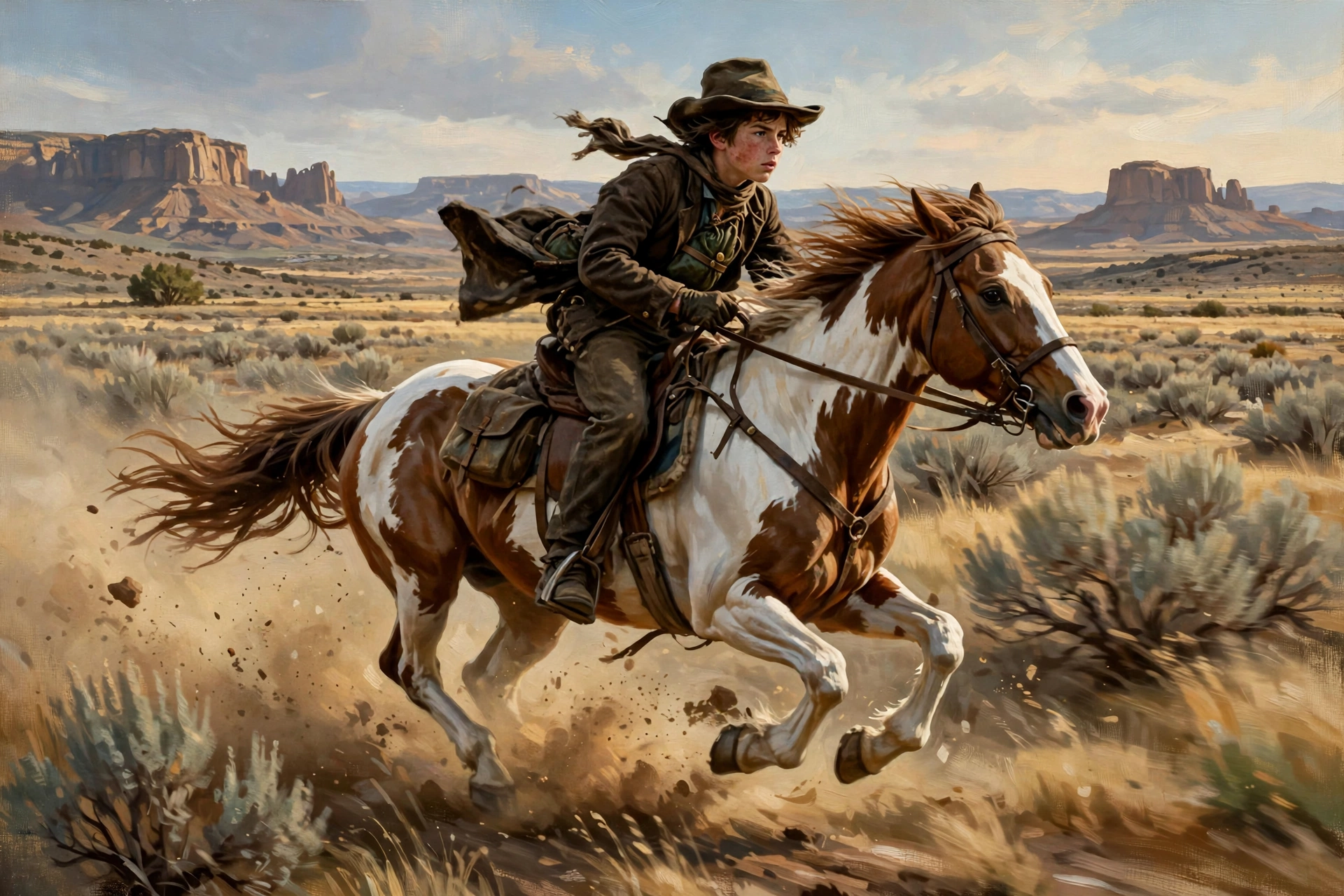
The summer of 1861 was a dry one in the Nevada Territory, and the land between Carson City and Ruby Valley had turned the color of old bones. Sixteen-year-old Tommy Calloway rode for the Pony Express, though he looked barely fourteen, all elbows and sunburn and stubbornness. The men at the station called him Sparrow because he was small and quick and never seemed to sit still.
On the morning of August 3rd, the station master pressed a sealed oilskin pouch into Tommy’s hands and said words the boy would never forget: “This one matters more than any letter you’ve carried. It goes to Judge Hardaway in Ruby Valley. It’s an offer of peace — and if it arrives in time, nobody has to die next week.”
For three months, the Barlow ranch and the Kessler ranch had been feuding over water rights to Cottonwood Creek. Two cowboys had been shot already, one dead, one crippled, and both ranchers had gathered riders like armies. The governor himself had written a compromise, and the signed agreement was folded inside that pouch. All it needed was Judge Hardaway’s signature and the two ranchers’ marks, and the range war would end before it truly began.
Tommy tucked the pouch inside his shirt, buttoned his coat over it, and swung up onto his paint mare, Cricket. She was the fastest horse at the station, and she knew the trail better than any map. “Ride like the wind, Sparrow,” the station master called after him. “And ride careful.”
The first forty miles went smooth as butter. Cricket’s hooves drummed the hard-packed trail, and the sagebrush blurred past in waves of silver-green. Tommy had made this run a dozen times. He knew every water hole, every dip in the land, every place a man might hide if he had reason to wait.
What he did not know was that the Kessler ranch had hired a man named Silas Vane — a former cavalry scout turned hired gun — to make sure that letter never reached Ruby Valley. Old man Kessler had decided he would rather fight than share the creek, and a dead peace treaty was worth more to him than a signed one.
At mile marker forty-six, where the trail narrowed between two red rock bluffs, Silas Vane stepped out of the shadows with a rifle in his hands. “Hold up, boy,” he said quietly. “Hand over the pouch.”
Tommy had been warned about road agents since his first day on the Express. The rule was simple: never stop, never fight, outrun them. He dug his heels into Cricket’s flanks — but Vane had been ready for that. He fired once, not at the boy, but at the horse. Cricket stumbled, shrieked, and went down hard, throwing Tommy clear across the rocks.
When Tommy woke, the sun had moved an hour across the sky. His head was sticky with blood, his ribs ached with every breath, and Cricket was gone. The pouch was gone too. The peace treaty was gone. He tried to stand and fell. He tried to crawl and made it twenty yards before his vision blurred. Forty miles from the nearest station, bleeding and alone under a climbing sun, he thought of the men who would die next week — and then, mercifully, of nothing at all.
Now, here is the part no one would have believed if three separate riders hadn’t witnessed what came after.
Twenty miles to the north, on a rocky ridge above the trail, lived a man the settlers called Old Coyote — though his real name was Tse-na-he, a Washoe elder whose family had hunted those hills since before any white man drew a map. The ranchers feared him. The town folk crossed themselves when he passed. He kept to himself and hadn’t been seen in Carson City in five years.
That morning, Old Coyote had been tracking a lame elk when he found Cricket first — the mare standing three-legged in an arroyo, her shoulder torn by the rifle ball. He read the ground the way you or I would read a newspaper: skid marks, blood drops, a drag trail leading east. He followed it until he found the boy, barely breathing. Then he did something the settlers would never have expected from the man they called a savage: he lifted Tommy onto his own horse and rode him back to his camp, where his twelve-year-old granddaughter, Wuna, waited.
For two days, Wuna tended Tommy. She cleaned the wound on his head with water boiled over a sagebrush fire, fed him broth from a tin cup, and told him stories about the creek and the eagles to keep him awake when he drifted. On the second evening, Tommy opened his eyes and said the only thing that mattered: “The pouch. The letter. Silas Vane took it. He’s riding for Kessler’s ranch.”
Old Coyote had returned by then, and he stood in the firelight listening. When Tommy finished, the old man was silent a long time. Then he said, in slow, careful English: “I know Silas Vane. He killed my brother ten winters ago over a horse. The ranchers call me a thief and a savage. But I know what a stolen peace looks like.”
What happened next became legend on that trail. Old Coyote knew a shortcut through the high rocks that no white rider had ever found — a narrow pass his people had used for generations. He wrapped Tommy’s head in clean cloth, set the boy in front of him in the saddle, and rode through the night like a man twenty years younger, while Wuna stayed behind to care for Cricket.
They reached the Kessler ranch at dawn — and found Silas Vane there, handing the oilskin pouch to old man Kessler himself, with six armed riders standing around the porch. Old Coyote rode straight into the yard. Alone. Unarmed, his hands open at his sides. The riders reached for their guns, but Kessler — to his credit, or his curiosity — held up a hand.
“I bring the boy who was shot for carrying that paper,” Old Coyote said, his voice carrying across the silent yard. “And I bring you a question, Henry Kessler. Is this how your father settled things? With a hired gun shooting children?”
Kessler’s face went dark. But before he could answer, Tommy — pale, swaying, barely able to sit upright — pulled himself straighter and spoke up. “Mr. Kessler, that letter isn’t a trick. It’s the governor’s compromise. You get the creek in the dry months. Barlow gets it in the spring. Nobody loses the ranch. But if that paper burns, men die — your men too. Maybe your sons.”
One of the riders on the porch was Kessler’s eldest boy, James, twenty years old and already hard-eyed. He looked at the bleeding kid in the saddle, then at Silas Vane, then at his father. “Pa,” he said quietly, “is it true? You had him shot?” Silence hung over the yard like dust.
Old Coyote spoke once more. “I have lived beside your fences for thirty years, Henry. You have called me every name there is. But today I rode through the night to bring you the truth, because dead boys and dry creeks help no one — not your people, not mine.”
Henry Kessler stared at the old man for a long moment. Then he walked down the porch steps, took the oilskin pouch from Silas Vane’s hand, and pressed it back into Tommy’s. “The boy rides on to Ruby Valley,” he said. “And Vane — you’re done here. Collect your pay and get off my land.” Silas Vane left that morning and was never seen in Nevada again.
Three days later, Judge Hardaway signed the agreement, and both ranchers made their marks. The range war never happened. The governor himself wrote a letter of thanks to the Pony Express station — and in it, he asked for the name of the rider who had carried the treaty through. But Tommy, when they asked him who deserved the credit, just shook his head. “Ask the old man on the ridge,” he said. “He’s the reason any of us are alive.”
Old Coyote never came down to collect any thanks. But that fall, for the first time in anyone’s memory, the Barlow ranch sent a wagon of beef up to the Washoe camp before winter — and Henry Kessler rode with it himself, and stayed for supper.
Tommy Calloway rode the Express for two more years, until the telegraph wires made the riders obsolete. He kept the scar on his temple his whole life, and whenever anyone asked about it, he told them about the night an old Washoe man rode through the darkness to save a peace that wasn’t even his to keep. Because sometimes, the person who saves you is the last person anyone would expect — and the first person who truly understands what it means to be brave.


