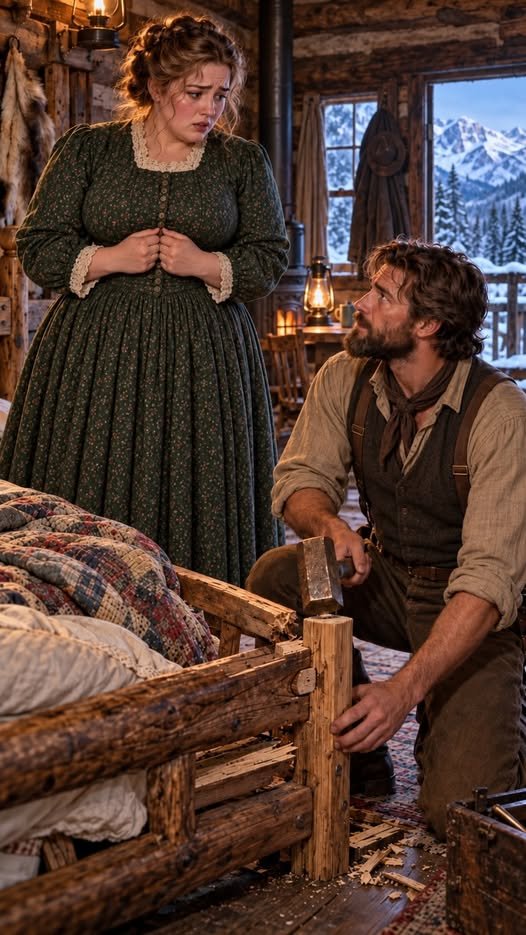
The bed broke beneath Cora Hayes on her first night in Wyatt Harper’s mountain cabin. She waited for the laugh, the disgust, the familiar look that had followed her for twenty-four years. Instead, the lonely mountain man knelt beside the broken frame and quietly said two words no one had ever said to her before: “My mistake.”
Cora had spent twenty-four years learning how quickly a room could turn cruel when she entered it. Her father called her sturdy as if he were pricing livestock, then finally decided no respectable man in St. Louis would marry a woman her size.
So when Wyatt Harper answered an advertisement for a mail-order bride in Wyoming, Cora’s family pinned a cheap veil into her hair, packed her belongings into a burlap sack, and sent her west.
Wyatt stared when she stepped down from the stagecoach. “You’re bigger than the picture.” “I am.” Cora lifted her chin. “If you want the driver to wait, he can.” Wyatt looked at her for another moment, then picked up her bag. “I didn’t order a painting to hang on the wall.”
His cabin was three punishing miles up the mountain. Cora followed him through freezing mud without asking once for him to slow down. That night, she scrubbed years of grease from his stove, cooked beans with salt pork, and finally lowered her exhausted body onto the pine bed. CRACK. The support slat snapped beneath her.
Cora froze. She already knew the expression she expected to see when Wyatt appeared in the doorway — she had seen versions of it at family tables, church gatherings, shops, and every place where someone decided her body was an inconvenience they were entitled to discuss.
Wyatt looked at the broken frame. Then he walked outside. Cora sat perfectly still, certain he had gone somewhere private to laugh. Instead, he returned carrying a block of oak and a heavy mallet. “Stand up.” She obeyed. Wyatt knelt, reinforced the frame, tested the mattress with both hands, and frowned — not at Cora, but at the bed he had built. “Pine’s too soft. Should’ve used oak to begin with.” Then he looked up at her. “My mistake.”
Cora did not know what to say. No one had ever looked at something that failed beneath her and blamed the thing that failed.
The days that followed were not easy, but they were honest. Cora learned the rhythms of the mountain cabin: the wood that needed splitting, the trap lines Wyatt checked at dawn, the silence that wasn’t unkind, just unused to company. Wyatt learned that Cora could outwork most men he’d known, that her cooking made the cabin smell like a home, and that her laugh — when it finally came — was worth waiting weeks to hear.
Spring brought another test. A supply wagon broke down below the ridge while cold rain turned the mountain path into sucking mud. Sacks of flour sat exposed as sleet began cutting across the trail. Wyatt warned Cora that the climb was difficult. She ignored him. Cora threw one fifty-pound sack over her shoulder, wedged another beneath her arm, and started uphill. Mud dragged at her boots. Sleet struck her face. Halfway up the ridge, she found Wyatt resting against a boulder. He stared as she passed him carrying both sacks. Cora kept walking.
By the time they reached the cabin, her arms were trembling. Hours later, with mud drying on their boots, the confession slipped out before she could stop it. “My father called me a burden.”
Wyatt scraped the mud from one heel. “Only weak men complain about the weight of a thing.” He glanced toward her. “A strong man builds a better wagon.”
That night, Wyatt did something he had never done. He took down the small wooden box where he kept his mother’s wedding ring — plain gold, worn thin by decades of work — and set it on the table between them. “I didn’t order a painting to hang on the wall,” he said, echoing his first words to her. “Turns out I got something better. A partner.”
Cora stared at the ring, then at him. “Wyatt—” “I’m not good with pretty words, Cora. But I know this: that bed broke because I built it wrong, not because of you. And everything I build from here on, I build for two.”
She said yes before he finished asking.
They were married in the cabin that autumn, with the mountains as witnesses and a neighbor’s wife crying happy tears in the corner. Wyatt built them a new bed — oak, reinforced, big enough for two people who had both been told they were too much and had decided to believe, instead, that they were exactly enough.
Years later, when travelers asked about the sturdy couple on the mountain who always had food for strangers and a bed that never broke, Wyatt would grin and say, “My wife carried two fifty-pound sacks up a mountain in the sleet. The bed never stood a chance.” And Cora would laugh — that laugh that had taken weeks to earn — and add, “He said ‘my mistake.’ Nobody ever said that to me before. That’s when I knew I was home.”