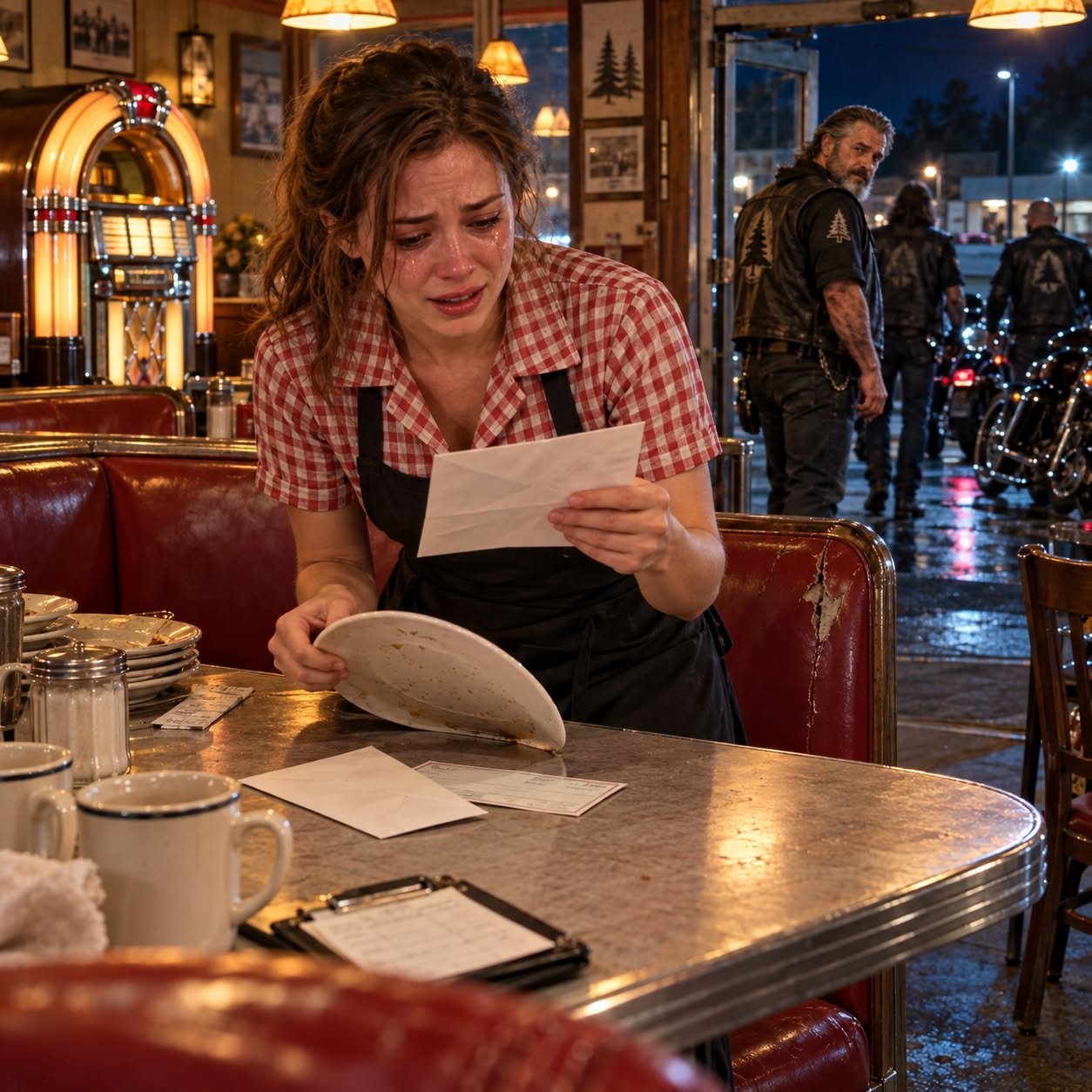
The biker left a zero-dollar tip. Rachel Bennett stared at the receipt, thinking about her six-year-old son’s inhaler and the fifteen-dollar field trip form sitting on their kitchen table. Then she lifted his plate — and found the envelope that would change everything.
Her name was Rachel Bennett. Twenty-nine years old, a single mother, working the evening shift at the Lantern Diner outside Springfield, Missouri. She knew how to carry five plates without spilling anything. She knew which truckers wanted conversation and which wanted silence. What she couldn’t figure out was how to make one paycheck cover a life that kept getting more expensive.
Her son Owen had asthma, an obsession with dinosaurs, and a habit of apologizing whenever he needed something. That was the part that hurt the most. Children shouldn’t say "It’s okay, Mommy" when their shoes pinch.
Owen’s father had been gone for three years. Rachel’s sister Beth watched the boy while Rachel worked, usually for nothing except groceries when Rachel could afford them. Every afternoon, Rachel dropped Owen at Beth’s apartment and promised she would see him before morning. Every night, she carried him home asleep.
That Saturday, Beth texted during Rachel’s break: his inhaler is getting low. He’s fine. Just letting you know. Rachel checked her bank balance. Then she counted her tips. Then she counted them again, as though embarrassment might somehow produce another twenty dollars.
She wrote three things on the back of her order pad. Medicine. Electric. Shoes. She crossed out shoes.
At eight-fifteen, three motorcycles pulled into the parking lot. Conversations slowed when the riders entered. They wore leather vests, heavy boots, and patches from a club called the Black Pines Riders. The man in front had a dark beard threaded with silver, scarred hands, and shoulders that barely cleared the doorway.
Their manager Dennis glanced up from the register. "Keep an eye on that table," he muttered. Rachel picked up three menus. "I keep an eye on all my tables."
The riders chose the corner booth. The big man with the silver-threaded beard looked at her name tag when she asked about coffee. "Please. Black." The others ordered burgers. He asked whether they served breakfast all day, and when she said yes, he ordered eggs, potatoes, toast — "however the cook does them best." That made her smile. "Scrambled, then. Don’t tell him I said that." The man’s expression softened slightly.
While their food cooked, Rachel did ordinary things. She helped an elderly woman read the menu because she’d forgotten her glasses. She wiped up a child’s spilled milk. She brought a fresh spoon to a trucker who had dropped his.
But whenever she passed the corner booth, the bearded man seemed to notice. Not her body. Her face. Her hands. The way she checked the clock. Once, he saw her looking through the window at her old sedan, its passenger window held together with clear tape. "That yours?" he asked. "Unfortunately." "Runs?" "When properly encouraged." One of his friends laughed. The bearded man didn’t. He studied the car for a second, then returned to his coffee.
Later, Beth called. Rachel stepped beside the hallway to answer. Owen had heard another child talking about the field trip. "He wants to know if he should turn in the form," Beth said. "Tell him yes." "Rachel—" "I’ll figure it out." When Rachel turned around, the biker was standing near the register. She couldn’t tell how much he’d heard. "Everything all right?" he asked. "Just family stuff."
He nodded. She rang up their meal. He handed her a card bearing the name Samuel Cole. The machine took forever. "Sorry," she said. "It’s having the same kind of day I am." "No hurry, Rachel."
She gave him the receipt and went to refill another table’s drinks. When she looked back, the three men were leaving. Their plates were stacked neatly. The mugs stood together at the edge. She appreciated that — until she saw the tip line. $0.00.
Dennis glanced over her shoulder. "Told you." Rachel folded the receipt before he could say anything else.
Then she found the envelope. Inside was a handwritten letter.
"Rachel, you treated us the way you treated everyone else tonight. That shouldn’t be unusual, but it is. I heard you say you would figure it out. My mother used to say that. Usually when she had no idea how."
Rachel sat down. Below the letter was a check made payable to Rachel Bennett. Five thousand dollars. Clipped behind it was a card: Samuel Cole Second Mile Foundation. And beneath the printed information, one handwritten sentence: "The money is yours whether you call or not. But if you’re tired of just surviving, call me."
Her hands shook so badly she had to set the check on the table. Dennis walked over, saw the envelope, and went quiet. For once, he had nothing to say.
That night, Rachel called Beth from the diner’s parking lot and told her everything. Beth cried. Owen, half asleep in the back seat of Beth’s car when Rachel picked him up, asked why Mommy was smiling so big. "Because somebody was kind to us," Rachel said, "and now we’re going to be okay for a while."
The five thousand dollars covered the inhaler, the electric bill, Owen’s shoes, and the field trip form — with enough left over to breathe for the first time in years. But it was the last line of that letter that stayed with Rachel longest.
Three weeks later, she called the number on the card. Samuel Cole answered himself. He told her the Second Mile Foundation helped single parents get back on their feet — not with charity that embarrassed them, but with a hand from someone who had once needed one himself. Years earlier, he said, a waitress in another town had treated him like a person when everyone else saw only the leather vest. He never forgot her name. He built the foundation so he would never have to forget again.
Rachel started with a part-time job the foundation helped her find — daytime hours, so she could be home when Owen got off the school bus. Within a year, she was managing the office of a small logistics company. Owen’s asthma was under control. The sedan with the taped window was replaced by a used car with windows that actually rolled up.
She still keeps the folded receipt with the $0.00 tip line in a frame on her kitchen wall. Not as a reminder of a bad night — but as proof that the things people assume about strangers are almost always wrong, and that the quietest man in the room is sometimes the one paying the closest attention.
Every so often, three motorcycles still pull into the Lantern Diner’s parking lot. And every so often, Rachel — who still picks up a weekend shift there, because she says it keeps her honest — walks over with three menus and a pot of coffee, and says the same thing she said that night: "I keep an eye on all my tables."


