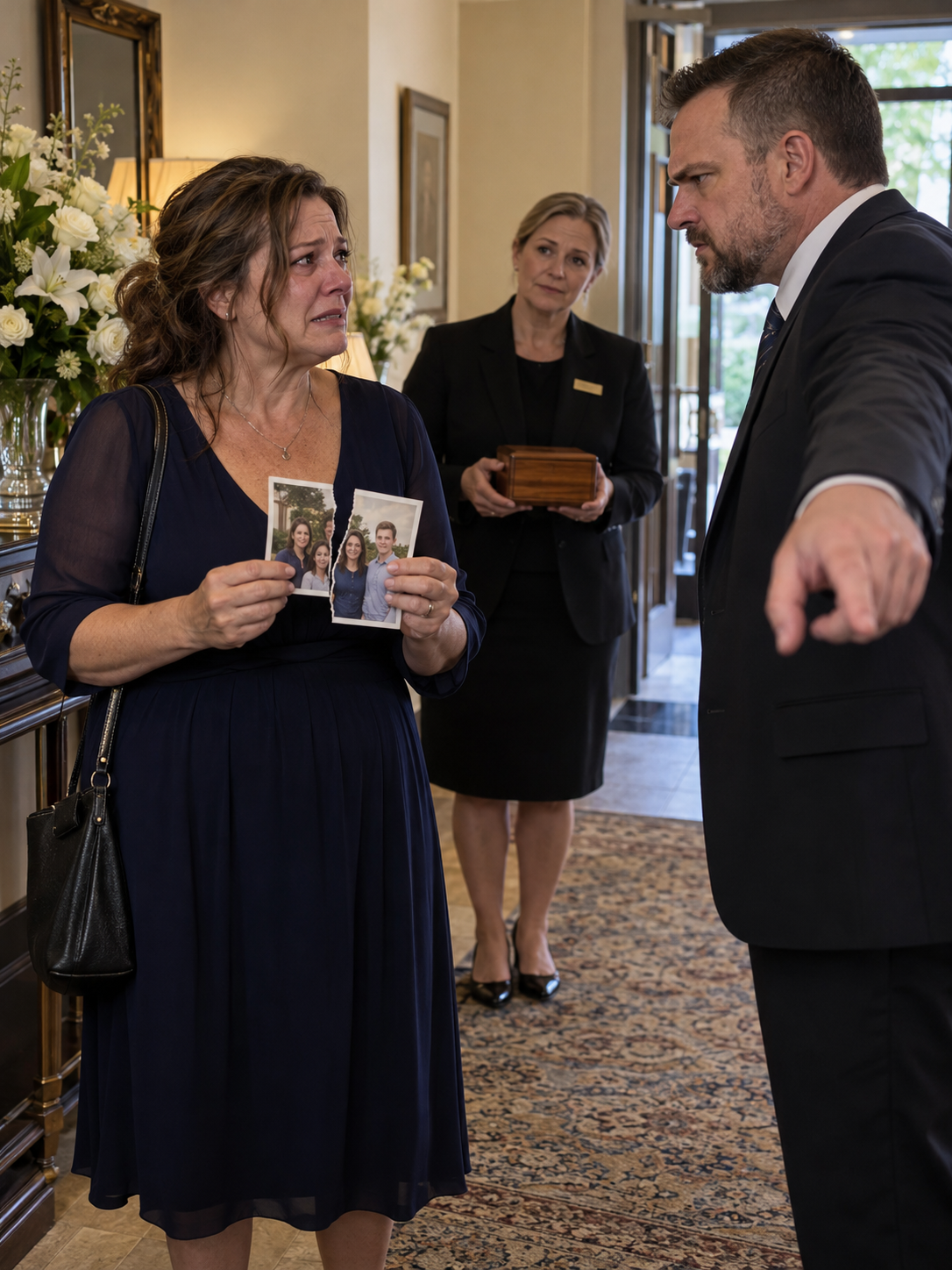
The photograph split down the middle between two smiling faces. Nora stared at the halves in her stepbrother’s hands. They were standing in the funeral home foyer, beside a table meant for visitors’ cards. “You weren’t his real daughter,” he said. Behind Nora, the funeral director stopped with a small wooden box she had been asked to deliver before the service.
Nora was forty-nine. Her mother married Peter when Nora was seven, and he helped raise her until she left for college. He attended school meetings, taught her to drive, and called on Sundays long after her mother died. His biological son, Grant, knew those facts. In the weeks before Peter’s death, however, every conversation between them seemed to become a contest over who had lost more.
The photograph came from Nora’s thirty-fifth birthday. Peter stood between his two children in the garden, holding a badly decorated cake. Grant had made the icing as a joke. Nora brought the picture because it showed the three of them laughing. She thought it might remind visitors of something kinder than the stiff portraits in which Peter always looked as if he was waiting for permission to move.
Grant took it from her when she approached the memory table. He said there was no room. Nora pointed to an empty space beside the guest book. His voice rose, she reached for the frame, and he pulled the loose print from behind the glass. Now the picture was in two pieces, and people arriving for the service were slowing down behind the outer door.
The funeral director, Ms. Bennett, asked Grant to step back. She did not discuss whose grief was more authentic. She offered Nora a quiet room and told another staff member to guide guests into the hall. Nora took the torn photograph and followed her. She had imagined many painful moments that morning. Being asked to prove she belonged to the man who raised her had not been one of them.
In the quiet room, Ms. Bennett set down the wooden box. Peter had left instructions about it when arranging parts of his service. It was for both Nora and Grant, to be opened together if they were willing. Nora touched the worn lid and recognized it from a shelf in his study. She had never known what he kept inside, only that he dusted it himself.
Grant arrived several minutes later, breathing hard. Ms. Bennett told him he could remain if he could speak respectfully. Otherwise the box could wait, and they would make arrangements for both people to receive their belongings. Her calm limits gave Nora something to lean against. She did not have to negotiate another insult simply to participate in a farewell.
Inside the box were two envelopes, a handful of small objects, and a note in Peter’s handwriting. No property documents appeared. There was no announcement about who inherited the house. Peter had already handled those matters separately with the appropriate people. This box held the things he wanted his children to remember when paperwork and grief threatened to make him feel like an account being closed. Ms. Bennett gave them time to examine the objects without narrating what each one should mean. She had seen families feel pressured to produce a moving scene on difficult days. When Nora asked for water, she brought it and stepped outside. Privacy allowed the siblings to react unevenly, which was closer to the truth than any photograph of an immediate embrace would have been.
Nora’s envelope contained a school permission slip from her first year living with him. A teacher had written “parent or guardian” above the signature line. Peter signed his name, then saved the duplicate because Nora had asked whether he was allowed. Beneath it was a short note: she had looked so relieved when he said he would be there that he decided never to forget the moment.
Grant’s envelope held a little wooden boat he thought was lost, along with a photograph of the two of them repairing it. Peter remembered being impatient that afternoon and apologized in the note. He wished he had let Grant choose the paint instead of insisting on the color he preferred. The memory was neither grand nor flattering. Its honesty made Grant sit down.
The shared note asked them not to measure their place in his life against each other’s. He had loved his son before he knew how to be a father and loved Nora while still learning. Neither relationship had replaced the other. He also wrote that he knew they were angry about decisions made near the end and hoped they would ask questions before turning uncertainty into an accusation.
Nora read that line twice. She had coordinated many appointments because she worked nearby, while Grant lived several hours away. Grant heard about some changes after they happened and felt excluded. Nora assumed his short replies meant he did not want details. Neither mistake justified tearing a photograph. The note did help them see how the argument had acquired meanings neither person had said plainly. Grant remembered receiving a brief update and reading it as a request to stay away. Nora remembered sending it while walking between work and an appointment, assuming he would call if he needed more. The difference was painful because neither message had to mean what it became. They could acknowledge that failure without treating the morning’s cruelty as unavoidable.
Grant apologized without asking Nora to say she understood. She told him the words about not being a real daughter were cruel, and that she would not continue a conversation in which he used them again. He nodded. He wanted to blame exhaustion, but the torn picture lay between them. An explanation could wait. He had made a choice in front of someone else’s grief.
They attended the service sitting in the same row, with an empty seat between them. Nobody required them to hold hands or reconcile for the comfort of the room. Nora was grateful. She listened to stories about Peter fixing bicycles, burning toast, and arriving early for everything. Grant laughed at one memory before catching himself, as if he needed permission to feel anything other than anger.
Afterward, Ms. Bennett returned the photograph in a protective sleeve. She had placed the edges together without trying to make an invisible repair. Nora asked for a scan so each of them could have a complete copy. Grant offered to pay for professional restoration. Nora said they could discuss it later. She wanted to get through the afternoon before deciding what any object should look like afterward.
Over the following month, they exchanged the practical records each had missed. There were misunderstandings, some hurtful assumptions, and a few issues that remained unresolved. They asked other family members for dates rather than for votes about which sibling was right. Peter’s final weeks did not become a tidy story. They became a fuller one, with both children’s limited views placed beside each other. They also agreed to contact each other directly about future arrangements. If someone could not answer immediately, the other would leave the question clearly instead of building an entire explanation around the delay. It was an ordinary agreement, and they both failed at it occasionally. The difference was being able to notice and correct the habit before anger supplied every missing detail.
Nora framed a new print of the birthday picture. Grant kept another in his kitchen. They divided the objects from the wooden box according to the envelopes and made copies of the notes. Nora kept the permission slip in a folder with her school photographs. She did not need it to prove Peter was her father. She valued knowing that being asked to sign it had mattered to him too.
Grant invited Nora to lunch several months later. She accepted, choosing a public place and a day when she had time to leave if she needed to. They spoke about Peter, then about their own lives. At one point Grant asked about a work project he would once have dismissed as small talk. Nora found herself answering more fully than she expected.
Their relationship remained careful. Some days the foyer returned to Nora with painful clarity. Grant learned not to ask whether she had moved past it yet. He could show up consistently, speak respectfully, and let her decide what trust felt possible. The wooden box had given them words from Peter. It had not done their future work for them. Nora sometimes declined an invitation when the memory felt too close. Grant learned to accept the answer without making it another measure of family loyalty. At other times she called him about a story Peter used to tell. Their contact slowly included choices instead of obligations, giving each person a chance to arrive willingly rather than defend a place already claimed.
Years later, Nora showed the permission slip to her own daughter, who was preparing for a school trip. She told her how nervous she had been about bringing the form home. Her daughter studied Peter’s signature and said it looked very ordinary. Nora smiled. That was the part she treasured: a man writing his name in the place where a child needed him to be.


