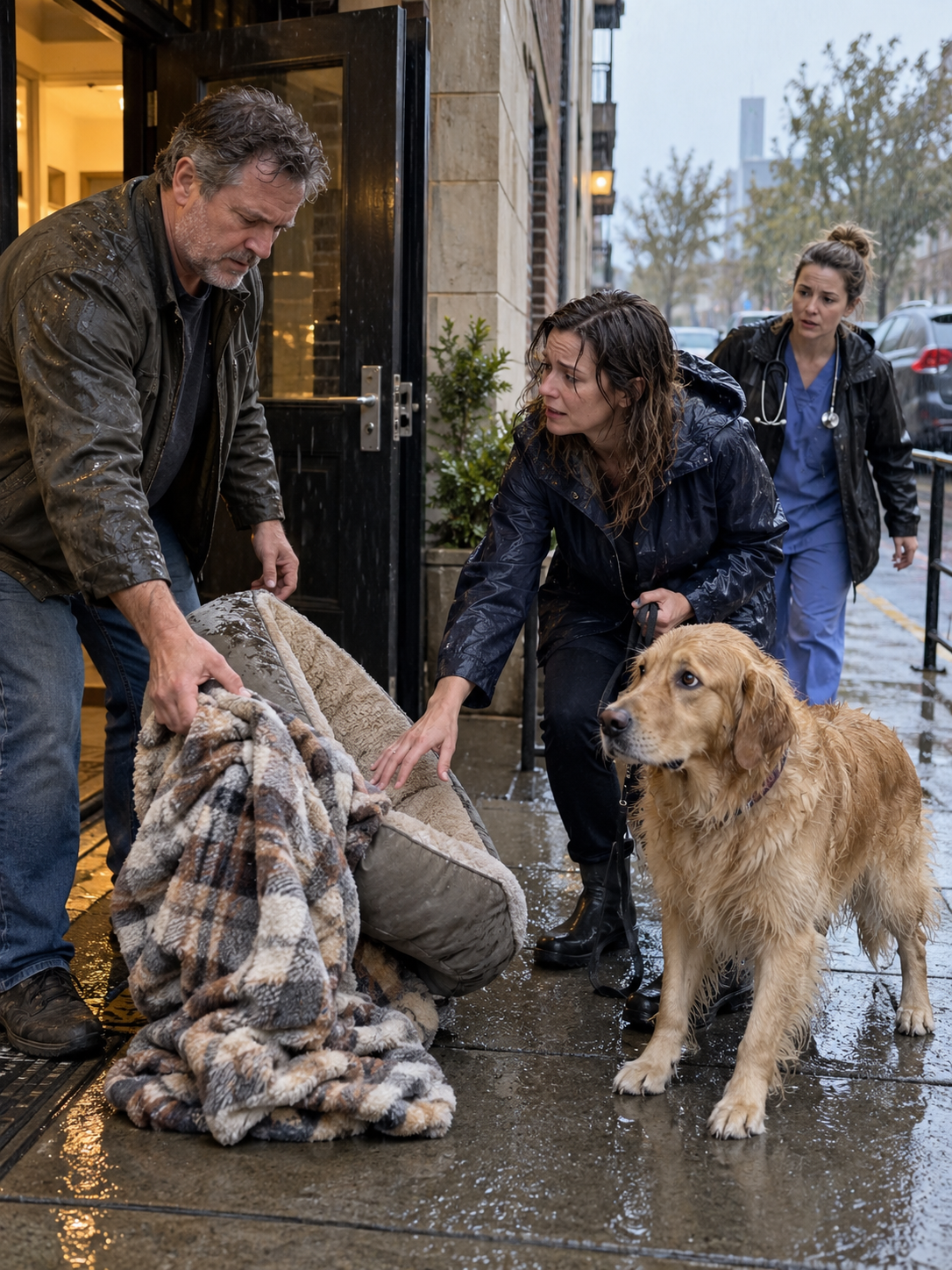
The dog’s bed landed upside down on the wet pavement. Its blanket followed, spreading into a puddle beside the curb. Natalie tightened her hold on the leash as the golden retriever moved toward it. From the apartment doorway, her stepfather told her to take everything and go. A woman in veterinary scrubs, returning home next door, stopped when she saw the blanket’s stitched corner.
Natalie was thirty-eight and had come to collect her late mother’s dog, Ben. The arrangement had been agreed by phone two days earlier. Her stepfather no longer wanted to care for him, and Natalie had spent the weekend organizing a suitable place for them both. She expected sadness while packing his bowls. She had not expected his familiar bed to be tossed into the street.
“It’s just old stuff,” her stepfather said. Natalie reached for the blanket without loosening the leash. Ben was healthy and frightened by the raised voices, pressing against her leg whenever someone moved suddenly. She kept speaking to him in the low tone her mother used. The sound helped her as much as the dog. She was trying to leave without losing the few things he recognized.
The neighbor introduced herself as Dr. Kim, a veterinarian who knew Natalie’s mother, Joan, through local foster work. She offered a dry towel from her car. Natalie accepted and asked whether they could move under the awning. Dr. Kim said yes, then asked the man in the doorway to stop throwing items while they packed. He went inside and shut the door.
Joan had died seven weeks earlier. Natalie had handled calls, paperwork, and meals for relatives while imagining the dog remained a comforting presence at home. She learned only later that her stepfather wanted Ben gone. Natalie did not argue that someone unwilling to care for an animal should keep doing so. She made a plan. The pain came from how carelessly he treated the things her mother had used every day.
Dr. Kim lifted the blanket and noticed three blue triangles sewn into its corner. “Your mother made these,” she said. Natalie nodded, surprised. Joan had always mended things rather than buy replacements. The vet turned the cloth carefully, finding a tiny numbered tag. Natalie had seen the stitching before but never asked about it. She had thought the blanket belonged only to Ben.
Joan had made blankets for foster animals for years. Each one carried the same blue corner so volunteers could identify and return them after washing. Ben arrived at Joan’s apartment as a temporary foster, then stayed when his adoption fell through. Dr. Kim remembered him sleeping on that exact blanket in the clinic office while Joan completed the paperwork to make the arrangement permanent.
Natalie knew about Ben’s adoption. She did not know the scale of her mother’s quiet work. Joan rarely described it as volunteering. She said she was dropping off laundry or helping a neighbor. Dr. Kim told Natalie about the stacks of clean bedding, the handwritten feeding notes, and the way Joan asked shy dogs to approach rather than reach for them too quickly. The vet remembered Joan bringing a notebook with each foster animal’s preferences written in plain language. She avoided grand claims about understanding them perfectly. She observed what helped and passed it on. Natalie found that detail especially comforting. Her mother’s care had not required being remarkable in public; it consisted of returning tomorrow with clean bedding and a useful note.
They packed the wet items separately. Dr. Kim offered to examine Ben at the clinic if Natalie wanted, with his existing records available there. Natalie arranged an appointment rather than trying to interpret every worried movement on the sidewalk. For that evening, she needed to get him warm, dry, and settled in the place she had prepared. The vet helped carry the bag of bowls to the car.
Ben hesitated at the open door until Natalie laid a dry towel on the seat. She let him sniff it and waited. When he climbed in, she secured him with the travel equipment she had brought and checked that the leash could not catch. Dr. Kim stood beside her without rushing. After a day of people telling her to move faster, that unhurried company felt unusually kind.
Natalie’s temporary apartment had an agreement allowing Ben, a small patch of shared grass, and a neighbor willing to help during work hours. It was not the home she hoped to keep forever, but the plan was workable. She set his water down, showed him the bed area, and sat nearby while he explored. The quiet made her realize how tightly she had been holding her shoulders.
She washed the blanket according to its fabric and let it dry. The old bed could not be fully cleaned, so she replaced it while saving the cover her mother had sewn. Natalie did not force herself to keep a ruined object merely because losing it hurt. She could preserve the pieces that mattered and still give Ben something clean and comfortable for tonight. She cut a small undamaged strip from the cover before replacing the ruined filling. Later she used it to patch the blanket’s frayed edge. Her sewing was less tidy than Joan’s, but the cloth lay flat. Natalie decided that was enough. Keeping her mother close did not require proving she could do every task with the same practiced hands.
At the clinic, Dr. Kim reviewed Ben’s records and answered Natalie’s questions. She also offered to introduce her to the foster coordinator who had worked with Joan. Natalie said she was not ready to volunteer; the vet made clear there was no expectation. Knowing more about her mother did not require inheriting every commitment at once. Caring for one dog was already a substantial change.
The coordinator later sent photographs with permission from the people involved. Joan appeared in the background of several adoption days, usually holding a stack of folded blankets. Natalie recognized the coat, the bent finger, and the smile her mother made when she thought nobody was photographing her. She saved the pictures in a folder named simply Joan, leaving room for parts of her life Natalie had yet to discover.
Her stepfather called to ask whether she had collected everything. Natalie listed the remaining bowls and a small tin of records. They arranged a time for a friend to retrieve them. She did not discuss the sidewalk again while he was dismissing it as nothing. She had described what happened once. Future contact could concern specific tasks without requiring her to convince him that her hurt was reasonable. A friend accompanied the final collection and brought a list Natalie prepared. Having it written down kept the visit short and spared her another search through cupboards while someone watched impatiently. Back at the apartment, she checked off each item and put the list away. Completing a practical task made a little more room for grief that did not have to defend itself.
Ben settled gradually. He learned when Natalie returned from work and where the afternoon light fell across the floor. Some evenings he waited by the front door longer than she expected. She sat with him rather than assigning a definite meaning to every pause. Both were living in a new arrangement shaped by an absence neither could explain to the other in words.
The clean blanket went over the new bed, blue triangles visible near the edge. Natalie found a note from Joan in the records tin: Ben liked his bowl away from noisy appliances and would wait politely if reminded. The note contained nothing profound. Its familiar instructions made Natalie laugh, then cry, then move the bowl a few inches. Her mother’s ordinary knowledge still had somewhere useful to go.
Six months later, Natalie helped at one adoption afternoon. She carried folded bedding and checked that volunteers had enough clean towels. She did not announce that she was continuing Joan’s work. She simply had a free Saturday and knew where help was needed. Dr. Kim thanked her, then handed her a stack of blankets with new blue corners waiting to be stitched. She stayed only for the hours she had promised, then left in time to walk Ben. The coordinator thanked her for being clear about her availability. Natalie appreciated that the work could accept a limited contribution. Her mother had helped for years through manageable routines, and Natalie was beginning to understand how those routines had made room for generosity without consuming every part of life.
At home, Ben greeted her with the unrestrained excitement he brought to the end of most workdays. Natalie took him outside, then sat near the window while he rested. The blanket had survived the puddle. More importantly, the habits of care sewn into it had survived a doorway where someone tried to reduce a life’s work to old stuff.
Natalie never found a way to make the memory of the bed striking the pavement gentle. She did find other memories to place beside it: Dr. Kim opening her car for a towel, Ben choosing the dry seat, and her mother smiling in photographs she had never seen. When she looked at the blue triangles, she remembered where the blanket went next.


