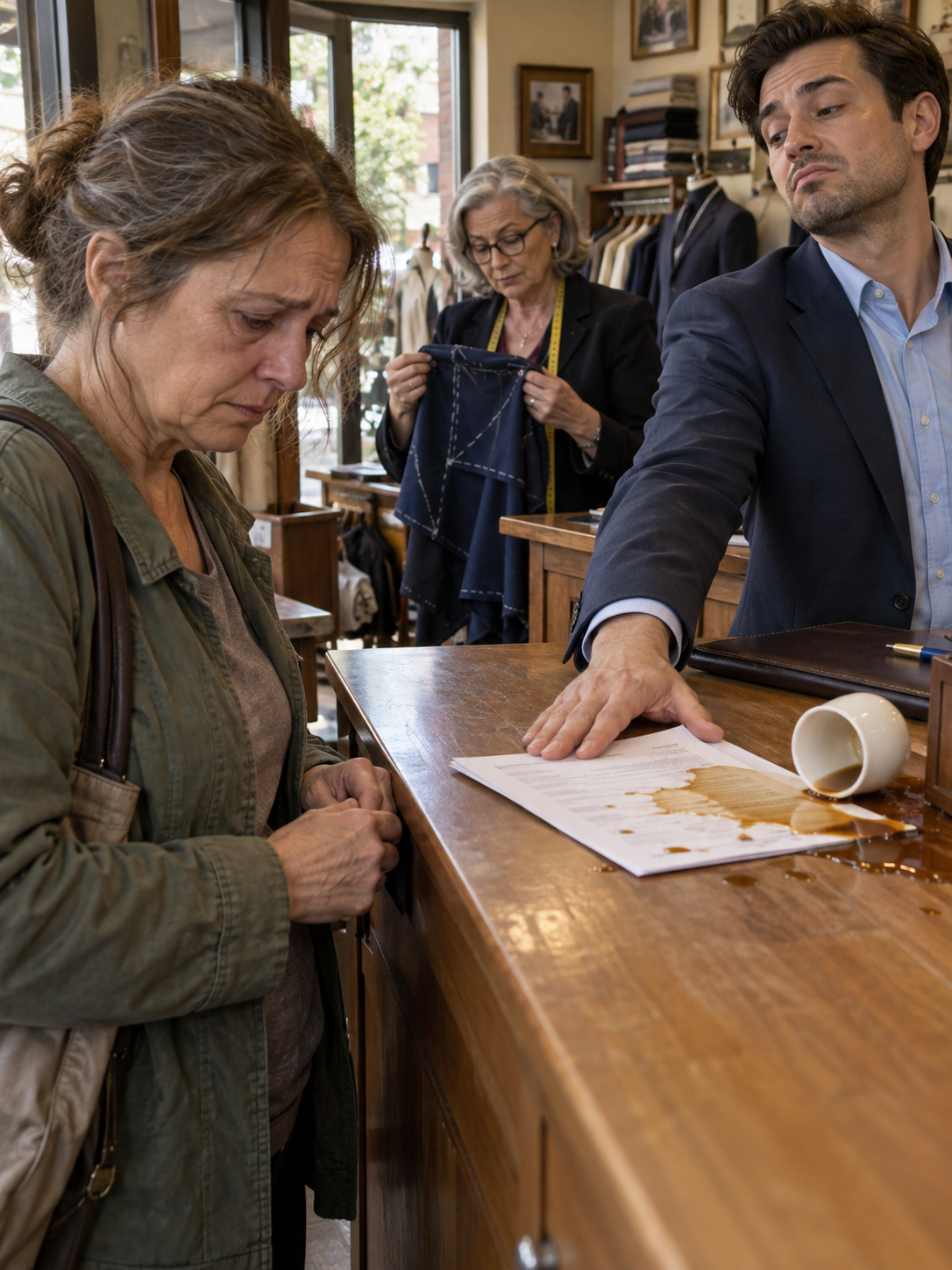
Coffee spread across Helen Marsh’s application in a dark crescent. The manager moved his cup but did not offer a towel. “You should really apply online,” he said, sliding the wet pages toward her. Helen looked down at the employment dates dissolving into the stain. Behind him, the shop’s owner had picked up the small fabric sample Helen brought in a separate envelope.
Helen was fifty-seven and had spent thirty years doing alterations, most recently from home while caring for her husband. After his death, she needed steadier hours and coworkers who were not voices on a telephone. The tailoring shop advertised a position for an experienced fitter. She called first and was told she could leave an application and examples of her work at the front desk.
The young manager, Owen, had glanced at her dates and asked whether she was comfortable using modern equipment. Helen said yes and named the machines she used. He did not ask about any of them. He said the shop needed someone who could keep up during busy periods. Then he reached across her papers for his phone, catching the coffee cup with his sleeve.
The spill was accidental. The indifference afterward was not. Helen asked for a dry surface so she could separate the pages. Owen said he had another appointment coming and that the online form would be easier. She knew how to complete it. What hurt was arriving for an agreed conversation and being treated as though she had wandered in asking someone to explain the internet.
She gathered the wet papers, leaving the fabric envelope because the owner had already opened it. Mrs. Langley was in her late sixties and spent more time in the workshop than at the front desk. She had overheard enough to wonder why an applicant was being dismissed before anyone examined the evidence she brought. She laid the sample across a clean section of the counter.
On the front, it was a neat seam in dark wool, the sort a customer might never notice. Then Mrs. Langley turned it over. Helen had shaped the inner layers so the fabric curved without bulk, each stitch doing a small, deliberate job. The owner ran a finger along the edge and asked Helen a question about construction. Helen answered at once, setting the coffee-stained pages down.
They discussed how the sample would behave when attached to a moving sleeve and why Helen chose one thread over another. Owen listened, apparently surprised the plain square could support a conversation he did not fully understand. Mrs. Langley asked where Helen learned the technique. Helen named a small alterations workshop that closed years earlier. She had been its youngest employee once.
Mrs. Langley knew the workshop by reputation, but she did not offer a job because of the name. She asked whether Helen would return for a paid practical trial using the same tasks offered to other candidates. Helen agreed and asked for the rate, expected duration, and duties in writing. A respectful conversation was encouraging. Clear terms would tell her whether the workplace deserved her time. Helen took a photograph of the written trial details before placing them in her bag. She had learned to keep arrangements clear when working from home, where an informal request could expand into days of unpriced changes. Returning to employment did not make that habit less useful. Mrs. Langley seemed pleased to be speaking with someone who asked precise questions.
The owner also handed her paper towels and asked whether the application could be reprinted. Helen had a digital copy ready on her phone. Owen looked embarrassed when she sent it without help. Mrs. Langley did not turn that into a joke about his assumptions. She asked him to confirm the email and restore the interview time that had been cut short.
During the conversation, Helen described fitting garments around different bodies, meeting deadlines, and explaining alterations a customer could reasonably expect. She did not pretend to know every new machine in the shop. When she needed familiarization, she said so. Mrs. Langley seemed to value that answer. Someone who named a limit was easier to trust than someone who promised a perfect result before seeing the work.
At home, Helen told her sister about the coffee. Her sister wanted her to forget that shop entirely. Helen was considering it, but the owner’s response interested her. She had no obligation to accept if offered the position. Returning for a paid trial would let her assess the workplace as it assessed her. She prepared her tools and wrote down questions she wanted answered before making a choice.
The trial began two mornings later. Helen worked beside another experienced fitter on a jacket and two ordinary alterations. She checked measurements, marked changes, and explained her sequence before cutting anything. The other fitter asked why she kept a row of temporary stitches in one section. Helen showed her how they helped test the curve. By midmorning, they were exchanging useful habits rather than competing over whose method sounded newer. The jacket belonged to a customer who had changed plans for an upcoming event. Helen asked what deadline had actually been promised and checked the fitting notes rather than relying on a comment passed across the room. The other fitter appreciated it. Much of good alterations work involved preventing a misunderstanding before it became an irreversible cut made for the wrong occasion.
Owen came through the workshop with a rush order. Helen asked whether it should replace the agreed trial task or wait for a scheduled worker. He began saying it would only take a minute. Mrs. Langley stepped in and clarified priorities. Helen watched carefully. A workplace could apologize for one rude moment and still expect people to absorb every poorly planned demand. This response mattered more than the apology alone.
At the end of the trial, Helen was paid as agreed. Mrs. Langley gave specific feedback and explained when a decision would be made. Helen asked about scheduling, breaks, and who spoke with customers when a requested alteration could not work. The answers were practical. Nobody asked her to prove commitment by staying late without pay or accepting a role different from the one advertised.
Owen apologized for his conduct at the first meeting. He acknowledged the spill, his dismissal of her answers, and the assumption behind the suggestion she needed help applying online. Helen accepted the apology without making him comfortable at her own expense. She said she would expect the same respect whether she was hired or not. He said he understood, and she left him to demonstrate it.
The offer arrived the following week with the terms they had discussed. Helen read it with her sister and asked for one scheduling detail to be clarified. Then she accepted. She needed the income, but she also wanted the daily exchange of skilled work. Her husband had always listened kindly to stories about a difficult hem. He could not tell her what another fitter would have tried first. Her sister asked how she felt about being the new person after so many years in the trade. Helen said experience did not tell her where this shop kept its spare chalk. There would be things to learn, and she looked forward to some of them. She wanted a place where learning a local routine did not erase the skills she already brought.
On her first full week, a customer assumed Helen was there to help with deliveries. Helen introduced herself as the fitter and invited her to the mirror. The customer adjusted without fuss. Small assumptions did not all require a battle. What mattered was that Helen could state her role and have her colleagues support it rather than leave her explaining why she belonged.
She kept the wool sample in a drawer until an apprentice asked about it. Helen turned it over and explained the inside construction. The apprentice said nobody would ever see that part. Helen laughed and said the person wearing it would feel the difference. She liked passing along work that improved something quietly, without needing a visible mark announcing who had done it. The apprentice tried the technique on scraps before using it on a customer’s garment. Helen watched one attempt, offered a correction, and stepped away long enough to let the next attempt belong to him. She remembered teachers who hovered until she became afraid to move. Sharing experience worked better when another person had room to develop confidence alongside the skill.
Months later, Owen interviewed another applicant with a long break in employment. He asked about experience, current skills, and what the person wanted to learn. Helen overheard from the workshop and returned to her measurements. She did not need him to look over for approval. The change would matter if he kept doing it when she was not there to listen.
The stained application ended up in Helen’s recycling. She did not want to save every piece of humiliation as evidence of a lesson. The fabric sample stayed. It reminded her of the morning a dismissive conversation changed because someone examined the work beneath the surface—and of the questions she asked afterward to make sure the opportunity was worth accepting.


