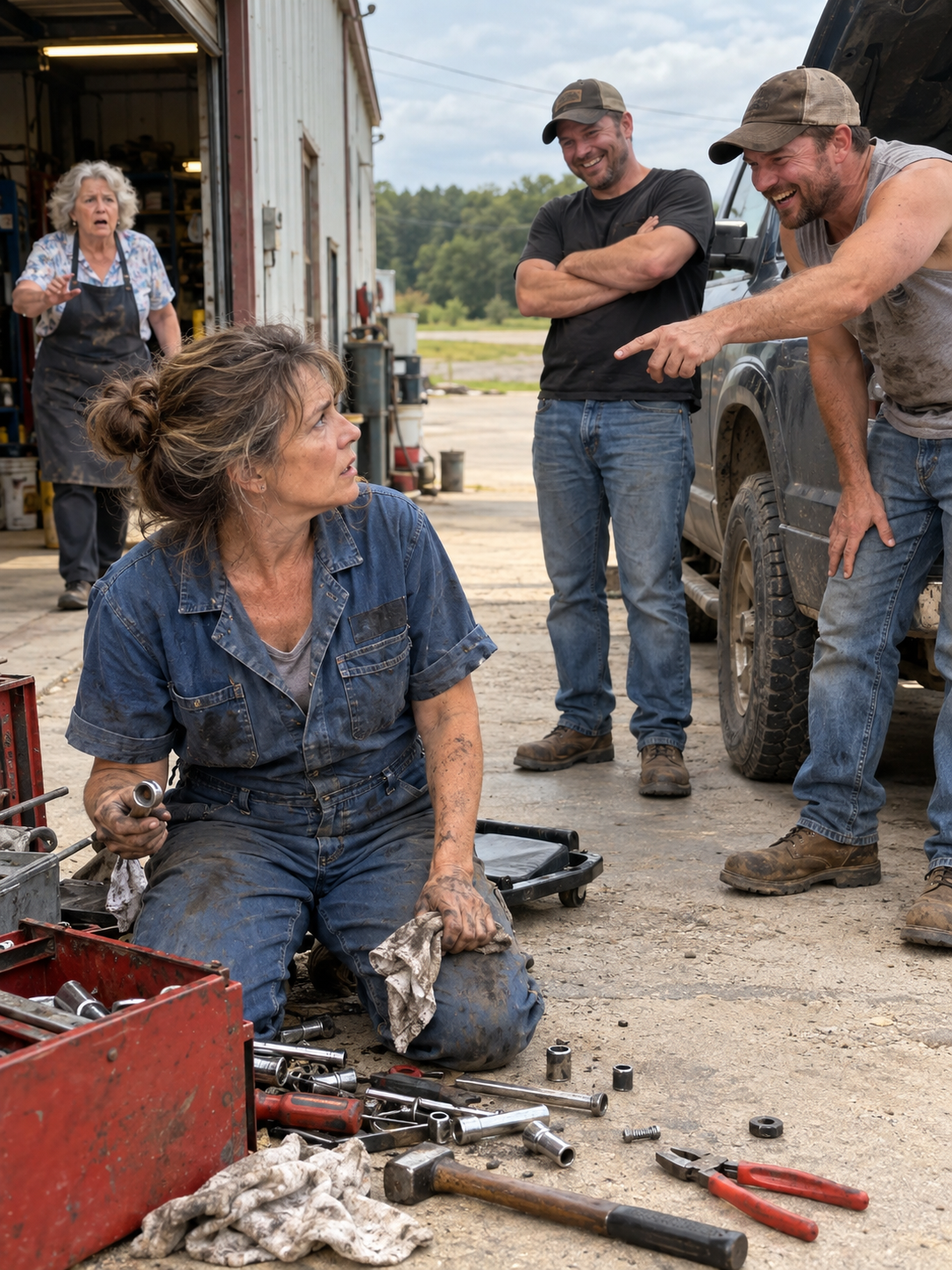
The toolbox hit the concrete with a metallic crash, spilling sockets beneath the pickup. Carla dropped to one knee to keep a small wrench from rolling into the drain. One of the men by the truck laughed and said she had packed enough equipment to look convincing. From the workshop doorway, the owner saw Carla gathering tools and asked what had happened.
Carla was fifty-three and had come for a practical interview. She spent twenty-five years repairing vehicles before reducing her hours to care for her father. Now she wanted to return to a small shop where she could know the customers and finish a job without three people changing the schedule. The owner, Marion, asked her to bring the tools she preferred using.
The men had arrived with a pickup that would not start after being shut off. One mistook Carla for someone dropping off a family member. When she said she was a mechanic, he asked whether she meant she changed her own oil. Carla continued unloading her toolbox. As he stepped around it, his boot caught the side. The laughter afterward made it clear he saw no reason to help.
Carla asked him to move away from the scattered tools. He said she should not leave things where people walked. The box had been beside her own vehicle, outside the marked customer path. His friend kept smiling. Marion came across the forecourt and asked again, this time looking directly at them. Carla named what happened without guessing whether the first contact had been deliberate.
The tools mattered individually. Some were inexpensive replacements; others had been shaped by years in her hands. Her father gave her the first small set when she began training, before anyone in the family knew whether she would stay with the work. She had brought them because she wanted to be judged using equipment she trusted. Now they were being treated as props in someone else’s joke.
Marion asked the men to wait in the customer area while she and Carla counted what was on the ground. Carla looked beneath the pickup and found the last socket near a tire. When she stood, Marion held a repair order. The same truck needed a diagnostic assessment. “Do you still want to do the agreed trial?” she asked. Carla read the order before answering.
She did not want a performance arranged to teach customers a lesson. Marion said that was not the proposal. The paid trial was already scheduled, the vehicle needed work within Carla’s experience, and another technician would review the assessment as planned. Carla could choose a different job if she preferred. Being given that choice made her willing to continue with the truck.
They checked the trial terms again: time, pay, supervision, and which work could proceed only after customer approval. Carla secured her toolbox and moved it to the work area. She inspected the vehicle methodically, following the shop’s procedures instead of guessing from the noise described at the counter. The other technician, Wes, watched her process and asked occasional questions without turning each answer into an interruption. Marion also made sure Carla had a place to put personal belongings and knew where to find the shop’s records. Those details were easy to neglect during a tense morning. Carla noticed them because they made the interview resemble an actual working day, with expectations and support, rather than a public challenge arranged to see whether she would fail.
The problem proved more straightforward than the men’s confident theories suggested, but Carla did not make a show of that. She documented what she found, noted another issue needing future attention, and asked Wes to verify the assessment. They agreed on the immediate work and the estimate. Marion took it to the customers, who asked who would be doing the repair.
“The technician who diagnosed it,” Marion said. One man requested someone more experienced. Marion explained Carla’s background and offered the choice of approving the work or arranging transport elsewhere. She did not promise a discount to make her employee acceptable. Carla could hear the exchange from the work area and appreciated that she did not have to argue her own résumé across the counter.
The men approved the estimate. Carla completed the authorized work and the normal checks with Wes. The truck started and operated as expected during verification. It was an ordinary successful repair, not a miracle produced in seconds for an audience. She wrote clear notes so whoever saw the vehicle next would know what had been tested and what still required the owner’s attention.
While waiting, Marion reviewed the forecourt camera recording concerning the toolbox. It showed the man’s boot knocking the box and his failure to stop before laughing. She saved the relevant portion for the incident record and asked him to address any damaged tools. Carla found one cracked handle and gave an honest replacement cost. The amount was small. Acknowledging it mattered more than making it impressive. She photographed the cracked handle for her own record and checked the rest under good light. There was no need to exaggerate the damage to establish that it happened. The camera record and the broken part were enough. Being accurate gave Carla a firmer position than an argument about whether someone who laughed afterward had intended every consequence of his foot moving.
The man paid and apologized when collecting the truck. He said he had not meant to damage anything. Carla answered that he could have stopped and helped regardless of his intention. His friend offered a quieter apology for laughing. She accepted the words, handed over the service notes, and explained the future issue in the same measured tone she would use with any customer willing to listen.
After they left, Marion asked about the trial itself. Carla described the work, the equipment she would need to learn, and a scheduling limitation related to family responsibilities. She also asked whether the shop consistently supported technicians when customers questioned them based on appearance. Marion gave examples and invited her to speak privately with Wes. Carla wanted evidence of the workplace, not reassurance manufactured for one difficult afternoon.
Wes said customers occasionally assumed the loudest man in a room knew the most, and Marion did not run the shop on that assumption. He also described busy days, parts delays, and the frustrations of a small business. Carla appreciated the ordinary complaints. A place where nobody admitted difficulties would have worried her more than a shop where people could explain how they worked through them.
The offer came two days later. Carla checked the written terms and accepted after agreeing on the hours. She celebrated with her father, who asked whether she still carried the old socket set. She told him every piece had survived. He looked pleased, then asked whether she needed a new box. Carla said perhaps eventually. For now, she wanted the one she knew back in daily use. Her father opened a drawer and found the faded receipt for the first set. Carla teased him for keeping it all those years. He said he liked knowing what things cost when they were new. She photographed it before returning it to the drawer. The tools were ordinary equipment, but the receipt marked the day someone invested in work she hoped she could learn.
During her first month, an apprentice asked permission to borrow a tool. Carla showed him where it belonged and asked him to return it clean. They developed a routine of checking the shared equipment at closing. She liked that care could be taught in small habits. People did not have to know an object’s family history to treat it as something another person relied on.
The pickup returned later for the additional work Carla had noted. Its owner asked for her by name. She took the booking and continued working, without turning the request into a public redemption scene. He was learning whom to trust because she had done competent work. She expected the same courtesy at the next visit, not an annual apology about the first one.
Marion added a clearer unloading space beside the workshop and reminded staff that customers could wait safely inside. The change did not suggest Carla caused the incident by placing her toolbox there. It reduced confusion and gave the shop another practical way to protect the people working. Carla helped mark the space, then returned to a repair she wanted finished before the afternoon collection. Customers soon learned which door to use and where to leave keys. The forecourt became calmer, which helped everybody, including people making deliveries. Carla preferred these quiet improvements to another retelling of the first afternoon. A shop earned trust through repeated working days, and she was pleased to have enough ordinary repairs ahead that the interview no longer dominated conversation.
The crash on the concrete was how the interview began. It was not how Carla chose to remember the job. She remembered Marion asking whether she wanted to continue, Wes checking an assessment without condescension, and her father asking about the old tools. The pickup left running properly. More valuable than surprising two men was finding a workshop where she could spend the next morning doing her work.


