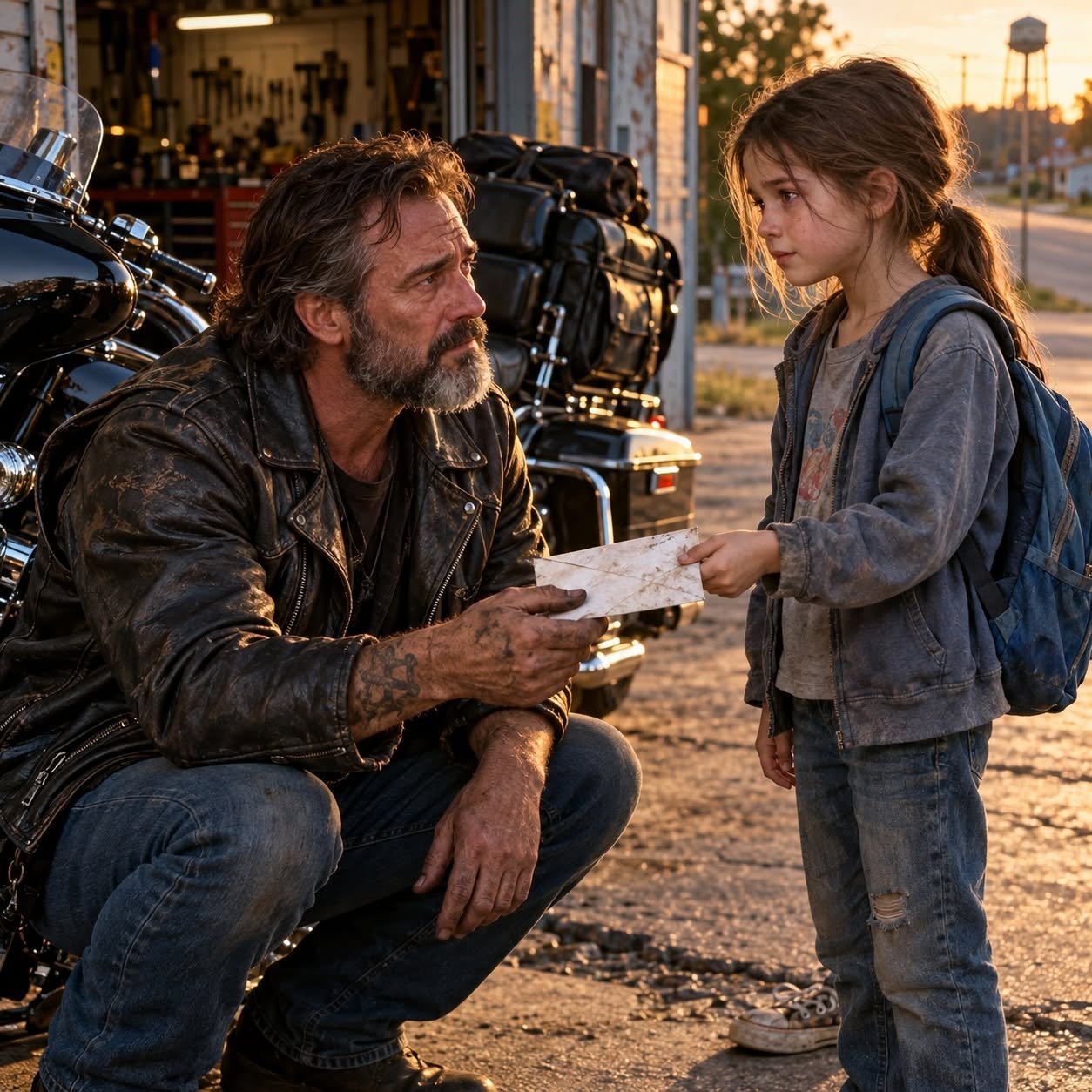
I was leaving town for good when a little girl stepped in front of my Harley.
“Please take me with you,” she whispered.
Then she said my dead best friend had sent her. He had been dead for eleven months. I hadn’t even gone to his funeral.
I killed the engine.
She stood three feet from my front tire, holding a faded blue backpack against her chest like a shield. Dust coated her sneakers. One shoelace had been knotted where it broke. She couldn’t have weighed sixty pounds, but she stood in the middle of my driveway like she had every right to be there.
“What’s your name?”
“Lucy. I’m nine.”
“Where’s your mom, Lucy?”
“County hospital.”
“And who was supposed to be watching you?”
Her eyes dropped to her sneakers. “Mrs. Bell. But I knew where your garage was.”
My name is Jack Mercer. I was forty-eight years old, I repaired motorcycles out of a cinder-block garage outside Dayton, Ohio, and I had spent eight years making very sure that nobody needed me after closing time. That afternoon, everything I still wanted in this world was strapped behind my seat: a change of clothes, my tools, and enough cash to get me west to somewhere the sky was bigger and nobody knew my name.
The girl lifted her chin. “My dad was Ben Lawson.”
I knew before she finished the sentence. Same gray eyes. Same stubborn set to the jaw that Ben wore whenever I insisted something couldn’t be fixed and he was about to prove me wrong.
Ben had been my best friend for twenty years. We’d grown up two streets apart, learned to ride on the same borrowed Honda, opened our garages within a year of each other. Then his calls started becoming reminders of a life I couldn’t stand remembering — cookouts I wouldn’t attend, birthdays I wouldn’t celebrate, a friendship I was slowly strangling because it hurt too much to hold. Eventually, he stopped calling.
When I heard he’d died — a heart attack at forty-seven, gone before the ambulance arrived — I sent flowers instead of myself. The card said Sorry for your loss. I never signed it. I told myself the shop couldn’t spare me for a day. The truth was simpler and uglier: I was afraid that if I walked into that funeral home, I’d have to feel something, and I’d spent eight years building a life around not feeling anything.
Now his daughter was standing in my driveway.
“Dad said if things got really bad, I should find you.”
I stared at the luggage strapped behind my seat. “He shouldn’t have told you that.”
Her fingers tightened around the backpack straps. “He said you’d say that, too.”
That hurt more than it should have. Ben had always been able to see around my corners.
I crouched down so we were eye to eye. “I’m calling Mrs. Bell. Then we’re getting you something to eat, and then we’re going to your mom. Nobody’s taking you away from anybody.”
“You’re taking me somewhere.”
“In my truck.”
She glanced at the Harley. “That one’s cooler.”
“That one’s staying here.”
Mrs. Bell answered on the second ring, frantic and breathless. Lucy had slipped outside while she was on the phone with the hospital — twenty minutes of pure panic. I gave her my address, let her talk to Lucy, and promised I’d call from the hospital. Then I loaded the world’s most reluctant passenger into my truck and drove to Millie’s Diner, because a nine-year-old who’d been running on fear needed food before anything else.
At Millie’s, Lucy ate a sugar packet before the waitress even brought our order. I ordered pancakes, eggs, and milk. She tried to eat slowly, like a lady. Then she stopped pretending and ate like a kid who’d missed lunch.
“Mom usually makes dinner,” she said between bites. “She’s been tired lately.”
I pushed the toast toward her. She opened the backpack and placed an envelope beside my coffee cup.
JACK.
Ben’s handwriting. Even his crooked K looked familiar — he’d been writing his name that way since we were twelve and he’d decided it looked tougher.
Inside was a single page folded around an old photograph: the two of us at twenty-five, standing beside our motorcycles, young and grinning and immortal.
I read the letter while Lucy dragged a fork through her syrup.
Jack — If Lucy is bringing you this, something has gone wrong. Help her get to Rachel. She’s going to act braver than she feels. Don’t let that fool you. You don’t have to replace me. Just don’t disappear when being needed scares you. — Ben
Lucy watched my face. “Did he say you’d help?”
“He asked me to.”
“Are you going to?”
I looked past her at my truck, at the highway beyond the diner windows. Leaving would still be easy. Nobody would blame me. A man with a packed truck and a plan doesn’t owe explanations.
“Yes,” I said.
At the county hospital, Rachel Lawson looked smaller than I remembered from the one time I’d met her, years ago at a cookout I’d left early. An oxygen tube rested beneath her nose. Pneumonia, the nurse told me — bad, but treatable, caught in time. Lucy climbed carefully onto the edge of the bed, and Rachel held her so tightly the backpack slid to the floor.
“You scared Mrs. Bell half to death,” Rachel whispered.
“I found Jack.”
Rachel looked at me over her daughter’s head. “Ben always hoped you’d come back.”
I couldn’t hold her gaze. “I’m sorry I didn’t come sooner.”
She nodded toward the chair beside the bed. “Then sit down now.”
So I sat. And I stayed. There were things to arrange — groceries, school pickup, someone to sit with Lucy while Rachel remained in the hospital — and with Rachel’s permission, I agreed to help Mrs. Bell cover the gaps. It was supposed to be temporary. A week, maybe two. Just until Rachel was on her feet.
Every afternoon that week, Lucy did her homework at my workbench. I bought a lamp, cleared away the solvents, pushed the parts bins to one side, and discovered that I remembered considerably less about fourth-grade fractions than I did about carburetors. She started laughing again — real laughter, the kind that comes from somewhere deep. I started listening for her footsteps on the gravel when the school bus dropped her off.
Friday evening, while we waited for Mrs. Bell to pick her up, Lucy found the photograph I’d left beside my toolbox. It was Emma’s school picture, the one from the spring before.
“Who’s the little girl?”
My hand went still on the wrench I was holding. “My daughter. Emma.”
“Does she live somewhere else?”
“She died when she was six.”
Lucy sat quietly for a moment, swinging her legs from the stool. Then she reached into her backpack — the same faded blue backpack — and set something small and brass on the workbench between us.
“Dad said you’d know what this opens.”
A key. Small, brass, worn smooth at the edges. I recognized it immediately, the way you recognize something you’ve tried for years to forget.
Under the stairs in my garage stood a steel cabinet I’d bought at an army surplus store a lifetime ago. After Emma died, I’d packed everything of hers into a wooden box — her drawings, the hospital bracelet, the stuffed rabbit with one ear chewed flat — and locked it in that cabinet. Then I’d handed the key to Ben and told him to keep it, because I never wanted to see it again. I never wanted to be the man who could open that door.
“Dad said to give it to you when the time was right,” Lucy said quietly. “He said you’d know.”
I stared at the key for a long time. Then I picked it up — it was lighter than I remembered, or maybe I was stronger — and walked to the stairs with Lucy beside me. The lock turned on the first try. Inside, exactly where I’d left it eight years earlier, sat the wooden box.
Beneath Emma’s photograph lay a folded note I had never seen before. Ben’s handwriting again.
The first line made my knees buckle: Jack, before you decide Lucy deserves a better man, there’s something you need to remember about the day Emma died.
I sat down on the concrete floor and read it twice.
You think you killed her by not getting her to the hospital fast enough. You’ve thought it every day for eight years. I was in the car behind you that night, Jack. I saw the whole thing. You did everything right. You did everything humanly possible. The doctors told us — told both of us, and you were too far gone in grief to hear it — that no one could have saved her. It was meningitis. It was hours ahead of all of us. There was nothing to outrun.
You asked me to keep this key because you said you’d never be ready to open that box. I’m giving it back through Lucy because I think you’re finally ready. Not because the grief is gone — it never goes. But because you’ve got someone who needs the man Emma always knew you were.
Don’t you dare leave town, you stubborn son of a bitch. — Ben
I don’t know how long I sat on that garage floor. Lucy sat beside me, not touching me, just there — the way Ben used to be there, back when we were kids and one of us was hurting and the other one just showed up and didn’t leave.
“He wrote that before he died?” I asked finally.
Lucy nodded. “He was sick for a while before the heart thing. He wrote lots of letters. He said grown-ups need instructions too.”
I laughed through the tears, because Ben had always been right about everything except his own heart.
That night, after Lucy went home with Mrs. Bell, I carried the wooden box into the house and set it on the kitchen table. I looked at Emma’s drawings — the crooked house, the sun with a smiling face, the motorcycle she’d drawn me on with “MY DAD” written underneath in wobbly capitals. I held the stuffed rabbit. I cried the way I hadn’t cried in eight years, not the locked-jaw silent kind, but the real kind, the kind that means something is finally moving.
In the morning, I called the landlord of the place I’d been planning to rent out west and told him I wouldn’t be coming. Then I drove to the sign shop and ordered a new sign for the garage. The old one just said MERCER’S. The new one would say MERCER & LAWSON.
Rachel came home from the hospital the following week. She was weak but recovering, and furious — in the way of mothers everywhere — that Lucy had “run off to find a virtual stranger.” Then she saw the homework station at my workbench, the lamp, the cleared solvents, the fractions worksheet with my embarrassing attempts at long division in the margins, and she cried a little too.
“You don’t have to do all this,” she said.
“I know,” I said. “Ben asked me not to disappear. I’m trying to honor that.”
Over the next months, something none of us planned began to take shape. I drove Lucy to school when Rachel had follow-up appointments. Rachel cooked — she was a better cook than Ben had ever been, which wasn’t hard — and the three of us ate at my kitchen table, which had never been used for anything but parts catalogs. Lucy taught me that fourth-grade math was, in fact, harder than carburetors. I taught her to change her own bicycle tire, and she declared it “easier than fractions, barely.”
One evening, about three months after Lucy stepped in front of my Harley, she left the brass key on my workbench with a note in her careful nine-year-old handwriting: For the next time you need to remember. — L.
I keep it in the top drawer now, next to Emma’s photograph. Not locked away. Just there.
Ben was right about one more thing: the grief never goes. But somewhere between Lucy’s laughter in my garage and Rachel’s cooking in my kitchen and the new sign over the door, I learned what Ben had been trying to tell me for years — that the way through grief isn’t around it, and it isn’t by leaving town. It’s by staying. It’s by letting yourself be needed, even when being needed scares you half to death.
Especially then.
Lucy still has the faded blue backpack. She says she’s keeping it for when she’s older, for when she needs to be brave about something. I told her she’s the bravest person I know, and she rolled her eyes the way only a nine-year-old can.
But last week, when the school bus dropped her off and she came running up the gravel drive, she stopped at the new sign and read it out loud, slowly, like she was memorizing it.
“MERCER and LAWSON,” she said. Then she looked at me and grinned — Ben’s grin, exactly. “Dad would’ve liked that.”
Yeah, kid. He would have.

