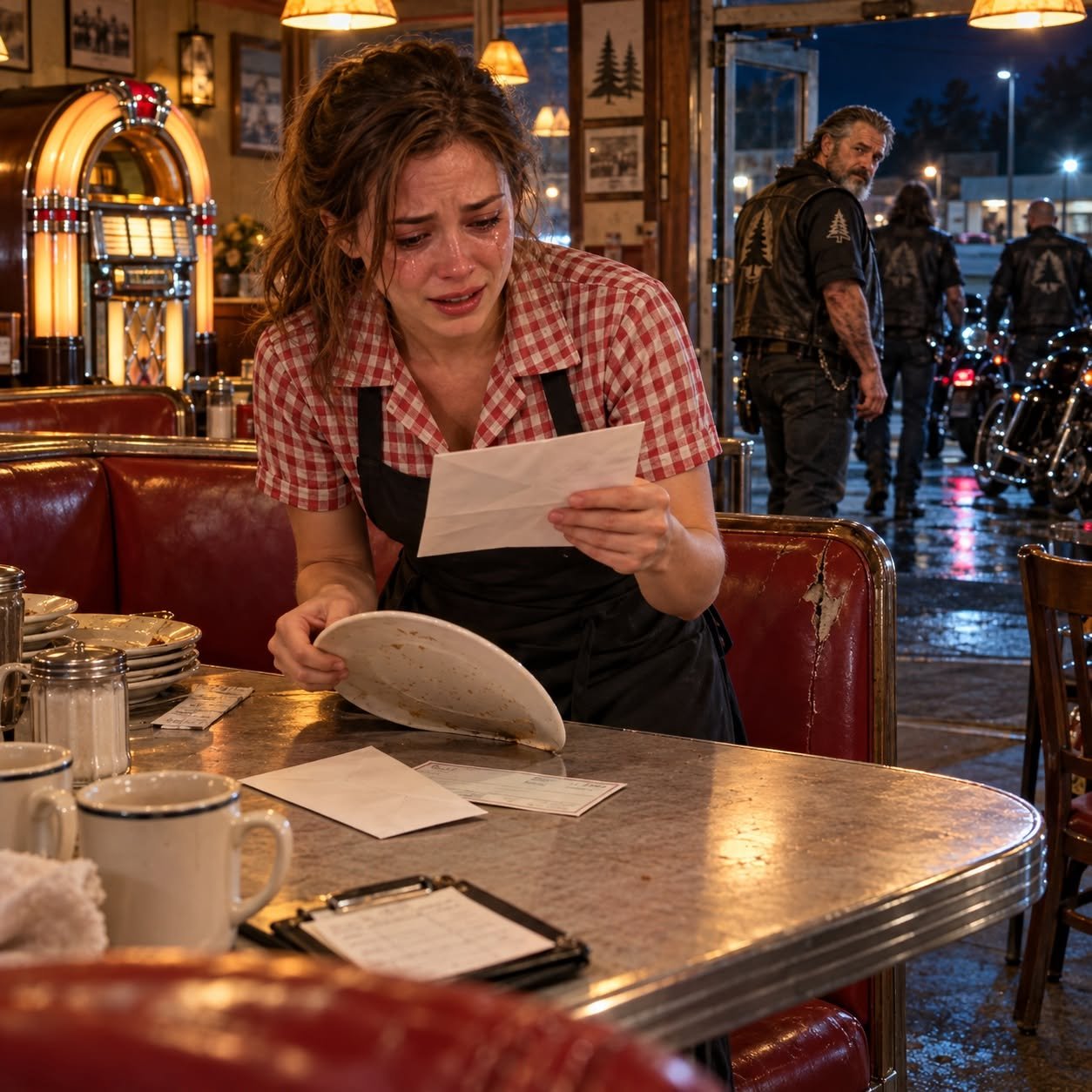
The biker left a zero-dollar tip.
Rachel Bennett stared at the receipt for a long moment, doing the math she had already done a dozen times that day. Her six-year-old son’s inhaler was running low. A fifteen-dollar field trip form sat on the kitchen table at her sister’s apartment, waiting for a signature and a check she wasn’t sure she could write. And now this — $0.00 on the tip line, from the biggest table she’d served all night.
She folded the receipt before her manager could say anything else. Then she lifted the first plate to clear the table, and froze.
There was a folded envelope underneath it, and her name was written across the front in careful block letters. Her full name. Rachel Bennett.
For a moment, that frightened her more than the three motorcycles still parked outside.
Rachel was twenty-nine, a single mother, and she worked the evening shift at the Lantern Diner on the highway outside Springfield, Missouri. She knew how to carry five plates without spilling a drop. She knew which truckers wanted conversation and which wanted to be left alone with their coffee. She could tell the coffee machine was about to quit by the particular groan it made just before the pot filled.
What she couldn’t figure out was how to make one paycheck cover a life that kept getting more expensive.
Her son, Owen, had asthma, an obsession with dinosaurs that bordered on the academic, and a habit that broke her heart a little more each time — he apologized whenever he needed something. “It’s okay, Mommy,” he’d whisper when his shoes pinched. “I can wait.” Children shouldn’t have to say that. Rachel knew it the way she knew the ache in her feet at the end of every shift.
Owen’s father had been gone for three years — not dead, just gone, which Rachel had privately decided was worse, because at least grief has an ending. Her sister Beth watched Owen while Rachel worked, usually for nothing more than groceries when Rachel could afford them. Every afternoon, Rachel dropped Owen at Beth’s apartment and promised she’d see him before morning. Every night, she carried him home asleep, his small body warm against her shoulder, and laid him in the bed they shared in the one-bedroom apartment above the laundromat.
That Saturday had started the way Saturdays usually did: with bad news delivered quietly. During her break, Beth texted. His inhaler is getting low. He’s fine. Just letting you know.
Rachel had checked her bank balance in the stockroom. Then she counted her tips. Then she counted them again, as though embarrassment might somehow produce another twenty dollars. On the back of her order pad, she wrote three words.
Medicine. Electric. Shoes.
Then she crossed out shoes.
At eight-fifteen, three motorcycles pulled into the parking lot, and the low rumble of the engines seemed to roll straight through the diner’s thin walls. Conversations slowed when the riders came through the door. They wore leather vests, heavy boots, and patches from a club called the Black Pines Riders. The man in front had a dark beard threaded with silver, scarred hands, and shoulders that barely cleared the doorway.
Dennis, the manager, glanced up from the register. “Keep an eye on that table,” he muttered.
Rachel picked up three menus. “I keep an eye on all my tables.”
The riders chose the corner booth. “Evening,” Rachel said. “Coffee?”
The big man looked at her name tag. “Please. Black.”
The others ordered burgers. He asked whether they served breakfast all day. “We do.” “Eggs, potatoes, toast.” “How do you want the eggs?” “However the cook does them best.” That made her smile despite herself. “Scrambled, then. Don’t tell him I said that.”
The man’s expression softened slightly — just a fraction, but Rachel noticed. She noticed everything. It was her job.
While their food cooked, she helped an elderly woman read the menu because she’d forgotten her glasses. She wiped up a child’s spilled milk without being asked. She brought a fresh spoon to a trucker who had dropped his on the floor. Ordinary things. The kind of things nobody tips extra for.
But whenever she passed the corner booth, she felt the bearded man’s eyes on her. Not on her body — she knew the difference, and God knew she’d learned to tell. He was watching her face. Her hands. The way she checked the clock above the pie case every twenty minutes, calculating how many hours were left and how many dollars they might hold.
Once, he saw her looking through the window at her old sedan in the parking lot, its passenger window held together with strips of clear packing tape.
“That yours?” he asked.
“Unfortunately.”
“Runs?”
“When properly encouraged.”
One of his friends laughed. The bearded man didn’t. He studied the car for a long second, then returned to his coffee.
Later, Beth called, and Rachel stepped into the hallway by the restrooms to answer. Owen had heard another kid talking about the field trip — the one with the fifteen-dollar form.
“He wants to know if he should turn in the form,” Beth said.
Rachel closed her eyes. “Tell him yes.”
“Rachel—”
“I’ll figure it out.”
When she turned around, the biker was standing near the register, waiting to pay. She couldn’t tell how much he’d heard.
“Everything all right?” he asked.
“Just family stuff.”
He nodded, like a man who knew exactly how much weight two words could carry.
She rang up their meal. He handed her a card bearing the name Samuel Cole. The ancient card machine took forever to process it, grinding and beeping like it was personally offended by the transaction.
“Sorry,” Rachel said. “It’s having the same kind of day I am.”
“No hurry, Rachel.”
She gave him the receipt and went to refill another table’s drinks. When she looked back, the three men were leaving. Their plates were stacked neatly at the edge of the table. The mugs stood together in a tidy row. She appreciated the courtesy right up until she saw the tip line.
$0.00.
Dennis glanced over her shoulder. “Told you.”
She folded the receipt before he could say anything else. Then she lifted the first plate — and found the envelope.
Inside was a handwritten letter, two pages, the writing steady and unhurried.
Rachel, You treated us the way you treated everyone else tonight. That shouldn’t be unusual, but it is. I heard you say you would figure it out. My mother used to say that. Usually when she had no idea how. I sat down.
Below the letter was a check made payable to Rachel Bennett. Five thousand dollars. Clipped behind it was a business card. Samuel Cole — Second Mile Foundation. And beneath the printed information, one handwritten sentence: The money is yours whether you call or not. But if you’re tired of just surviving, call me.
Rachel read the letter three times standing in the empty dining room, the check shaking slightly in her hand. Dennis asked what was wrong. She showed him the check. He went very quiet.
That night, after she carried Owen home asleep, she sat at the kitchen table and stared at the card until the sun came up. At seven in the morning, with Owen still sleeping, she dialed the number.
Samuel answered on the second ring. “I wondered if you’d call,” he said.
The Second Mile Foundation, he explained, was a small nonprofit he and his late wife had started years earlier. They helped single parents in the Ozarks — not with handouts, he said firmly, but with footing. Car repairs. Medical bills. Job training. “The money’s yours, no strings,” he said. “But if you want more than the check, we can talk about what comes next.”
What came next, it turned out, was everything.
The check covered Owen’s inhaler refills for a year, the electric bill, the field trip form, and new shoes — the word Rachel un-crossed from her list with a feeling she would later describe as physical, like a knot loosening in her chest. But Samuel didn’t stop there. He asked what Rachel was good at. She laughed — a short, surprised sound — and said she was good at remembering people’s orders and making them feel like somebody noticed them.
“That’s not nothing,” Samuel said. “That’s hospitality. That’s management.”
The foundation paid for Rachel to take evening business courses at the community college — Beth watched Owen, and this time Rachel could pay her properly. Within eight months, Rachel was the assistant manager of a new family restaurant in Springfield. Within two years, she was running it. She hired single mothers first, always. She told every one of them the story of the envelope, because she wanted them to know that being seen could change the shape of a life.
And the bikers? They became regulars. Every second Saturday, three motorcycles pulled into the parking lot — sometimes more, because word travels in the riding community — and the men in the leather vests took the corner booth and ordered breakfast for dinner. Samuel always asked for his eggs “however the cook does them best.” Rachel always smiled and said, “Scrambled, then. Don’t tell him I said that.”
Dennis, to his credit, apologized. Rachel accepted, because she’d learned something the bikers seemed to have known all along: most people are doing their best with what they have, and the ones who look the toughest are sometimes the ones paying the closest attention.
Owen is eleven now. His asthma is managed. He still loves dinosaurs, and he no longer apologizes for needing things — though he says please and thank you with the polish of a boy raised by a woman who notices everything. On the wall of Rachel’s office hangs a framed copy of the letter, and beneath the glass, in Rachel’s own handwriting, five words she added the day she hung it: I called. It changed everything.
She keeps the business card too, tucked in her wallet behind her driver’s license. She doesn’t need the number anymore — she has it memorized, along with the numbers of a dozen single mothers she’s referred to the foundation herself. Because that’s what the second mile is, Samuel told her once: not the help you receive, but the help you pass on.
Rachel volunteers every Thanksgiving now, serving dinner at the foundation’s community meal. And every year, without fail, three motorcycles pull up outside, and the men in the leather vests come in and roll up their sleeves and serve plates alongside her.
The tip line on their checks always reads $0.00.
Rachel just smiles now. She knows what’s underneath the plates.


