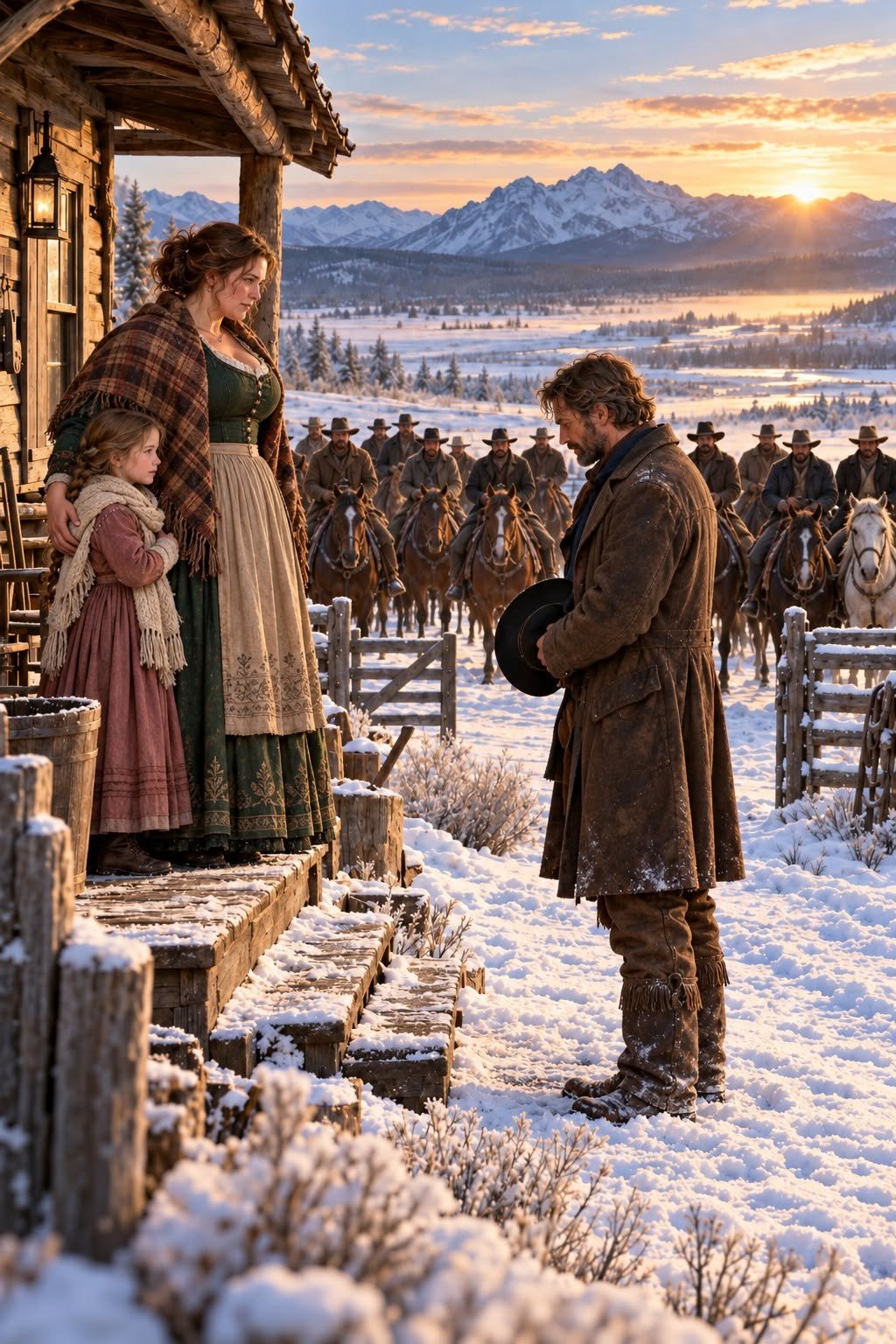
The twelve horsemen appeared at Ruth Callaway’s gate just after sunrise, riding in two perfect lines with the easy confidence of men who had traveled far and knew exactly where they were going. Their horses gleamed beneath expensive saddles, and their long coats stirred in the cold Montana wind. At their head rode a broad-shouldered man with silver at his temples and a face that looked as though it had forgotten how to smile.
Ruth stood on her porch with her eight-year-old daughter’s hand clutched in her own, and she did a quick, frightened inventory of everything she owned. She had no money worth stealing and no cattle herd worth taking. She had forty struggling acres, one stubborn milk cow, and a cabin that barely kept winter outside. Yet these men had come directly to her door, as if she were someone who mattered.
The leader dismounted with the smooth grace of a man half his age. He removed his hat and held it against his chest, and when he spoke, he said a name Ruth had not expected to hear. “Abel Merrick,” he said quietly, and the morning seemed to hold its breath around them.
Ruth went perfectly still, because three months earlier she had dragged a dying man named Abel Merrick out of a blizzard, and she had never imagined that saving him would bring twelve armed riders to her home. But the story, like so many stories on the frontier, had begun on a December morning when Ruth had almost nothing left to give.
Montana Territory, December 1883. The blizzard arrived like the wrath of God, and by dawn the snow had buried the fence rails, swallowed the wagon tracks, and turned the world beyond Ruth Callaway’s kitchen window into a wall of white. The cabin trembled beneath the wind, ice gathered around the windowpanes, and the little iron stove consumed firewood faster than Ruth could afford to replace it.
At thirty-two, Ruth had already learned that survival was not always about strength. Sometimes it was about refusing to surrender when surrender seemed reasonable. Her husband, Ben, had been dead three years, gone through river ice while trying to rescue a frightened heifer, leaving Ruth with forty acres of stubborn Montana soil, a mortgage she struggled to pay, and a daughter who still sometimes asked whether heaven had horses.
Lily was eight years old, with her father’s dark eyes and her mother’s determination, and a habit of asking questions nobody knew how to answer. That morning she sat beside the stove with a patched quilt wrapped around her shoulders. “Mama?” she said. “Do you think the angels get cold?” Ruth paused while stirring the last of their oatmeal. “I reckon heaven has better weather than Montana,” she said, and divided the oatmeal into two bowls, keeping barely three spoonfuls for herself. It was a lie she had told so often — “I already ate” — that her daughter had begun recognizing it.
Before Lily could argue, something moved beyond the kitchen window. A shadow, then another. Ruth leaned closer, and at first she thought the wind was pushing loose branches across the yard, but there were no trees in that direction, only the buried path toward the eastern ridge. Then she saw a human figure stumble, and another figure reach for him, and both disappeared into the snow. Lily jumped from her chair. “Mama! Somebody fell!”
Ruth was already moving. She grabbed Ben’s old wool coat from its peg, pulled on her boots, and reached for the heavy rope beside the door, tying one end around the porch post and the other around her waist. “Listen carefully,” she told Lily, kneeling before her. “You stay inside until I call. Then you stand in the doorway and help pull the rope.” Lily nodded, frightened but determined, and Ruth opened the door into a storm that struck so violently it nearly knocked her backward.
She followed the rope into the white darkness, her boots sinking nearly to her knees, falling twice and once losing her direction entirely until she pulled against the rope to find the porch again. Then her hand struck something solid — a frozen boot. She dropped to her knees and found an elderly man half-buried beneath the snow, his beard crusted with ice, and beside him an older woman wrapped in a plum-colored shawl, still moving, barely. “Help,” the woman whispered. Ruth grabbed the man beneath his arms and shouted, “Lily! Pull!” and inch by inch, mother and daughter dragged the stranger toward the cabin. Ruth went back for the woman, and by the time she reached the porch again, her fingers were so numb she could barely untie the knot around her waist.
Inside, with the door slammed shut, the two strangers lay motionless on the cabin floor, and for one terrible moment Ruth wondered whether she had been too late. Then the old man coughed, and Ruth fell to her knees beside him. “That’s it,” she whispered. “Keep breathing.” She stripped away their frozen outer clothing, wrapped them in dry blankets, warmed them gradually beside the stove, heated water, prepared broth, and used the last of her precious flour to make a thin soup. Lily brought extra blankets from her own bed, and hours passed with the storm still raging outside.
Finally the elderly woman opened her eyes and looked around the humble cabin. “Where are we?” she asked. “My home,” Ruth said. “My husband?” “He’s alive. Resting beside the stove.” Tears filled the woman’s eyes at once. “We have no money,” she said. Ruth adjusted the blanket around her shoulders. “Then it’s a good thing I wasn’t selling anything.” The woman stared at her. “You don’t understand. We cannot repay you.” Ruth gave a tired smile. “You can repay me by staying alive.”
The woman began to cry softly. Her name was Sarah Merrick, and her husband was Abel. They had traveled west searching for a son they had not seen in twenty-three years, had lost their wagon near the ridge when the storm overtook them, their horse had broken free, and they had walked until their strength disappeared. “Twenty-three years?” Ruth asked gently as she added wood to the fire. Sarah nodded. “We made a terrible mistake when he was young.” Abel stirred beneath his blanket, his voice rough and weak. “I made the mistake,” he said. Sarah reached for his hand. “We both did.” Neither explained further, and Ruth did not press them, because she understood what it meant to carry grief that could not be spoken aloud.
For five days the Merricks remained in her cabin. Ruth shared every meal, Lily surrendered her bed, Abel gradually regained his strength while Sarah helped mend torn clothing and told Lily stories about towns far beyond Montana, and something unexpected happened — the little cabin began to feel less lonely. One evening Sarah watched Ruth divide a small loaf of bread into four portions and said, “You should keep more for your daughter.” Ruth looked at Lily, who was laughing at one of Abel’s stories. “She has enough tonight.” Sarah’s eyes filled. “Why would you do all this for strangers?” Ruth considered the question, then answered quietly, “Because I hope somebody would have done the same for Ben.” Sarah reached across the table and squeezed her hand.
When the weather finally cleared, Ruth arranged for a passing freight driver to take the elderly couple toward Miles City. Before leaving, Abel stood on the porch studying the little homestead — the broken fence, the sagging barn roof, the woodpile reduced to a handful of logs. “You’ve had a difficult life here,” he said. Ruth shrugged. “It’s still my life.” Abel looked at her for a long moment, then asked something strange. “Mrs. Callaway, what was your husband’s full name?” “Benjamin Thomas Callaway,” Ruth said. The old man’s expression changed, only slightly, but Ruth noticed. “Did you know him?” she asked. Abel looked toward the distant mountains. “No,” he said after a pause. “Not personally.” Then he took her hand. “You gave us something money cannot purchase.” Ruth smiled. “Just promise me you won’t walk through another blizzard.” Abel nodded. “I promise.” The wagon carried them away, and Ruth believed that was the end of it.
Winter passed slowly. The cow survived, Lily grew another inch, and the roof leaked during the spring thaw. Then a letter arrived from the bank warning Ruth that unless she settled her overdue payments, the land would be sold. She read it three times, folded it carefully, and hid it beneath the flour tin. She would find a way. She always had.
But on a bright morning three months after the blizzard, Lily came running from the barn. “Mama! Horsemen!” Ruth stepped outside and saw twelve riders approaching, their horses magnificent, their clothing expensive, the man leading them carrying himself with the quiet authority of someone accustomed to being obeyed. They stopped at her gate. “Can I help you gentlemen?” Ruth asked. The leader dismounted, tall and powerfully built, perhaps forty-five, with dark eyes that seemed strangely familiar, and removed his hat. “Are you Ruth Callaway?” “Yes.” “Did you shelter an elderly couple during the December blizzard?” Ruth felt her heartbeat quicken. “Yes. Abel and Sarah Merrick.” The man closed his eyes briefly, and several of the riders behind him lowered their heads. “Are they all right?” Ruth asked. “They’re alive, Mrs. Callaway,” the stranger said. “Because of you.” Relief washed through her, but the man had not finished. “My name is Nathaniel Merrick,” he said. “Their son. The son they spent twenty-three years trying to find.”
Nathaniel reached into his coat and withdrew a worn leather pouch, and inside was an old photograph that he held toward Ruth. It showed a younger Abel and Sarah standing beside a boy of perhaps twelve. But it was not the boy who caught Ruth’s attention — it was the object hanging from his neck, a small silver pendant shaped like a horseshoe. Ruth stopped breathing, because she had seen that pendant before. Ben had worn one exactly like it, kept hidden beneath his shirt throughout their marriage, and before he died he had given it to Lily. Ruth slowly turned toward her daughter. Lily was wearing the pendant that morning. Nathaniel followed her gaze, and his expression changed. “Where did that child get that necklace?” he asked. Ruth could barely speak. “It belonged to my husband.” Nathaniel took one unsteady step forward. “What was his name again?” “Benjamin Thomas Callaway.” The man’s face drained of color as he looked at the pendant, then at Ruth, then back at the faded photograph.
When he finally spoke, his voice was almost a whisper. “Mrs. Callaway, there is something about your husband that my parents never told you.” Ruth tightened her grip on Lily’s hand. Nathaniel swallowed hard. “Benjamin Callaway wasn’t the man you thought he was.” And then he revealed the name that made Ruth’s entire world tilt beneath her feet. “His name was Samuel Merrick,” Nathaniel said. “He was my little brother.”
The story came out slowly, the way hard truths always do. Twenty-three years earlier, sixteen-year-old Samuel Merrick had quarreled bitterly with his father over the family’s failing ranch and run off into the night, changing his name to Benjamin Callaway and heading west to become someone new. Abel’s pride had kept him from chasing the boy, and Sarah’s grief had kept her from forgiving Abel, and the years had hardened into decades. Nathaniel had spent his adult life building a railroad supply business and searching for the brother who had vanished, and when his parents finally told him everything, he had ridden west to find them — arriving in Miles City only days after the freight wagon carried them out of Ruth’s yard.
“They told me about the woman in the blizzard,” Nathaniel said, his voice thick. “The woman who gave them her food and her daughter’s bed and asked for nothing. I hired men and rode north the same day.” He looked at Lily, at the pendant, at the little homestead. “I came to thank you, Mrs. Callaway. I didn’t know I was coming to find my brother’s family.”
What happened over the following days, the neighbors talked about for years. Nathaniel produced a bank draft and rode to town himself to settle Ruth’s mortgage in full, returning with the papers and placing them in her hands. His twelve men — railroad men, every one of them, handy with tools — spent three days mending the fence, shoring up the barn roof, and stacking a woodpile that would last two winters. Nathaniel walked with Ruth to the small churchyard and stood a long time before Ben’s grave, and he told Lily stories about the mischievous boy Samuel had been — the boy who could gentle any horse and who cried the day his dog died. Lily listened with shining eyes, holding the horseshoe pendant in her small fist.
On the last evening, Nathaniel knelt before Lily and fastened a second pendant around her neck — a tiny silver star. “Your father gave you the horseshoe,” he said. “This is from his big brother. So you’ll always know you have family watching over you.” Then he turned to Ruth. “My parents are settled in Miles City now. There’s a spare room with your name on it whenever you want it. And there’s a standing offer — a good position managing the supply depot’s accounts, if you ever tire of forty acres.” Ruth looked at her cabin, her cow, her daughter, and shook her head with a smile. “This is still my life, Mr. Merrick.” “Then it’s a good life,” he said. “My brother chose well.”
The riders left at dawn, and the valley felt quieter for their going. But the cabin was different now — the roof held, the fence stood straight, and the mortgage papers sat in the flour tin where the bank letter had been. That winter, when the snow came, Ruth hung two extra stockings by the stove: one for Abel, one for Sarah, who had promised to visit. And Lily wore two pendants now, a horseshoe and a star, and told anyone who asked that her papa had been a Merrick all along — a man who ran from his family but never ran from anyone who needed him. Some doors, Ruth thought, open twice: once when kindness walks in out of a blizzard, and once when family rides in at sunrise to say thank you.