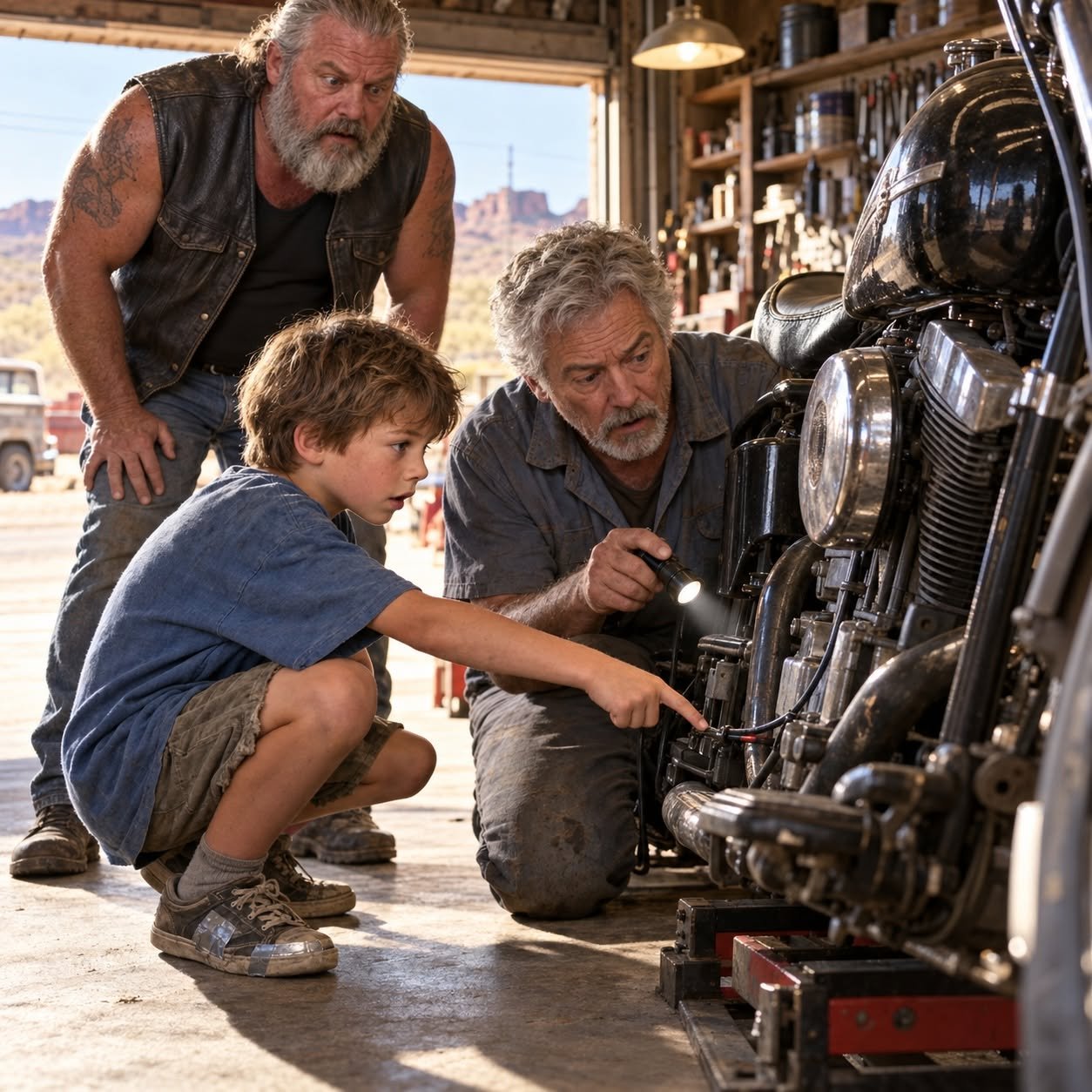
The biggest man I had ever seen was threatening the only person who remembered whether I’d eaten. So I stepped between them. I was eight years old, wearing sneakers held together with silver tape, and I knew almost nothing about motorcycles. But I had seen something none of those grown men had bothered to look at. “There’s a wire underneath,” I said. “I think it’s getting squashed.” Nobody moved. Then one of the bikers laughed. That was twenty-seven years ago. I still remember the sound, because I was certain it meant I had made everything worse.
Back then, I lived with my mother in a trailer outside Kingman, Arizona. The refrigerator hummed louder than the television, and sometimes humming was all it did. Mom worked irregular shifts at a truck stop. Some days she came home exhausted and tried. Other days she disappeared behind her bedroom door, and I learned to make crackers last. I loved her. I also knew which floorboards I could step on without waking her.
At school, I was the quiet kid in the back row — the one whose clothes didn’t always match and whose lunch was sometimes just crackers. My teacher, Mrs. Abernathy, kept a drawer of granola bars for “anyone who forgot breakfast,” and I was the anyone more often than not. She never made a fuss about it. She’d just slide one across my desk during reading time like it was nothing. I think about her sometimes — how the smallest kindnesses are the ones you remember word for word.
Three lots away stood Dale’s Auto & Cycle, a sun-bleached garage with a crooked soda machine. Dale Foster was fifty-three, gray around the temples, and permanently annoyed with something. “Don’t touch anything sharp,” he told me the first afternoon I wandered in. Then he handed me half his sandwich. After that, I kept coming back. I sorted clean washers into coffee cans and swept around the front counter. Dale let me sit in the office when the heat got bad. He never asked why I stayed until closing. I never asked why he started packing two sandwiches.
Years later, Dale told me his own father had died when he was nine, and a neighbor mechanic named Gus had let him sweep a shop just like his. “Gus packed two sandwiches too,” Dale said, not looking at me. “Some debts you don’t pay back. You pay forward.” I didn’t fully understand him then. I was eight. But I remembered the words, the way you remember a seed, and I carried them around until they sprouted.
The motorcycle arrived on a Monday. It was an old black Harley with scratched paint and handlebars polished by years of somebody’s hands. Its owner, Wade Mercer, wore a leather vest and walked with a stiff left leg. “My brother helped me build it,” he told Dale. Dale nodded toward the service bay. “We’ll figure it out.” For three days, he didn’t. Another mechanic stopped by. Then another. They checked things, replaced things, argued over things. The engine turned. It wouldn’t start. I watched from my usual stool. When you’re small, you see a different part of the world — knees, table legs, things dropped underneath furniture.
While retrieving a washer that had rolled under the Harley, I noticed a black wire tucked behind the bike’s lower frame. Its covering had worn through where it was pinched against a bracket, and a thread of bright copper showed through the crack. I tried telling Dale. “Later, Eli.” Later never came. Friday afternoon, Wade returned with two riders. One was broad and red-faced. The other kept turning a toothpick between his lips. Dale laid down his rag. “It needs more time.” “You’ve had time,” the broad man said. Wade circled the bike, his fingers resting on the scratched tank. “Maybe I ought to take it somewhere else.” “Maybe you should,” Dale answered.
That was when the room changed. The broad man stepped forward. Dale straightened. Wade said something about getting his motorcycle back in the condition he’d brought it in. Nobody had hit anybody. But I knew the pause before trouble — I had heard it through the thin wall beside my bed. Then Wade moved closer to Dale, and I stepped off my stool. “There’s a wire underneath.” The toothpick man laughed. Dale’s face tightened. “Eli. Office.” I should have obeyed. Instead, I pointed. “It’s got the inside showing. Right by the bracket.” Wade looked down at me. “You saw that?” I nodded. For a second, all I could hear was the ceiling fan clicking. Then Wade stepped away from Dale. “Show us.”
Dale disconnected the battery before anyone touched anything. He crouched beside the bike, aimed a flashlight where I pointed, and went completely still. “Well,” he said finally. Just that. He traced the damaged section, checked it, then sat back on his heels. “I missed it.” Nobody laughed now. I stood by the office door while he repaired the wire and secured it away from the bracket, his big hands surprisingly gentle. Wade rolled the Harley outside. The first attempt produced a cough. The second brought a roar so sudden I jumped. Wade stayed astride it, head bowed, both hands on the handlebars. When he looked up, his eyes were wet. He shut off the engine and came toward me. I backed into the doorframe. He stopped. Then he took a hundred-dollar bill from his wallet. “Good eyes deserve something.” I stared at it. Dale said, quietly, “You can take it, Eli.”
That night, I hid the money beneath my mattress. I couldn’t sleep. I kept reaching down to make sure it was there. A hundred dollars was more money than I had ever held at one time — more than Mom sometimes brought home in a week. I lay awake planning: groceries, the electric bill, new sneakers without tape. In the morning, I put forty dollars in an envelope and left it on the kitchen counter for Mom. She found it before her shift and cried, and I pretended I didn’t see, because eight-year-old boys aren’t supposed to make their mothers cry, even the good kind.
Mom told me later she took that envelope to the truck stop and showed it to her friend Carla, and the two of them sat in a booth and cried over coffee. “My boy,” Mom kept saying. “My boy did that.” Carla told me Mom talked about it for weeks — not the money, but the fact that I’d thought of her first. When you’re a mother working double shifts and barely keeping the lights on, somebody thinking of you first is worth more than the forty dollars. I know that now. I think I knew it then, too.
On Monday, Wade returned in a pickup. In the bed sat a tiny motorcycle, orange beneath the rust, with flat tires and no seat cushion. He wheeled it into the garage. Dale frowned. “What’s that supposed to be?” Wade looked at me. “Yours, if you want to learn.” I reached toward the handlebar. Then he added, “Let’s see if you can get it running.” My hand stopped. Because all I heard was if you can — and I had spent my whole life being afraid of what happened when I couldn’t. At home, “if you can” meant if you can be quiet, if you can make the crackers last, if you can not need anything. I pulled my hand back.
Wade saw it. He crouched down until his eyes were level with mine, and his voice went soft. “Hey. That wasn’t a test. That was an invitation.” He told me then what the little bike was: his first motorcycle, the one his brother had taught him to fix when Wade was barely older than me. “It hasn’t run in years,” he said. “I was going to scrap it. But then I thought — maybe it was waiting for somebody with good eyes.” Dale put a hand on my shoulder. “We’ll do it together, kid. Nobody expects you to know anything yet. That’s the whole point of learning.”
Dale gave me a small spiral notebook that first week. “Every mechanic keeps notes,” he said. “Write down what you learn.” I filled it with careful eight-year-old printing: SPARK PLUG — MAKES THE SPARK. CARBURETOR — MIXES THE AIR. DON’T FORCE IT — ASK IT WHAT’S WRONG. On the last page, years later, I added one more line: GOOD EYES — AND A GOOD HEART. THAT’S THE WHOLE JOB. Dale read it over my shoulder and pretended he had something in his eye.
So began the best summer of my childhood. Every afternoon after my chores, I went to Dale’s, and the three of us — a gruff mechanic, a limping biker, and an eight-year-old — took that little orange bike apart and put it back together. Dale taught me the names of things: carburetor, spark plug, clutch cable. Wade taught me patience: “Don’t force it, Eli. Ask it what’s wrong.” I skinned my knuckles, got grease in my hair, and learned that a washer dropped in the dirt is still a good washer if you clean it. Mom started coming by after her shifts to watch, and Dale — who noticed everything and said little — began setting aside the other half of his sandwich for her.
One evening, while we waited for paint to dry, Wade told me about his brother. They had built the big black Harley together, bolt by bolt, and two years ago his brother had died — suddenly, senselessly, the way the people you love sometimes do. Wade hadn’t been able to look at the Harley since, let alone ride it, until the day a kid with taped sneakers pointed at a wire three mechanics had missed. “You didn’t just fix my bike, Eli,” he said, staring at the little orange frame. “You reminded me he’s still with me. Every time an engine turns over, that’s him.” I didn’t know what to say, so I handed him a wrench. He laughed — a real laugh this time — and took it.
The day the little bike ran, Mom was there. It took four kicks, and then the engine caught with a sputtering putt-putt-putt that was the most beautiful sound I had ever heard. Dale whooped. Mom covered her mouth with both hands. Wade lifted me onto the seat, held the bike steady, and ran beside me around the garage lot with his hand on the back of the seat, the way fathers do in the stories. I rode in wobbly circles, grinning so hard my face hurt, and when I finally stopped, Wade took off his brother’s old helmet — the good one, the one he’d kept all these years — and settled it on my head. “He’d want you to have it,” he said roughly. “Take care of it. Take care of yourself.”
Dale never forgot that day either. The next time a mechanic came through his shop and got too big for his britches, Dale told the story: “Three of us missed a pinched wire. An eight-year-old didn’t.” He said it with pride, like I was his own. In a way, I suppose I was — his shop was the steadiest home I knew. And Wade kept his word about the invitation: he taught me to ride properly, in the empty lot on Sunday mornings, patient as sunrise. “Good eyes,” he’d say when I spotted a loose bolt or a low tire, “and a good heart. That’s the whole job, Eli.”
I understand now what I didn’t understand that Friday in the garage. When Wade wheeled in that broken little motorcycle and said “let’s see if you can get it running,” I thought he was making fun of me — offering something broken to a kid who’d gotten lucky once. I was wrong. He wasn’t offering me a test. He was offering me a beginning. A busted bike, a patient teacher, and the radical idea that an eight-year-old boy from a trailer outside Kingman was worth investing in.
I still have the helmet. The little orange bike sits in my own garage now, restored, and my daughter learned to ride on it last summer. Dale’s shop is mine these days — he left it to me when he retired, along with the crooked soda machine and the coffee cans full of sorted washers. Wade still comes by on Sundays, his limp a little worse, his laugh a little louder. And taped to the inside of my toolbox, yellowed and soft, is a hundred-dollar bill I never spent. Mom framed the other sixty in groceries and a winter coat and a birthday cake with my name on it. “Good eyes deserve something,” Wade had said. He was right. They deserved everything that came after.


